



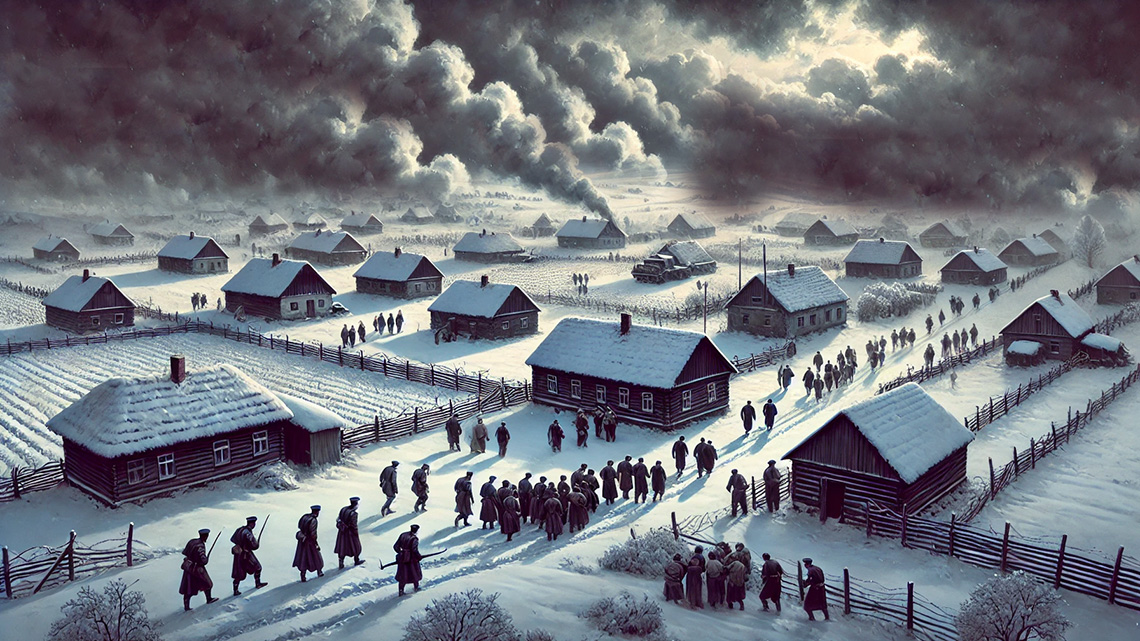
The enemy patiently waited for the first heavy snow to cover the village and fields before launching a general hunt for the People's Liberation Movement (NOP) and its prominent fighters in Dragutinovo and Beodra; especially targeting the Dragutinovo Partisan Detachment, which had caused them considerable trouble during the summer and autumn.
The fascist plan was very simple: as soon as the snow fell, the village would be blocked, and using numerous groups of police officers and engaged Hungarian and German collaborators from Beodra, a thorough search would be conducted in the village and its surrounding areas. Every house, every yard, and farmstead would be searched. Although this plan was kept secret, its realization could be sensed in the early days of November, given the hurry and frequent visits of police officials and agents in the municipal areas of Dragutinovo and Beodra.
Lacking any substantial experience in dealing with the fascists, the activists believed that such an enemy action would not be successful: that it would not cause significant harm to the movement, considering the solid organization and courage of the people. Because of this, the necessary measures and caution were delayed and underestimated.
Around November 15, heavy clouds from the north indicated that snow was coming. This brought a certain fear and concern among the locals for their fighters, most of whom they did not know the whereabouts of or where they were hiding. Few people in the village suspected that the occupiers would arrest not only the illegal members but also others involved in the movement. No one expected the raid to extend to the entire organization. There was a firm belief that even if the partisans were arrested, they would maintain composure in front of the police, thereby localizing further enemy infiltration into the organization. With this mindset and belief, November 15 arrived.
On the night between November 14 and 15, a considerable amount of snow fell. The village and its surroundings were covered in a blanket of white. The view of the plain became twice as large. Early in the morning, the village was blocked, and no one could enter or exit without being checked. Every fifty meters or so, there was a guard, and numerous patrols began searching every house in detail.
In the early hours, word spread that the Germans were searching for undeclared and hidden weapons, military equipment, tobacco, and hidden food (wheat, corn). However, such rumors were meant to divert the villagers' attention from the real goal of the occupiers.
The groups conducting the searches would invade houses, demanding that all family members be present for identification. If anyone was absent, it had to be explained, and the absence justified. One of the three group members would stay with the family while the other two searched every corner, closet, and bed, looking for anything that could be hidden. They climbed to the attic and thoroughly searched it, went into pigsties, barns, and behind straw, trying to find anything suspicious. They typically spent half an hour or more in each house, carefully performing their duty.
By 9:00 AM, the first arrest was reported. Those who had direct connections to the arrested individuals within the movement had no choice but to wait, knowing they could be arrested at any moment. Judging by the arrests, it was assumed that the occupiers had infiltrated the organization, as several prominent patriots were among the detainees. However, at that moment, there was some consolation in the fact that the enemy had not managed to find and arrest any of the illegal members, and so the evening was awaited with hope and anticipation.
Suddenly, early in the afternoon, news spread that the commander of the Partisan Detachment, Laza Pajić, had been captured. Initially, people did not believe the news, but its truth was soon confirmed by the municipal coachmen who had seen when the police escorted Laza. Uncertainty and anxiety increased.
Soon after, alongside Laza, members of the Partisan Detachment were arrested, including Sredoje Veskov, who had been hiding in his house, and Vlada Dragomirov, also hidden at his family’s house. By evening, the police brought in Drago Stanaćev, a machine gunner in the Partisan Detachment, whom they had arrested at a pumping station on the Tisa River where he had been hiding for a long time.
In addition to these individuals, about fifty other active participants and collaborators of the NOP were arrested in the municipality. The fascist police had their hands full, conducting their usual investigation on the detainees. Several teams were working in various municipal rooms. Every prisoner went through their hands, enduring a specific regimen of beatings aimed at extracting confessions. Suspected and prominent activists were subjected to torture to "loosen their tongues." Known patriot and active NOP collaborator Radnović Gruja was brutally tortured. The fascists broke both his arms and legs, but he preferred to bravely die rather than betray his comrades and dishonor the great and noble national revolution.
One of the first arrests was that of Rade Đuričin, a farmhand and one of the most active participants in the uprising. Regarding this case, some details based on memories were provided by Milivoje Đukičin:
"Rade's farm on the Ugar River was the closest to the initial Partisan base, or the Partisan camp, and it’s no surprise that Rade was one of the first to establish contact with the illegal fighters in July 1941. Until a steady supply of food and other necessities for the detachment was organized, Rade fed a group of fighters. His wife regularly cooked meals for the partisans, and he would deliver water to them daily, so their movements would not arouse suspicion among passers-by. Rade also acted as a courier between the village and the partisans, which is why he knew many comrades from the village who were actively involved in the movement."
After August 6, Mirko Kosić, a well-known fighter from Kikinda, stayed at his farm for a while. He had been hiding from the Kikinda police after the death of the Kikinda Partisan Detachment at Simić’s farm. Later in the autumn, Mirko was captured by the police, and under pressure, he betrayed Rade Đuričin. Before the village blockade, the police first arrested Rade, and under torture, he betrayed Milan Pavlović—“Šmrčko” and Neda Mirkov—“Brdara,” who had maintained contact with the partisans during the summer, as well as many others from the village involved in the movement. This expanded the raid, and due to Neda Mirkov’s weak resistance, Laza Pajić was also discovered and captured."
Following Milan Pavlović’s treachery, nearly all the older activists from Malider were arrested. Very few people were left out of his memory, and the municipality quickly became full of locals.
That same day, Neda Mirkov admitted that he had hidden a rifle and ammunition belonging to the commander of the Partisan detachment at his home. He claimed that Laza had not stayed with him and that he did not know where he was. He tried to avoid implicating Laza, but under greater pressure, he eventually admitted that Laza had told him before leaving that he would be hiding at Đura Džikin’s house at the end of the village. This was enough for the police to quickly surround Đura Džikin’s house and capture Laza Pajić there. Laza attempted to flee through the garden, but it was unsuccessful. Surrounded on all sides, the fascists shot at him, and Laza raised his hands.
The fascist police rushed with the investigation. As soon as Laza was brought to the municipal building, he was subjected to beatings and torture. They slammed his fingers in doors, jumped on his stomach from tables, broke his arms, and used various forms of torture. However, he refused to confess anything. Only after enduring long hours of torment and being confronted with Neda Mirkov did he admit that the rifle found in Neda’s house was his. That was all the commander of the detachment revealed to the police.
Later that afternoon, Sredoje Veskov was captured at his house. Despite having a well-built underground hideout, Sredoje failed to use it in time and allowed the fascists to surprise him. When arrested, the police discovered and destroyed the hideout. Like Laza, Sredoje held up well under the beatings and torture inflicted by the trained agents. In his confession, he did not implicate anyone from the village. He admitted that he had belonged to the Partisan detachment, that he had spent some time on Melenack Island as a fighter, and that after the detachment broke up, he had continuously hidden at his house.
Under the same circumstances, by evening, Vlada Dragomirov—Remo was arrested. He did not have any hideout at home and, demoralized, sat waiting for his end. Under pressure from the fascists, Vlada gave a statement similar to Sredoje Veskov’s.
Drago Stanaćev, who was captured at the pumping station near the Tisa River, remained bold and defiant in front of the police. He had already experienced the harshest methods of torture that day. He did not even admit to being an illegal fighter, claiming that he had spent the summer in Belgrade. The fascist criminals focused most of their attention on him. They did not leave him alone as long as he could still speak, and late into the night, they locked him in a cramped municipal prison in an unconscious state. In the main police file on Drago Stanaćev's interrogation, it was noted that he refused to testify, but had a reputation among his associates as a highly capable and persistent fighter. However, the document also noted his lack of any substantial confession that could have been used against anyone from the village.
Comments