



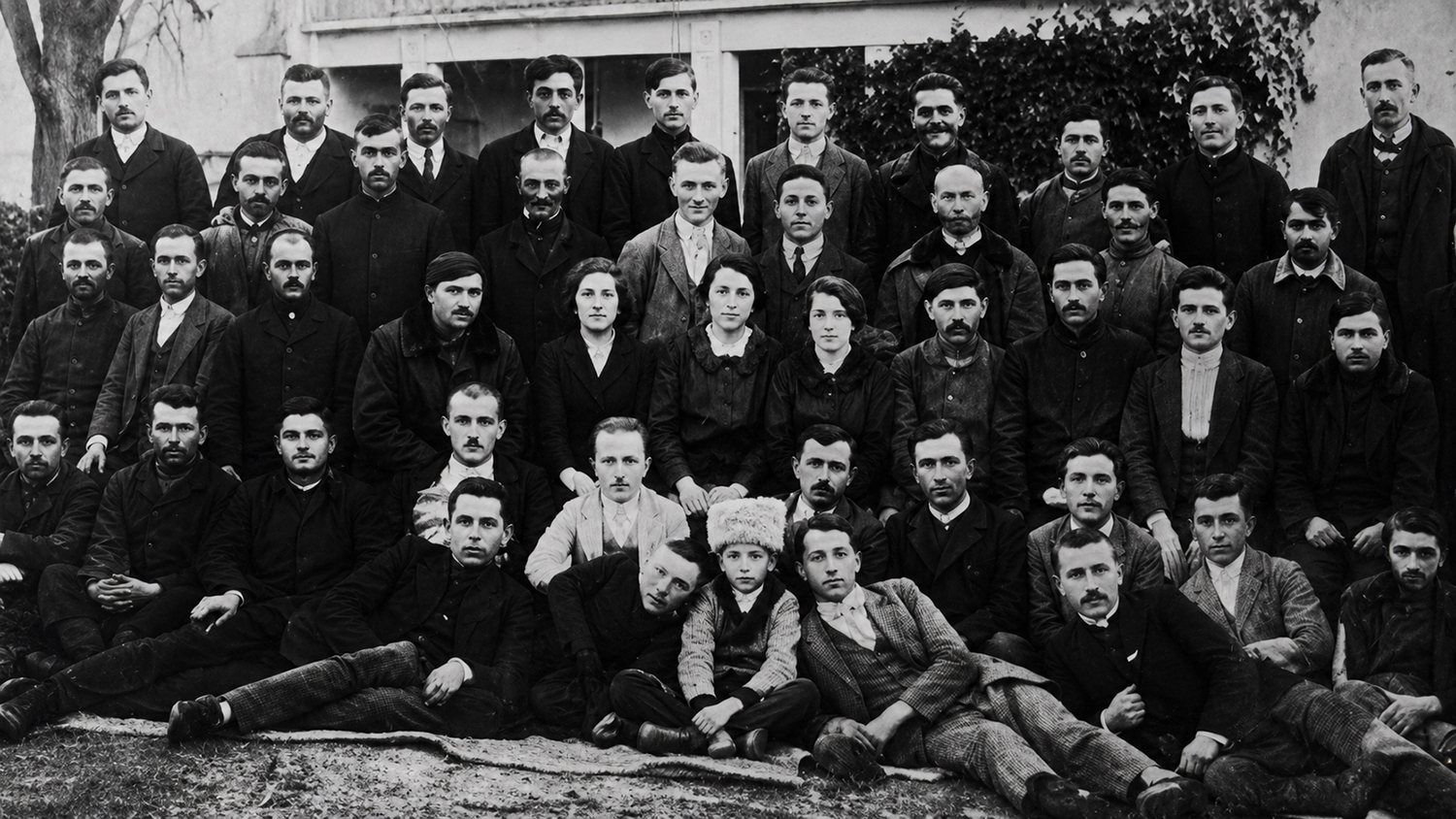
The reason for the arrests was the political activity of communists related to the regional elections held on January 23, 1927. For these elections, the regime conducted an electoral campaign under conditions of dictatorship.
The authorities did not allow any conference or public gathering to be held in Kumane. The distribution of legal electoral proclamations was also prohibited. In every possible way, the introduction of new voters from among agricultural workers into the voter lists was obstructed. Despite this, the party organization arranged the distribution of NRPJ posters titled: “To the Working People of Town and Village.” Voters were called to abstain and boycott the elections, because the regime did not allow workers and peasants to present their own electoral list.
Because of the distribution of these leaflets, searches and arrests were carried out in Kumane, Melenci, and Zrenjanin. A gendarmerie patrol established that the leaflets in Kumane were brought by Čeda Čolić, a fourth-year high school student, son of Milutin Čolić, who distributed them around the village on election day.
“After further investigation on January 25 of the current year, the patrol established that the mentioned posters were brought to Kumane on January 22 by the president of the trade union from Veliki Bečkerek, Domonkoš Holcner and Toša Kaluđerski. Together with Nikola Bišof and Jovan Bogner, in addition to the mentioned posters, they also distributed various communist brochures and books in the village of Kumane...”
On January 28, by order of the district chief from Novi Bečej, house searches were carried out in several locations in the village. Various illegal materials were found. On that occasion, the following were arrested: Čeda Čolić, a high school student from Kumane, Dušan Tatić, Milutin Solarov, Laza Ćurčić, Veselin Tatić, Cveta Stančić, Đura Brančić, Svetozar Solarov, Živa Eremić, Kajica Stančić, Boža Baračkov, Milivoj Kaluđerski, Boža Ješić (farmers), and Miloš Savin, a high school student. All were handed over to the competent State Prosecutor’s Office in Zrenjanin.
According to statements from residents of Kumane, the following were also arrested at the time: Slavko Strajnić-Nađa, Dragić Trifunjagić, Slavko Miškov, Boško Ćurčić, Ljuba Petrović, Boško Zarić-Sikra, Voja Stančić-Laskov, Žarko Aćimov-Kalić, Lazar Brančić, Mileta Zokić, Branko Aćimov, and Žarko Tatić. After interrogation, they were released but placed under strict police surveillance and were required to report daily to the municipal administration.
Since some of those arrested were also signatories of the request to establish the branch of the Agricultural Workers’ Union (SPRJ), the authorities dissolved the branch and closed the Trade Union Hall. Despite the ban, the branch continued to operate illegally for about two more years.
Among those arrested were also youths Kajica Stančić, Dina Baračkov, Boža Ješić, Čeda Čolić, and Miloš Savin, in whose possession a large quantity of proclamations titled “To the Working People of Town and Village” was found. This gave the district chief reason to order the sealing and police guarding of the Reading Room where meetings of the Association for the Education of Young People were held.
However, the organization still managed to find a way around this. Milorad Odžić, on party assignment, took Tima Ognjenov, who had been appointed to guard the sealed Reading Room, to a nearby tavern and treated him until Slavko Strajnić and Ljuba Petrović removed the seals from the Reading Room and took out all illegal material. They then resealed the Reading Room as if nothing had happened. When the police entered the building the next day to search it, they could not find anything.
Nevertheless, on February 1, 1927, the district chief banned all activities of the Youth Education Association.
The newspaper “Borba” of February 12, 1927, published an article titled “Persecutions, Arrests, and Electoral Violence in Vojvodina,” stating that in the latest regional elections the regime acted with extreme brutality against workers and peasants. In Kumane and Melenci, 33 peasants were arrested, and in Zrenjanin three more workers, allegedly for “communist propaganda.” However, the real reason was that the vast majority of voters abstained from the elections under the influence of agitation led by party members.
The article ends with a protest against such violence and an appeal to workers and peasants of Banat to continue their struggle against the regime.
The arrests and persecutions of February 1927 did not hinder the further intensive activity of the KPJ in Kumane. After a party consultation in Zrenjanin, attended by Lazar Blažić as a delegate, a plenary meeting of communists in Kumane was held on March 15 with the goal of reorganization and expansion.
The meeting was held illegally, at night, in the barn of Boško Zarić-Sikra, on the initiative and under the leadership of Laza Blažić. About 20 comrades attended, including Voja Stančić-Laskov, Dobra Gladić, Sredoje Stančić, Ljuba Petrović, Žarko Aćimov-Kalić, Boško Zarić-Sikra, Lazar Brančić, Svetozar Solarov, Vesa Tatić, Branko Vlajkov, Dušan Tatić, Boško Ćurčić, Slavko Strajnić-Bađa, Slavko Miškov, Lazar Mirčetić, Sredoje Stanisevljev, and three female comrades: Nevenka Petrović, Kova Mečkić, and Milica Blažić.
A report on the KPJ Local Committee organization was presented by Lazar Blažić. After discussion, the Local Party Committee was elected, with Laza Blažić as secretary. The task was set to organize party cells of 3–4 members, which was achieved.
Cells were organized on a territorial basis, meaning each communist organized a group of comrades in their area, collected membership fees monthly, and regularly provided illegal party press for reading. Local Committee meetings were held at the homes of Ljuba Petrović, Laza Brančić, and Laza Blažić, where cell secretaries submitted reports on their work.
With this reorganization, about 100 people could be involved, who received and carried out tasks, although not all were formal members of the KPJ.
One of the cell secretaries, Boško Zarić-Sikra, recalls the names of the members of his cell: Racko Čolić, Svetozar Čolić, Milutin Čolić, Dobra Gladić-Uvalin, Branko Tatić, Marinko Marinkov-Kojin, Draga Stanisavljev-Andričin, and Đura Aćimov-Kalić.
Trial of the Communists in June 1927
Due to abuse, beatings, and mistreatment in investigative detention, the detainees from Kumane went on a hunger strike from April 9 to 15. They refused all food, including that brought by their families. In this way, they managed to improve their living conditions and treatment.
The main trial against those arrested from Zrenjanin, Kumane, and Melenci, on suspicion of being members of a communist organization, began on June 9, 1927, at the District Court.
The newspaper “Torontal” writes that this was the first trial in which Banat communists appeared in the dock, charged under Article 2 of the Law on State Protection, although there had been earlier arrests on suspicion of communist activity. Interestingly, the newspaper notes that the oldest defendant was 37 years old, four were only 17, and three high school students appeared in court wearing student caps.
We will quote part of the trial material which clearly shows the attitude of the people of Kumane before the class enemy.
Judge: “Why did you go to a secret meeting?”
Đurica Jeremić: “It was not a secret meeting, but a friendly gathering. Through the education of the Agricultural Workers’ Union, i.e. the branch, we wanted to improve the situation of our people. We live in such poverty that it is heartbreaking...”
Slavko Strajnić from Kumane stated at the trial that they had submitted a request to the District Administration in Novi Bečej to establish a branch of the Agricultural Workers’ Union, headquartered in Subotica, but approval was not granted. When Šljapić from Melenci was arrested, all signatories of the request in Kumane were also arrested.
They considered their organization within the branch necessary because agricultural workers lived in extremely difficult material conditions. In Kumane, daily wages were 10 dinars, so they sought to improve living and working conditions in this way.
On the evening of June 10, 1927, the verdict was read in a fully packed courtroom. From the people of Kumane, Kajica Stančić was sentenced to 30 days in prison and Miloš Savin to 15 days. The others were released due to lack of evidence.
When the decision of release was announced, the audience cheered enthusiastically, and red flowers appeared from under coats, which were thrown at the released prisoners. At the prison gates, crowds welcomed the released with large bouquets of red flowers, as reported by “Torontal.”
The trial turned into an indictment of the regime and vividly illustrated the poor position of the rural proletariat. The Local Party Committee and the Trade Union Council in Zrenjanin prepared a warm welcome for the released communists in front of the court building. Together with them, they formed a column and marched through the city center carrying a red flag.
Accompanied by joyful comrades, women, and youth, they arrived at the Workers’ Home on Nikola Tesla Street. There they were greeted with speeches and invited to a celebration held in their honor the following day. The reception in the courtyard of the Workers’ Home was deeply emotional, and Andrija Mihajlović praised them for their courageous stance before the class enemy.
While the trial of rural poor peasants was taking place in Zrenjanin due to their activities in the Agricultural Workers’ Union, the Agricultural Workers’ Union held a congress where the main topics were: the unresolved agrarian question, arrests and persecutions of the rural proletariat, the ban on union activity, and the closure of union halls. These issues were also discussed at the third plenary session of the SPRJ in October 1927.
The regime treated the Agricultural Workers’ Union as a purely communist organization. This is clearly shown in the order of the Ministry of Internal Affairs dated July 29, 1927, addressed to the Grand Prefect of the Belgrade region, stating that members of the SPRJ were to be treated under Article 15 of the Law on State Protection.
Laza Blažić was a member of the leadership of the Red Aid. Some people from Kumane believe he was the treasurer because he participated in distributing aid to agricultural workers. However, in July 1927 there were arrests, although the Red Aid itself was not the issue.
On July 13, 1927, aid worth 6,350 dinars was distributed in Kumane. This assistance was sent by Yugoslav workers from America through independent unions to regions affected by floods and poor harvests.
Records show that 20 families received assistance ranging from 250 to 400 dinars. The money was brought by Andrija Mihajlović from Zrenjanin and distributed according to the number of family members, regardless of party affiliation.
Because of this, the police first arrested Andrija Mihajlović, and then Laza Blažić, Ljubomir Petrović, Boško Zarić-Sikra, Boško Ćurčić, who participated in the distribution of this aid, as well as those who received it. They were all interrogated overnight and held in municipal custody until the evening of the next day.
In the evening, under authorization of the district public prosecutor, an investigation was conducted into the origin of the money. Since it was determined that the funds were not used for election agitation or political campaigning, all those arrested were released.
Comments