



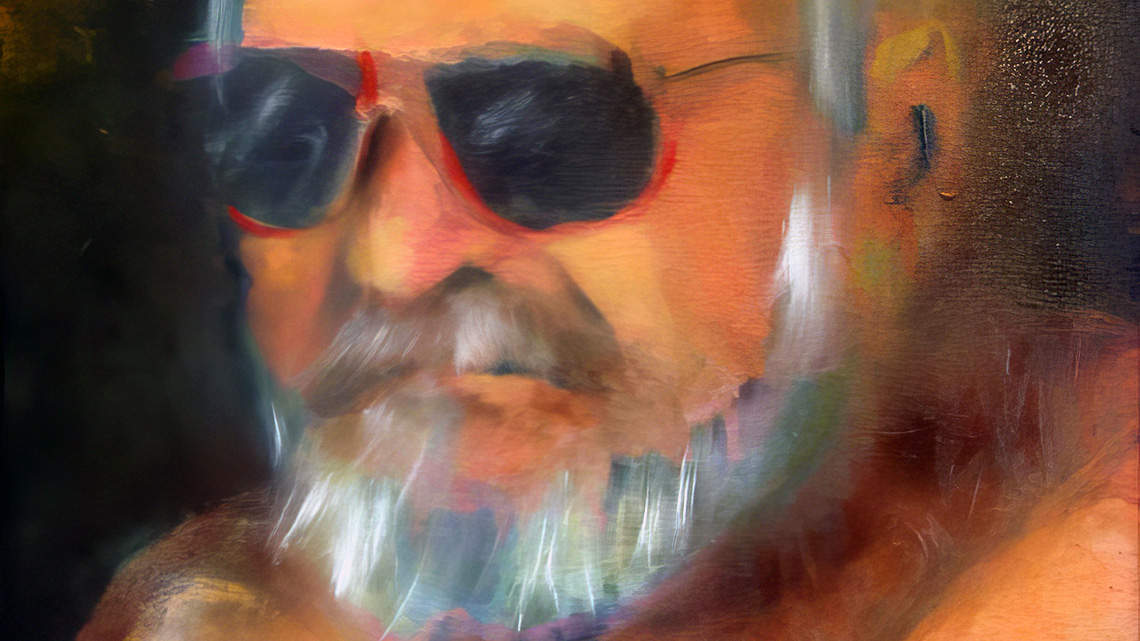
This year, and specifically these days, marks exactly 20 years since the founding of the Tisa Watercolor Academy, which has been held continuously to this day. On all brochures, catalogs, monographs, and records of this watercolor art colony’s history, you will find undeniable facts that in 1995, Milorad "Miša" Berbakov, Zdravko Mandić, Grujica Lazarević, Đorđe Simić, and Vlastimir "Vlasta" Nikolić decided to establish this artistic colony in Novi Bečej, within the premises of the Workers' University on the Tisa River, under the auspices of the Cultural Center.
When examining the biographies and residential cities of the founders, Novi Bečej does not appear in terms of their birthplaces or addresses. Zrenjanin, Čačak, Kraljevo, Belgrade, Vojvoda Stepa, Strigova, and Novi Kozarci are mentioned as the birthplaces and residences of the founders. So, who connected all these artists and this event, which has been held continuously for two decades, to this magical place on the Tisa? The unequivocal answer is: Miša Berbakov and his love for Novi Bečej.
“Galactic Center of Vojvodina,” “Austro-Hungarian Spa in the Off-Season,” “Attila’s Watery Grave,” “The Most Beautiful Crimson Sunset” are just some of the terms Miša used to lovingly describe his Novi Bečej.
Born on August 2, 1936, in Vojvoda Stepa, where his father, an Orthodox priest and later archpriest Radiša Berbakov, was stationed, Miša spent his early childhood and the wartime years in his father’s hometown of Karlovo (now part of Novo Miloševo). After World War II, in 1946, his family moved to Novi Bečej, where his father took over the parish. Miša completed high school in Zrenjanin and graduated from the Faculty of Architecture in Belgrade. He spent his professional career officially working at the Urban Planning and Construction Directorate in Zrenjanin. Married to architect Mirjana, he was the father of two daughters, Aleksandra and Nataša.
This brief sketch outlines the life journey of Milorad Miša Berbakov. Yet behind this outline lies the rich biography of a talented, educated, noble, insightful, and tolerant man.
Nature favored Miša Berbakov in many ways. It endowed him with striking looks, charm, a pleasant voice and demeanor, talent, and exceptional communication skills—a rare virtue. By nurturing and equally developing all his talents, Miša lived an extraordinarily rich and fulfilling life. Through his deep and multifaceted observation of the world and people around him, he developed a unique, unconventional perspective on events, individuals, and circumstances.
When one of his boats was stolen, and his mother, Mariška, exclaimed in shock, “Your boat was stolen?” Miša replied calmly, “Better they steal from me than I steal from others.” This response perhaps best illustrates the moral integrity he upheld.
I consider it a great privilege to have had the opportunity to learn from Miša during our daily summer gatherings on his boat on the Tisa River. He shared wisdom about life’s circumstances, Banat’s character, tamburitza music, tolerance, political contradictions, and the ironic arrangements life often presents. Miša could teach you which songs were genuinely Banat originals and which were not, the colorful characters of Vranjevo (a part of Novi Bečej where his mother’s family came from), and their sayings.
He knew how people running the locks on our canals would treat visitors depending on their diverse Vojvodina nationalities, how the famous tamburitza players of Vranjevo—Števa, Pera, and Naša—performed and improvised their music, and how the political establishment in Vojvodina approached architectural needs and challenges in the 1970s. He shared insights on why the famous “Zrenjanin Bridge” celebrated in song was demolished.
Behind all these stories was a genuine intention to offer friendly advice, never imposing it, and to share his mistakes, misconceptions, regrets, fears, triumphs, and defeats. All of us who gathered on his boat, anchored at the Novi Bečej shore of the Tisa at the start of summer, shared a love for this river, which curves so beautifully at that spot where the sunset sinks into the water. This beauty reflected in Miša’s watercolors.
In the cultural and artistic heritage of Vojvodina and even Yugoslavia, Miša made his mark through his architectural works. Competing in various architecture contests at the Yugoslav level, he achieved significant recognition by winning two major competitions: the Museum of the Battle of Batina and the Rohai Base Monument on Fruška Gora near Crveni Čot.
His second great love, painting—especially using ink and watercolor techniques—brought him recognition and respect from prominent Serbian artists. Through each professional and artistic triumph, Miša found a way to share a part of his glory with Novi Bečej. Thanks to him, the Urban Planners’ Days of Yugoslavia, later Serbia and Vojvodina, were headquartered in Novi Bečej. Likewise, the Tisa Watercolor Academy became primarily associated with Novi Bečej.
On the other hand, the recognition Novi Bečej returned to Miša pales compared to how much Milorad Miša Berbakov wove Novi Bečej into his personal legacy. Thus, this exhibition represents merely a small token of gratitude from our town for everything Miša did for it—achievements that the town so proudly boasts of.
Enjoy tonight’s experience of Miša’s vision of Novi Bečej and the Tisa.
Comments