



Traces of permanent human settlements in the municipality of Novi Bečej have been discovered in Borđoš, Garajevac, and Matejski Brod. Recognized as a significant archaeological site, Matejski Brod was placed under state protection by the decision of the Institute for Protection and Scientific Study of Cultural Monuments of the People’s Republic of Serbia in 1950.
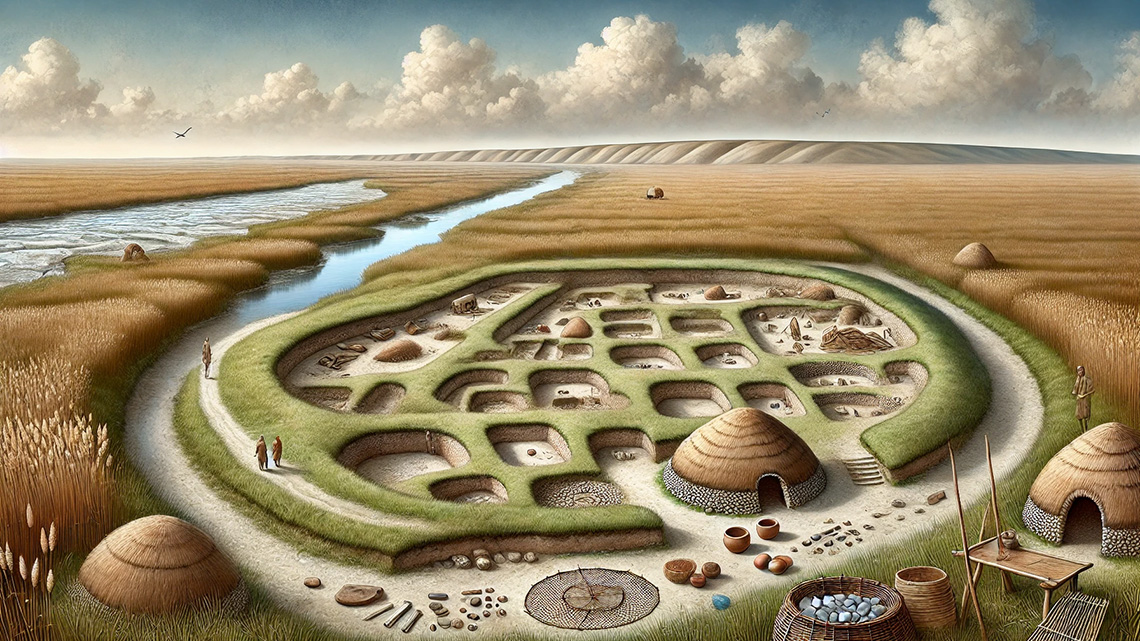
The Matejski Brod archaeological site is located approximately 6 kilometers northeast of Novi Bečej, at the boundary of two areas: Matej and Šimuđska Strana. It is an isolated plateau on the edge of a lower loess terrace, elliptical in shape, measuring 136 by 50 meters. The plateau's western side descends steeply into a marsh, a remnant of the former riverbed of the Mali Begej.
Protective excavations conducted from 1949 to 1952 uncovered seven Neolithic houses. The houses were separated by narrow passages, suggesting the possibility of primitive urban planning. Matejski Brod is a Neolithic settlement belonging to the Potiska cultural group of the Middle Neolithic, dating from 3900–3550 BCE. The Potiska culture is concentrated in the northern region of present-day Serbia, particularly between the rivers Mureș, Zlatița, and Tisa, extending south to the Galați River. In later phases, the culture spread southward along the Tisa River, predominantly on the Banat side.
Settlements of the Potiska culture were typically established on slightly elevated terrain, protecting them from flooding. Matejski Brod is primarily a fishing settlement, as evidenced by shallow fish containers and fishing net weights. The discovery of carbonized grains points to the development of agriculture, while numerous animal bones suggest advanced livestock breeding during that period.
Pottery decorations included plastic appliqués or rib-like patterns dividing the vessel surface into distinct sections. Coarse ceramics featured incised meandering motifs or zigzag lines. The pottery was typically light brown, yellowish, or brick-red, often with traces of red paint but without glaze.
The cultic ceramics of the Potiska culture include altars and zoomorphic figurines shaped like animal heads (bulls, birds). Idol sculptures are represented by rare specimens. Tools made from bone, stone, and baked clay, such as flat stone axes, bone tools, awls, spatulas, harpoons, and horn implements, are characteristic. The use of obsidian, evidenced by numerous finds, suggests the production of flint knives at this site.
More detailed research on the Potiska culture and the Matejski Brod site will provide additional insights into the existence and duration of this culture in the region.
Multilayered Archaeological Site: Matejski Brod
Matejski Brod is situated on an elliptical plateau along the former branch of the Tisa River, Mali Begej. The plateau is irregularly shaped, approximately ellipsoid, with an area of about 3,500 square meters. It rises roughly 7 meters above the level of the former Tisa branch and is located 6 kilometers northeast of Novi Bečej.
Archaeological research began in 1949 under the direction of Š. Nađ, then the director of the City Museum in Zrenjanin, and continued until 1952. After a long hiatus, systematic research resumed in 1962, led by R. Radišić, a curator at the National Museum in Zrenjanin. The excavations, which lasted until 1965, focused primarily on the western half of the plateau due to erosion along its entire 136-meter length.
The findings indicate that various permanent settlements, both large and small, were established on the Matejski Brod plateau over an extended period. The earliest, likely a short-term settlement, was from the Middle Neolithic, during the late phase of the Starčevo culture. Two later Neolithic settlements belong to the Vinča-Tordoš II phase and the Potiska culture, with ten above-ground houses explored within the latter.
The plateau was also inhabited during the Late Bronze Age but remained unpopulated until the Middle Ages.
Due to its terrain configuration and hydrological systems, Vojvodina offered favorable conditions for prehistoric, especially Neolithic, communities. Elevated riverbanks, marshes, streams, loess terraces, and ridges provided safe locations for settlements, ensuring proximity to water, protection from floods, and the use of rivers for natural communication routes.
These ecological advantages also influenced the establishment of the Neolithic settlement at Matejski Brod. The transition from the hunter-gatherer cultures of the Mesolithic to primitive farming and early animal husbandry led to the development of permanent settlements. This shift was accompanied by advancements in pottery production for food storage, polished stone tools, semi-subterranean and later above-ground dwellings. The detailed documentation from Matejski Brod provides valuable insights into these prolonged and complex processes.


Comments