



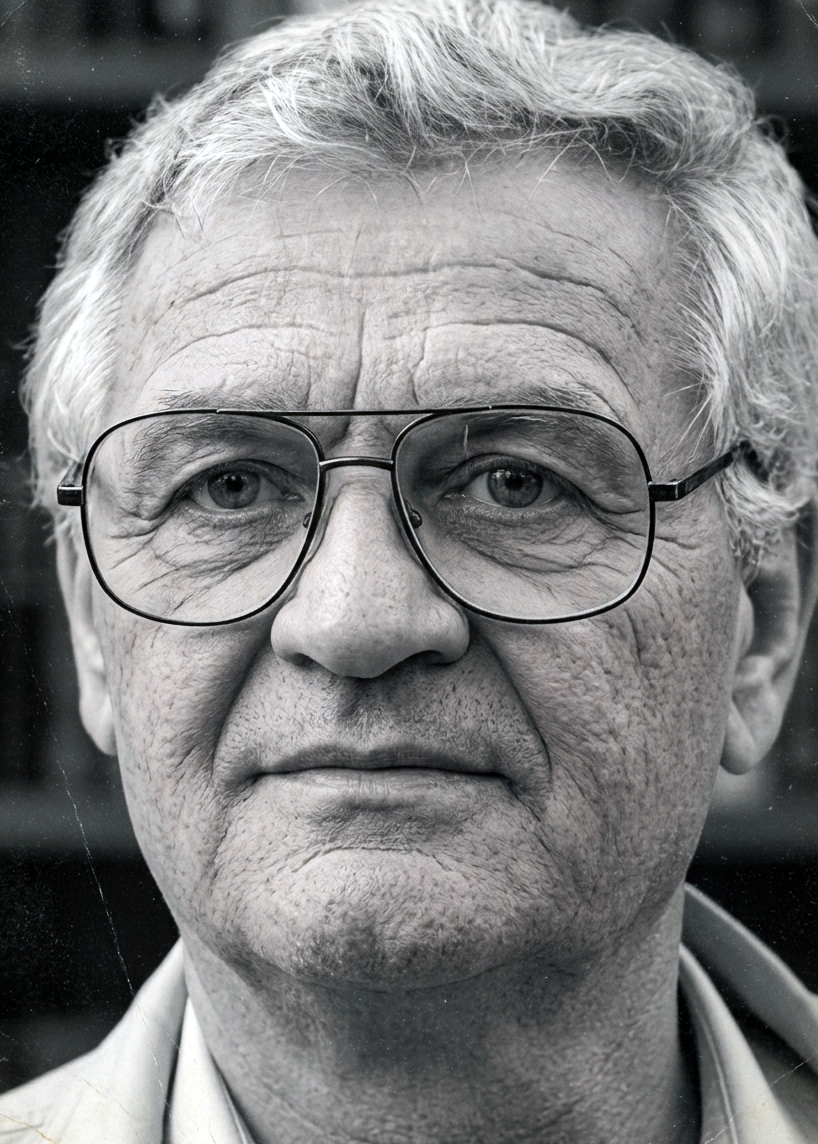
Pavle Janković - Šole, born on January 19, 1939, in Novi Bečej, was one of the most respected Serbian poets, whose poetry, although primarily intended for children, carried deep messages for adults as well. His name in literature is associated with an authentic and gentle approach to childhood, making him an expert in understanding children's thoughts and dreams.
Through aphorisms and poems published in numerous magazines, newspapers, and radio programs, Janković gained wide popularity, and his works were translated into several languages, including Hungarian, Romanian, Macedonian, Albanian, and Turkish. His poems are also featured in the "Anthology of Vojvodina Poetry for Children" in Macedonian, highlighting the international significance of his work.
Poetry as a Bridge Between the World and Imagination
Janković's poetry for children was special. It was not direct, nor was it "pedagogical" in the way it is often imagined. Instead, Janković engaged in a dialogue with children. Through verses, he introduced them to the world of imagination, revealing new meanings of everyday concepts and objects. He was a poet who not only entertained but also educated, helping children understand the deeper connections between the world around them and their inner worlds of dreams and fantasy.
His poetry was not "moralistic" in the traditional sense. Janković knew that children should not be given ready-made answers, but rather encouraged to discover the world on their own. As seen in his poems about numbers, where each number was given "life," turning mathematical operations into mini-fairy tales that revealed the origin and magical character of numbers. In this way, he taught children to think outside the box, to view the question "Why is six – six?" as a challenge, not just a fact to accept.
The Adult World in Verse: Invisible Struggles and Joys
Although he wrote for children, Janković's poetry carries a deep emotion that does not disappear even in his lightest verses. The story of his birth, told in one of his poems, carries strong symbolism. Pavle was born on January 19, 1939, in Novi Bečej, a place where the Tisa and Mrtva Tisa rivers formed a unique geographical and cultural framework. Thus, growing up in this "magical" world, Janković found inspiration in nature, choosing Tisa as a symbol, which runs through many of his poems.
Despite early hardships, Janković showed strength of will and life’s struggles, emphasizing that even in moments of uncertainty, such as his birth, he fought for his life. His story about his grandfather’s suicide attempt, told with a touch of humor, adds another layer – struggle is present in his world, but sometimes it is wrapped in irony, resourcefulness, and the need to find light in dark moments.
Pavle Janković - Šole Among Great Names
Through his rich literary career, Pavle Janković was among great names. The memory of his performance at the 1987 Zmajeve dečije igre in Sremska Kamenica, alongside Dušan Petričić, Vesna Parun, Svetlana Makarević, and Slobodan Ž. Marković, illustrates his significance in the cultural life of Yugoslavia. As a poet who knew how to guide children through the world of play, dreams, and nature, he remained remembered as an important pillar of Serbian children's literature.
His poetry was not just a way to convey words, but a bridge connecting a child with the world they live in, as well as the world in which imagination creates reality. He was a poet who did not impose his interpretations on children but invited them to become part of the world he wrote about.
Legal Heirs – Janković's Legacy
In the end, the poet left behind a rich body of work, and perhaps the greatest legacy that Janković – Šole left is the ability to discover the child’s world in its most beautiful, dawn-like form through simple verses in a poem or aphorism. With his poems, he not only entered the minds of boys and girls but also revealed a world in which all of us can once again be children.
Comments