



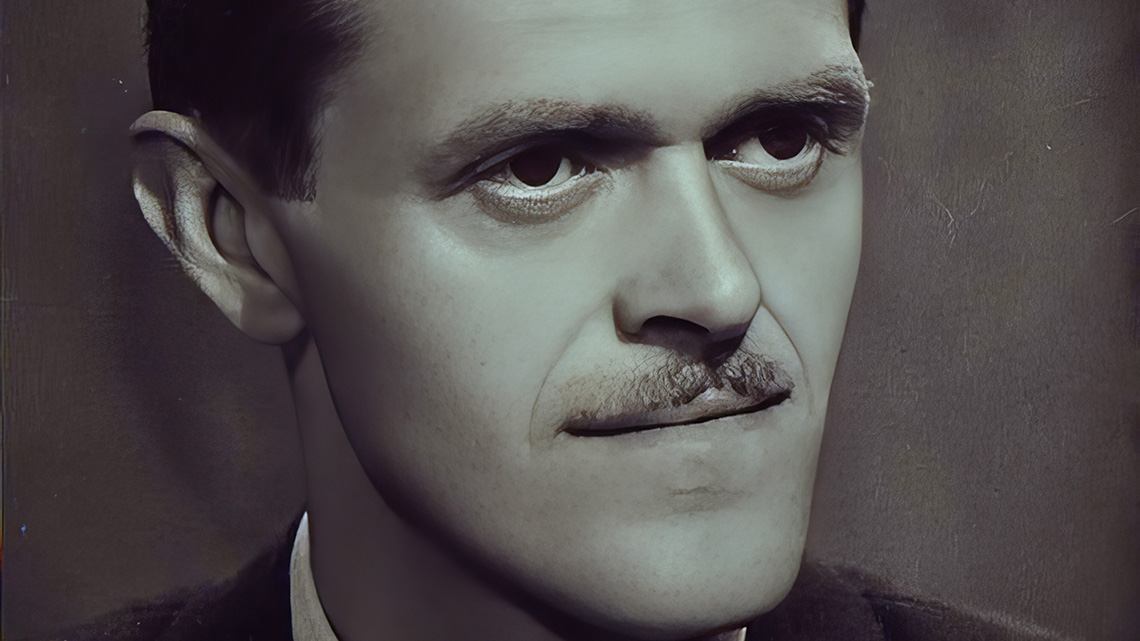
Ivan Jovanović, an only child of Dragomir Jovanović, a merchant, and Zlata Jovanović, née Aranka Stanišić, a teacher, was born in Novi Bečej on February 13, 1928. The Jovanović family house was located in the heart of the town on Žarka Zrenjanina Street, number 1. While his father Dragomir was busy with the family business, Ivan mostly grew up alongside his mother and his aunt Leposava Jovanović, a teacher, who were known not only for their strictness but also for their versatility and fair pedagogical approach toward children.
His mother Zlata owned a piano and was regularly subscribed to various music scores and magazines. In her free time, she often played the piano or painted and drew. She taught Hungarian, geography, history, and drawing at school. Aunt Lepa, or Miss Lepa as the locals called her, was notable for her voice, being a member of various choirs in Vranjevo and Novi Bečej. She was very active in the Sokol Society, just like her brother Dragomir.
 The influence and example of his mother and aunt were likely crucial in Ivan Jovanović's choice of a teaching career. When the Novi Bečej Gymnasium was founded in 1962, Ivan Jovanović applied for a history teaching position. Along with his diploma, he submitted a biography that stated the following:
"I was born on February 13, 1928, in Novi Bečej. I completed primary school in Novi Bečej. I started attending high school in Stari Bečej, and during the occupation, I lived in Zrenjanin. I graduated from high school in Stari Bečej in June 1948. After high school, I studied history at the Faculty of Philosophy in Belgrade. I graduated in June 1955. In September 1955, I went to serve my mandatory military service in the Yugoslav People's Army (JNA).
I became a member of the National Committee right after Novi Bečej was liberated. I was immediately mobilized as a courier for the National Liberation Committee (NOO) of Novi Bečej and served in that capacity for two months. In the eighth grade of high school, I joined the SKOJ (League of Communist Youth). While at university, I was involved in the leadership of the cultural and artistic society Krsto Bajić at the Faculty of Philosophy, where I served for four years from 1948 to 1952. I represented the university twice in student festivals in 1949 and 1950. As the head of the folklore group, I was rewarded by the Cultural and Artistic Society.
I participated in four federal actions: Šamac – Sarajevo in 1947, Željeznik in 1948, Novi Beograd in 1949, and Vlasina in 1952. In 1948, I received praise from the Youth Brigade Headquarters in Željeznik. During my service in the JNA, I was praised twice.
Upon joining the education service, I became a member of the Yugoslav Trade Union Federation. I was part of the commission for political education at the OSV, secretary of the Nature Friends, and secretary of the Teachers, Educators, and Professors Association in Novi Bečej. I am currently a member of the executive board of the Zrenjanin History Teachers Association.
 After my demobilization from the JNA, I immediately took up a position in Turija at the primary school. Due to a family bereavement, I resigned from this position. I served there from September 1956 to February 1, 1957. In the same year, I received a position at the Miloje Čiplić Primary School in Novi Bečej, where I still serve.
In March 1960, I took the state exam in Belgrade. I passed the teaching profession exam, but I have to retake the exam for the September 1960 session."
Of course, Professor Jovanović was hired, and he began teaching history at the Gymnasium in September 1962. According to his students, in the early years, he also taught drawing, and at times, he would cheer up his students by playing the piano. As a teacher, he was frequently a class teacher. He demanded maximum knowledge from his students, especially the accuracy of dates for various historical events. As for discipline, Jovanović advocated for military discipline. It was not uncommon for students who didn’t know the material to stand in front of the geographical map for the entire lesson. He rarely questioned the best students and his favorites. He regularly sent a few students to the make-up exam to review the material.
In the late 1960s and early 1970s, Professor Ivica Jovanović owned a Wartburg 311 limousine. He would often drive around the town very carefully but also recklessly on the open road, reaching speeds of up to 60 kilometers per hour.
He was an active participant as a courier in the large People's Defense Drill OTPOR 81 held in Novi Bečej in 1981. During this drill, he never took off his uniform and could always be seen parading around the town with his head held high.
Ivan Jovanović, known as Bata Iva, retired early due to health reasons, specifically on September 6, 1981. At that time, the school was named Gymnasium Ivo Lola Ribar Novi Bečej, but since 2004, it has been renamed Secondary School, a name it still holds today.
After the death of his wife Julijana and the marriage of his daughter, who moved to Kovačica, Professor Jovanović lived alone in his parents’ house. He often walked the streets and the embankment alone, as though searching for a conversation partner or listener for his musings. Whether it was due to his small pension or something else, he began selling literally everything that could be taken out of the house. The large family icon, painted by Žarko Čiplić, had no price as he intended to donate it to a monastery. The years spent in solitude with inadequate nutrition completely exhausted him, and it seemed he had lost the will to live. His daughter took care of him and brought him to her home in Kovačica.
Professor Ivan Jovanović passed away on October 20, 2004. He was buried in the Novi Bečej Orthodox cemetery in the family grave. The funeral service was conducted by priests from Vranjevo and Novi Bečej, with many students and acquaintances in attendance.
1 The National Committee of Novi Bečej Municipality adopted the decision to establish the Gymnasium in Novi Bečej on June 9, 1962. (From the archive of the Secondary School)
2 By the decision of the Novi Bečej Municipal Assembly on June 15, 1968, the name of this educational institution was changed to Gymnasium Ivo Lola Ribar Novi Bečej. (From the archive of the Secondary School)
3 By the decision of the School Board on April 6, 2004, the name was changed to Secondary School. (From the archive of the Secondary School)
Comments