



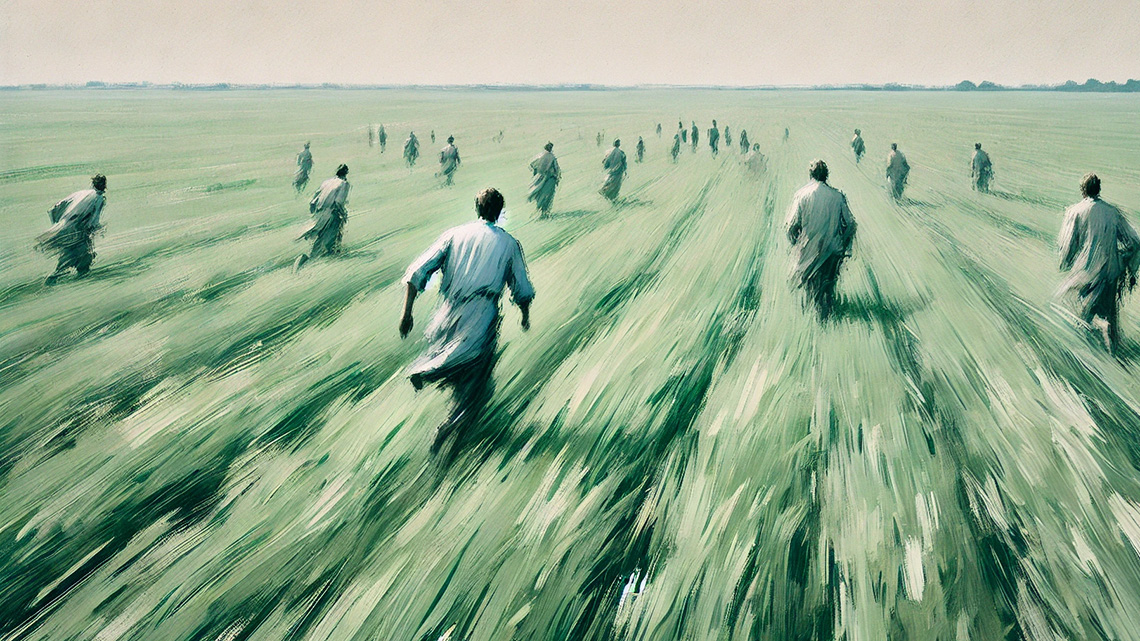
On June 22, 1941, a Sunday, the fascists launched their first significant and organized action against communists and other patriots. That day, the occupier tightened measures against the population regarding movement and communication. It began with an announcement through the municipal drummers, stating that all owners of radio receivers and bicycles must surrender them to the municipality within twenty-four hours. This way, the already small number of receivers in the village was reduced, leaving the residents without the most suitable means of information at a time when news was most urgently needed due to the significance of both internal and external events.
On the same day, the occupier increased police patrols and introduced a curfew starting at 6 PM, or no later than 8 PM, which would remain in effect until the end of the war. Gathering of citizens in homes and on the streets was strictly prohibited, and the police diligently enforced this rule. The residents were surprised and confused by these tightened measures from the occupying authorities, especially since some citizens were already harassed and beaten on the first day for "disrespecting" public order and the issued orders, making such sentiment even more pronounced. There was significant disappointment among a large number of citizens in the Germans and their order, as many had initially believed the national-bourgeois and fascist-Ljotić propaganda that "the Germans do not mean any harm to the Serbs and will allow them to freely express themselves and develop in educational, cultural, and economic terms within the great Reich and so on." It is clear that this was a cultural association slogan intended to neutralize any activity or resistance from the occupied population in the opposite direction; that the Germans and their "order" should be portrayed as well-meaning, humane, and necessary, given the "sacred mission" that the German state should fully implement "in the interest of humanity."
The cowardly attack of Germany on the Soviet Union and the measures taken during these days opened the eyes of most residents. The fabricated myth of the "German mission" shattered into pieces. Fascism began to present itself in its brutality as a typical militaristic oppressor.
Already on the night between June 22 and 23, the occupying police began the sudden arrest of communists and their sympathizers. A significant number of prominent citizens and well-known patriots were arrested as hostages. That night, 49 residents were detained, including 12 communists and members of the SKOJ (Union of Communist Youth), for whom the police had obtained information from the records of the former County Administration. Other members of the KPJ (Communist Party of Yugoslavia) were on alert, managing to evade arrest in time, retreating to illegal life in the fields and farms. In this way, around a dozen of the best and most prominent communists went underground, taking immediate measures for propaganda-political and organizational-military preparations for the people's struggle against the enemy.
The arrested individuals were taken to the county police on June 23, where they were subjected to a brief interrogation. During this time, one of the cultural association officials spoke to them "about the greatness and strength of the German Reich, about the invincibility of Germany, and the new German order that would rule the world." He lectured them on how they should behave in the future, warning that both they and all Serbs would face "troubles" if they did not comply and wanted to keep their heads intact. Finally, the forty individuals were informed that from that day on, they represented hostages, and if anything unforeseen occurred in the village in terms of breaking or disturbing "order and peace," they would bear full responsibility if the perpetrators were not caught.
With such a "lesson" and threat, they were released home that same day. Eight communists were transferred to the police in Petrograd, where they were interrogated and beaten for about a week to reveal the hiding places of other comrades and their intentions. After a week of torture, at the request of the Belgrade police, they were taken to the Banjica concentration camp: Živa Popov, Petar Plavkić, Vojica Isakov, Rada Stanaćev, Milorad Farkaš, and Lazar Pap. At Banjica, they were re-interrogated and tortured, and during this time, Petar Plavkić was forever separated from them, as the special police already had ample information about his pre-war revolutionary activity as a student at the Technical Faculty in Belgrade.
The communists from Dragutinovo and Beodra had the opportunity to meet local resident Marija Pajić, a medical student, at Banjica, who had already been severely tortured by fascist agents. Marija was suspected of participating in several diversions by Belgrade SKOJ members against German military targets and soldiers in Belgrade itself. By early September, the fascists executed Petar and Marija along with a larger group of Belgrade communists. All other Milosevac communists were returned to Petrograd, to the police, where they remained until the end of September, after which Špiler released them home with a threat and warning that they would be the first to answer with their heads if there was any "disorder" in the village.
Upon returning to the village, they were the first to announce the tragic and heroic deaths of MARIJA PAJIĆ and PETAR PLAVKIĆ at Banjica in Belgrade. They were also the first victims of fascist terror from the ranks of the avant-garde fighters of the Beodra and Dragutinovo people. After these initial arrests and killings, the people needed no special explanations. They saw and came to the conclusion of what kind of enemy they faced. The inevitability of a long, arduous, and bloody struggle was imminent.
Comments