



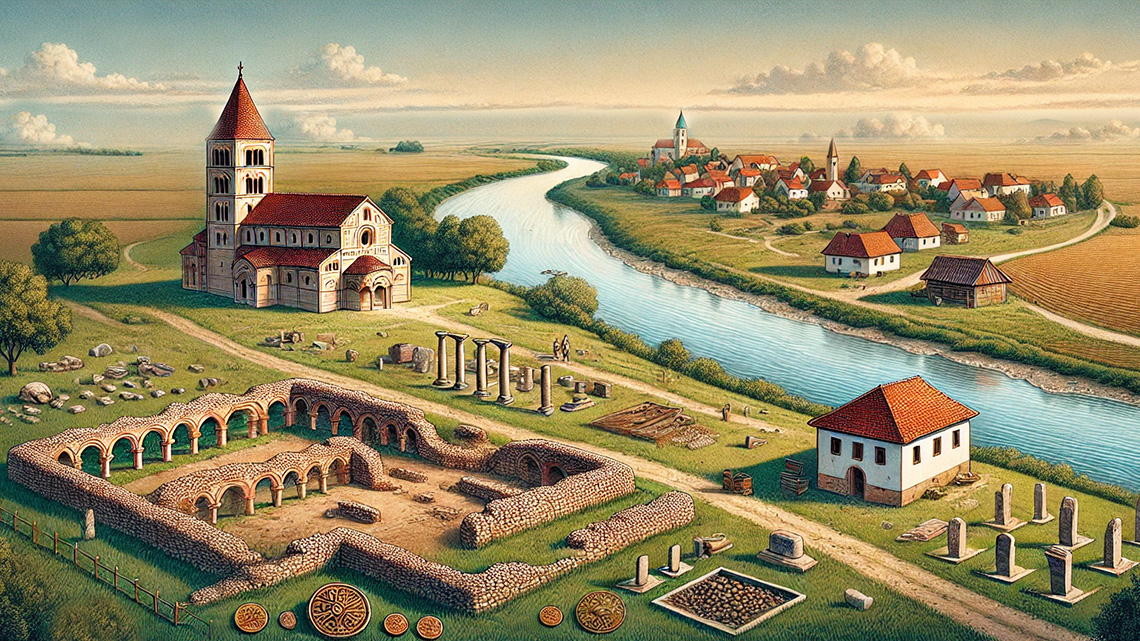
The medieval settlement of Arača is located on the southern shore of Crna Bara, a watercourse within the alluvial plain of the Tisza River, about 13 kilometers east of its riverbed. The name of this settlement, also referred to in sources as Potiska Arača, is associated with the ruins of a basilica and monastery.
The first settlements along the shores of Crna Bara date back to the Neolithic period. Archaeological research, primarily through movable finds such as pottery, confirms habitation during all periods of prehistory. Pottery, as well as coin finds, indicate settlement during the Late Antiquity period.
Surface finds and aerial photography reveal aligned rows of houses along the banks of Crna Bara. The houses of this medieval town are located on its western bank, near a gentle bend where the watercourse turns towards the Tisza. Based on visible evidence, this settlement dates to the 15th and early 16th centuries. It was abandoned and fell into ruin simultaneously with the monastic complex. The southern bank and its hinterland feature several masonry structures that developed alongside the religious complex. Excavations have also focused on this area, spurred by dislocated floor fragments, profiled bricks, terracotta, and stone sculptures. These finds suggest several significant buildings within the medieval settlement.
Medieval archaeological materials from this zone also include pottery, while coin finds help date the structures. Initial investigations indicate a time span from the first quarter of the 13th century to the mid-16th century.
The foundations of one of the excavated structures and movable materials point to a significant and critical phase in the development of the medieval settlement of Arača. This structure, a tower/gate, was part of the eastern wall of the enclosed complex. Coins discovered here date to the first half of the 13th century. A fire destroyed the building, deforming numerous metal objects.
In the trenches surrounding the tower, stone sculptures and wall blocks were found. These trenches were dug, and palisades were constructed to defend the tower/gate shortly before its conquest and destruction. Evidence suggests the tower also served as a modest residence, akin to a small palace.
Remains of several presumed similar structures have been found near the basilica and monastery. These suggest a relatively affluent class of Arača residents who may have been key supporters and financiers of the basilica's construction as a parish church, later becoming a monastery.
Sections of walls were identified north and south of the tower/gate, whose alignment and construction suggest they enclosed a clearly defined urban space. Following these walls would delineate the core zone of the medieval settlement. West of the basilica, surface observations indicate a structure likely marking the entrance to the settlement and providing access to the basilica and monastery from the west. The remains of these masonry buildings could be included in a presentation of the medieval settlement of Arača, potentially involving partial reconstruction of their foundations and above-ground elements.
A significant number of silos have been documented in the settlement, carved into loess and pear-shaped, primarily used for storing grain. In one silo, already collapsed in the medieval period, a skeleton was found along with 34 silver denarii from the mid-16th century.
The necropolis of the medieval settlement was formed along the outer bank of Crna Bara's bend. This location, the site of a medieval cemetery, later became the foundation for a religious complex. It began with a relatively small but evidently significant parish church, determining the location, patronage, orientation, and importance of the now-charismatic remains of the former basilica. These remnants, reflecting late Romanesque architecture, were characteristic of Central Europe and Hungarian Pannonia.
Excavations at the end of the last century aimed to delve deeper into the history of the basilica's remains. However, the importance of these excavations was underscored by a discovery that significantly enriched knowledge of Arača while becoming a symbol of this sacred site. The Arača stone soon garnered attention and debates, with analyses focusing primarily on the depictions on one of its broader sides.
On the lateral sides of the slab, motifs with three-part and two-part interlaces are carved, framing depictions of a bird and a saddled horse. On the shorter side, there is an image of a church.
An analysis of the motifs, representations, carving technique, and proportions of the stone—albeit fragmentary—indicates the following. The slab exhibits two distinct carving phases in terms of chronology and spatial context. These phases reflect the stone's purpose and function as a whole. Based on the preserved proportions and motifs, it is likely that the slab originally served as a lintel with primary carvings. One side features interlace motifs, while the other depicts Byzantine-style interlaces, a bird, and a horse. The secondary carving was performed later, after the lintel ceased to function in its original role and was repurposed as an ex-voto slab or a tombstone. At that time, carvings of a deacon, interlaces, potential donors, and an image of a church on the shorter side were added.
The lintel likely supported a tympanum with a depiction of a cross, a Deesis, or another motif. The inner face of this lintel is adorned with a three-part band framing depictions of a bird and a saddled horse within rectangular fields. A two-part band is fragmentarily visible along the upper edge of the lintel. This band transitions via volutes into a parallel band forming two rectangular fields. In the right field, there is a depiction of a bird with outspread wings, its head turned to the left. The wings are emphasized with vertical incisions and shorter oblique parallel lines. The body features shallowly incised parallel lines forming diamonds. A volute is visible to the right of the bird. Judging by the final motif, the volute to the right of the bird is also a terminating element and does not extend into another field. The lower parts of the bird (tail, legs) are not preserved.
The second field, also fragmentarily preserved, contains the depiction of a horse, though its head, front legs, and lower parts of the hind legs are missing. The partially preserved tail is slightly twisted. The horse is saddled, with pronounced decorative straps extending over its hind legs. Beneath the saddle is an ornamental blanket. A roughly triangular stirrup is clearly visible. This horse, with its elaborate Byzantine-style equipment, can be compared to a depiction of a horse on a capital from Bački Monoštor. Free spaces on the slab are carved with depictions of a deacon, donors, and text, along with an image of the church.
The preserved part of the ex-voto depiction includes a cleric or deacon and an inscription carved in shallow relief in the upper part of the slab. The depiction in this area is almost entirely preserved, while the lower part is fragmentary. The upper parts of the heads of two figures, believed by most researchers to represent donors, are visible. These figures are slightly larger in scale, likely busts. An inscription is also carved. On the left side, there is a twisted column, likely mirrored on the right. Between these two scenes is a horizontal three-part interlace composed of four bands.
The cleric or deacon, in the upper part of the slab, is dressed in a pleated garment with a clearly carved stole. It is unclear what the left hand is pressing against the chest—possibly a church book. The right hand is bent at the elbow and raised, with fingers forming a Catholic blessing gesture. The face is elongated and rounded, with hair emphasized by vertical incisions. The ears are elliptical, and the almond-shaped eyes are detailed. The beard is emphasized with shallow parallel incisions. The mouth and nose are understated and subsequently damaged. The bust rests directly on the horizontal interlace, occupying about two-thirds of the left side of the slab. The right side is filled with a vertically incised inscription.
The lower surface is only fragmentarily preserved and is framed by interlace at the top and a twisted column emerging from the interlace on the left, likely mirrored on the right. The upper parts of two larger-than-average heads are fragmentarily preserved, carved in a style similar to the cleric in the upper part of the slab. The left figure’s hair, emphasized with horizontal incisions, is parted. Fragmentarily preserved eyes and ears are carved similarly to those of the upper figure. The headwear features three horizontal bands covering the upper forehead and back of the head, emphasized by two horizontal parallel incised lines. The top forms a rounded dome with incisions radiating from the apex to the lower bands, highlighting the structure and folds of the headwear.
The shorter lateral side contains a depiction of a church, which can be compared with archaeologically documented remains. Arch-shaped windows are visible on the tower and nave of the church. Two vertical pilasters are evident on the northern wall.
The slab suggests the existence of an older church or another sacred structure near the basilica. Another possibility is that it was brought from the ruins of a church in another settlement. By combining excavation data with the elements depicted on the slab, it is highly likely that the church depicted on the Arač slab represents the church whose foundations have been confirmed in the central nave of the basilica. Considering the rectangular sanctuary indicated by the slab, a theoretical reconstruction of the previous church is feasible.
If we accept the explanation that the Arač slab originally served as a lintel with interlaces, bird, and horse carvings, it can be associated with a church from the second half of the 11th century. The second phase, involving the addition of the bell tower and its depiction on the stone, along with the cleric and donors, belongs to the late 12th or early 13th century. The church depicted on the Arač slab can be positively compared to the architectural elements of the church documented in the basilica’s central nave. By combining interior elements from excavations (width of the nave, gallery) with exterior elements from the depiction, a theoretical reconstruction of the church is achievable. Notably, the church’s proportions in the depiction correspond satisfactorily to the proportions indicated by the foundations.
With the construction of the monumental three-nave basilica, the remnants of this church—specifically its foundations—were buried beneath its floor, in the central nave. The basilica was built in the first half of the 13th century, during the reign of Béla IV.
The churches and monastery are relatively well-studied and documented, although much remains unknown about the primary donor or patrons of this sacred site. The basilica's status within the ecclesiastical organization of southern Hungary, as well as its connection to specific monastic orders, remains speculative.
The basilica is a three-nave structure with three apses on the eastern side. The naves are divided by three pairs of columns, with the easternmost pair being profiled, and the others having octagonal bases. The columns are connected by arches along the naves, which show remnants of cross vaults. Externally, there are rows of blind arcades. The apses feature attached colonettes, with a pronounced base in the lower zone. The west wall contains a rosette, and the interior is richly decorated with stone carvings, including preserved corbels and capitals with vegetal and figurative motifs. The interior is divided into bays.
In the second half of the 13th century, a tower or chapel was added above the northeastern bay. The central apse and the bay with the tower are the best-preserved parts. Conservation and restoration efforts have connected these sections to the standing west wall, stabilizing the remaining elements of the basilica.
As mentioned, many unknowns remain regarding the donors and patrons. On the other hand, the name and location of this significant medieval town are certain, emphasizing its importance due to its position, size, and the sacred site that developed in its vicinity.
For the reasons mentioned above, the purpose of the protective systematic excavations is to research and document the medieval settlement and establish chronological and spatial relationships with the monastic complex. The excavations document all horizons of the settlement, from prehistory to the late Middle Ages. Changes in the design of houses and settlements are recorded, especially those changes that occur as the sacred complex grows. Analyses are carried out with the intention of determining in which part of the settlement, or from which part, the sacred complex emerges and develops. The ultimate goal is to reconstruct life in the settlement in general, and specifically in the period contemporaneous with the churches and the monastery, and immediately adjacent to them.
These defined entities should be presented by incorporating them into cultural, educational, and tourist programs. A significant part of the project and initiative was the construction of a road, sufficiently passable to allow access for interested parties, thus justifying the investment and preserving what has already been restored. The road is passable but without any indication that the current environment would be threatened, and it was fully completed in 2012. There is also an appropriate expansion, parking, for those arriving by various means of transportation. The next steps include landscaping and, as always, the problematic issue of maintenance.
Different markers that were placed in the immediate vicinity of the basilica must be removed by those who installed them. Their removal must be controlled by the appropriate state institutions. Regulations are clear, and visually, as well as in photography, an exceptional encounter with the basilica in the plain is quite sufficient.
Archaeological research was focused on the area around the basilica and the monastery, and its aim was also to gather data for partial reconstruction and revitalization of this complex. At the same time, part of the necropolis that formed near the parish churches, and later partially near the monastery, was documented. Burial also took place in stone tombs. The finds from the necropolis are largely displaced, displaced by the new burials on top of the previous ones. The items from the necropolis mostly consist of rings, earrings, and appliqués.
The churches and the monastery are being fortified, the complex and the town are acquiring new perspectives. The monastery was founded and built in the last quarter of the 15th century. Most of it has only the foundation zones preserved. It was constructed using bricks made on the outskirts of the settlement. Only some architectural details were made of stone, mostly sandstone. In the remains of the monastery, the uncertain years marked by Turkish incursions are visible. Destructions and subsequent restorations of certain parts of the monastic complex have been documented.
The monastery itself lasted for a relatively short period, with the Turks occupying it in 1551. Recent research indicates that, in order to ensure the defense of the complex to the west, two towers with a gate were built immediately next to the western portal. A moat, also dug during times of immediate danger, was part of the defense system. The moat, and possibly two concentric ones, surrounded the complex. The complex was located on the shore of the Black Marsh, so water from this once silted depression certainly entered the moat or moats that were part of the defense system. In one of the attacks, these two defensive towers were destroyed. On the same site, a smaller tower gate was built on the ruins of the previous one. The ability of this tower to withstand even minor attacks was modest. It was only a symbolic attempt to halt changes, the ultimate outcome of which would be the gradual disappearance of this sacred complex.
The movable archaeological material from the monastery mostly consists of ceramics and glass. Finds of coins in the rooms helped to more securely determine the time of the monastery's establishment and duration. Coins were also found in graves, along with jewelry, most of which was made of silver. This movable archaeological material reliably indicates that the monastery's cells were built only in the second half of the 15th century, during the time of Matthias Corvinus. Bells, parts of candlesticks, baptismal fonts, stone sculptures, and other finds allow us to view, alongside the remains of church walls, the deep religiosity of the Middle Ages, but also the monastery as a precursor to the spread of moral, cultural, and educational values in these regions.
The settlement of Arača was in the possession of Despot Stefan Lazarević in the first half of the 15th century, and later in the possession of Despot Đurađ Branković. Although the settlement is mentioned in the 17th century, it never again reached this level of significance.
A relatively large number of visitors have already toured this location via the dirt road. Thanks to the local government of Novi Bečej, a road with a solid surface has been built, which will bring this holy site closer to a greater number of interested parties. Planned research works will be much more efficient, and within the IPA program, actions will continue that will contribute to a better presentation of this unique complex. The site is multi-layered, with horizons ranging from the Neolithic to the late Middle Ages, which opens up opportunities for diverse presentations. Within the IPA cross-border cooperation program with the Republic of Hungary, various activities are being carried out. The Museum of Vojvodina, the museum in Kecskemét, and the Tourist Organization of Vojvodina are involved in the already completed and planned activities.
The research is carried out in a joint organization by the Provincial Institute for the Protection of Cultural Monuments and the Museum of Vojvodina. All the movable archaeological material has been deposited at the Museum of Vojvodina.
Comments