



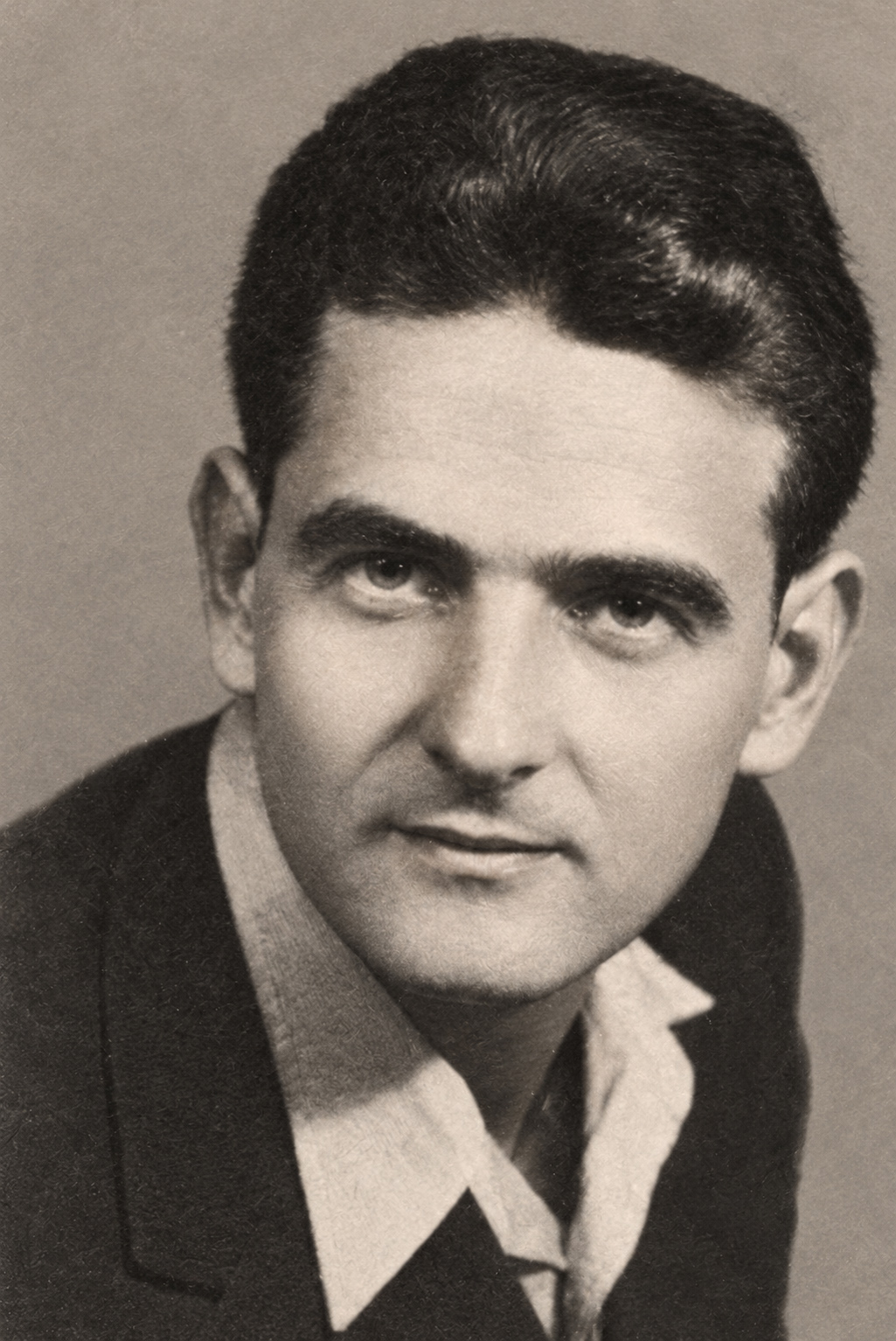
Miloje Čiplić was born on February 25, 1912, in Novi Bečej.
His parents, both teachers in Novi Bečej, provided conditions for their three sons—Miloje being the youngest—to prepare themselves, undisturbed in a quiet and orderly family haven, to ascend higher on the hierarchical ladder of bourgeois society than they themselves had.
However, Miloje, by nature bold and curious, a lover of life and eager to live it with every fiber of his being, believed that true life was one of passion, heroism, and daring efforts. At the age of fifteen, he broke free from the idyllic framework of the family refuge and realized that the reality he lived in was full of misery, fear, and violence.
As he would later write in his poems, he learned "how peasant heads crack when they hit the hard, cracked soil shallowly plowed," how "human, that unfortunate blood, flows madly," and he asked, "must a man bite the earth not to die of shame?"
Miloje's intellectual maturation coincided with the years in the former Kingdom of Serbs, Croats, and Slovenes when the last remnants of national and democratic freedoms were being destroyed through persecution, arrests, and murders, during the hurried preparations of King Alexander to stage a coup and establish his personal dictatorship.
And although the time when Miloje began to observe the world with his own eyes was gloomy and dark, he—an optimist and passionate devotee of life—did not see it as the end of life, but believed that life, "exciting, colossal, beautiful, and romantic in itself," had to be fought for and conquered.
It was precisely this conviction that led the revolution to become the first idea to fully captivate him. His second lifelong obsession became literature—not only as a powerful tool for revolutionary transformation of society but also as the meaning of his personal existence, a compensation for everything that harsh times took from man:
“Oh, nights, never of dead poets … oh, nights of Pushkin, oh, his work instead of shining events / instead of spring, green meadows, crystal fountains / instead of white boats, moonlight, and songs…”
Realizing that global relations were becoming increasingly complex and burdened with the threat of international armed conflicts, Miloje believed that it was the duty of everyone who “wishes to eliminate evil, darkness, and save both themselves and others from agony” to master some means of struggle as soon as possible. This belief became the driving force of his work.
He studied and worked persistently, feverishly, and at the same time invested tremendous willpower to overcome the weaknesses of his upbringing and resist the many temptations and pressures of the time, aware that only an educated, brave, and unyielding person could be a participant in the transformation of society—
“… and unfortunately, we were not created with such qualities, but rather they tried to turn us into weaklings, and that model, that mold, was incredibly successful.”
Not fearing for his future, he did not try to materially secure his existence (he was an actor and a theater clerk, a journalist, and a private official), nor did he attach importance to formal school qualifications (he finished high school with delay and abandoned university studies, first in psychology, then in law). He was completely dedicated to studying the problems of the modern world. With special attention, he studied the course of social movements and events in culture and art. Instead of in schools, the knowledge and experience he gained and his work he refined and corrected in direct contacts, corresponding with literary figures of revolutionary views — Jovan Popović, Todor Krušec, Jovan Kršić, Viktor Rozenvejg (Vitomir Jovanović), Vladimir Kolarević — Koča, and others; then, he made contacts with personalities from public life who were democratically oriented; collaborating with the Youth Cultural-Economic Movement; socializing with progressive and communist youth in the Vojvodina Student Dormitory in Belgrade and finding himself in many other places where young men and women, devoted to political struggle, were preparing for the decisive upcoming battle — revolution, for which most of them would consciously sacrifice their lives, and among them were often heard words: "We are the generation that will never die."
Miloje began his literary work at the age of fifteen, writing poems, in which he was obsessed with the vision of revolution — and his earliest preserved poem is titled "The Dream of Revolution." But soon, he became familiar with surrealism. The unconventional approach by surrealists in debunking the apparent idealism of bourgeois society and introducing changes in the understanding and methods of artistic creation attracted his curious mind, and at the same time, alongside poems where the social tendency was very emphasized, he wrote surrealist poetry. He appeared in public with a poem about revolution and a surrealist poem simultaneously. The first poems, not considering those that appeared in the magazines of high school literary societies, were published in 1929. That year, in "The Book of Comrades," the almanac of the youngest Yugoslav social lyrical poets, whose editors were the Marxist writers Jovan Popović and Novak Simić, he published the poem "Smoke of the Chimney," and in the Belgrade magazine "50 in Europe," the organ of a group of surrealist writers, he published the surrealist poetic text "It is not hard to pass over a road covered with footsteps and silence..."
In 1932, he renounced surrealism. From then on, his poetry predominantly reflects rebellion against social injustices and the expression of political beliefs. However, despite this, it also contains verses of high value.
In the following years, Miloje expanded his literary work to writing short stories, engaging in essay writing and literary journalism, and in the last two months of his life, together with his friend, the writer Ljubiša Jocić, he wrote the novel "Prisons."
The themes of Miloje's short stories are mainly from Vojvodina's life. The petty spirit, egoism, and greed of the nationally unstable petty bourgeoisie, war deserters and their resistance to saving the interests of the decaying Austrian Empire, attacks on the helpless and exhausted population on the estates of landowners, small-town merchants, and greenhorns, etc. Psychologically deepened, imaginative, filled with authentic atmosphere, the short stories are undeniable proof of Miloje's talent and his potential for romantic possibilities.
Essays, articles, and numerous reviews and notes written by Miloje undoubtedly show the breadth of his interests, the firmness of his Marxist orientation, and his ability to boldly and non-dogmatically make assessments and conclusions. He wrote about contemporary figures in literature—Dušan Vasiljev, Branimir Ćosić, Vladislav Petković Dis, Antun Branko Šimić, Hasan Kikić, Maxim Gorky, Karel Čapek, and others—about current problems of poetry, about literary traditions of Vojvodina, about the need for cultural-educational organization of broad popular layers, about issues of youth, about peasant ownership, about the Civil War in Spain, about the growing danger of the strengthening of reactionary forces and fascism in the world, and other current and pressing problems of his time. As a good observer of the conditions in which he lived, he precisely distinguished between tendencies and efforts that brought society closer to a revolutionary transformation and those that led to ruin and catastrophe. And just as much as he passionately advocated for positive tendencies and movements, his attacks and criticism of harmful and dangerous phenomena were sharp and uncompromising. "With pleasure, I received your comments regarding my article 'Fascism in War'—he wrote to Vasi Stojić—but, if you’ll believe me, I responded just as the fascists defend and attack. Well, in the opposite way, don’t they have more venom than we do?"
In presenting his assessments and conclusions, Miloje did not know opportunism. He stated them without hesitation and openly, even when they meant criticism of prominent figures in public life, whom he otherwise greatly respected. "...The first issue of 'Ljetopis', I think your—Miloje’s words addressed to Vasi Stojić—has very little, or none at all, difference in a broader ideological sense from that of Milutinović. You repeatedly speak of Milutinović's, so I wonder why instead of new chessboards and new pieces, old figures entered your 'Ljetopis,' on the old board, with old individuals. Well, your selection didn’t have the courage to even publish Krleža..."
Strict in his assessments of others, Miloje was equally strict and open in judging his own mistakes and misconceptions. His affiliation with surrealism, for example, was condemned in 1932 in a letter to Mladen Leskovac as a mistake of his youth and a lack of conscience, as apostasy and betrayal of the struggle for a revolutionary transformation of society. Later, however, after his views and position on surrealism had changed (most surrealists politically aligned with revolution), he corrected his stance toward surrealism and surrealists. In 1937, writing about Milan Dedinac, he expressed the view that surrealists, since they had "said enough about bourgeois society with a few bold but well-known truths, for which they didn’t need to answer to anyone, neither in our country nor in the world," had become "revolutionary realists" and that surrealism remained a movement in the great European literature "to together with everyone else explore the most important issues of the human process, to conquer unacquired sectors of understanding, logic, but with means whose motion force does not get lost in the depths of the involuntary subconscious and automaticism."
Sociable, open-hearted towards everyone, he loved and respected people and believed in the specific abilities of each individual. While living far away from his close friends for a period, he corresponded with them diligently, encouraging them, cheering them on to work, and pointing out their own abilities and potential. Despite many connections with people from various social layers, his circle of acquaintances was constantly expanding, meeting new people, studying them, trying to connect them, simultaneously exploring both contemporary reality and the past values that could serve as a basis for uniting all positive elements of society in the face of the forces of reaction and fascism, which were daily becoming more ominous. Out of the need to contribute to strengthening the resistance front against these destructive forces, many of his actions arose. Together with his brother, the writer Bogdan Čiplić, he compiled an anthology "20 Years of Serbo-Croatian Lyrics (1918–1938)," which covered everything they considered valuable in Serbo-Croatian poetry—because, "...if we divide people by their affiliation, we are able to notice on the other side what is valuable and until when it was valuable yesterday, until when it reaches today, and until tomorrow." Since he couldn't find a publisher, the anthology remained unpublished. He was the initiator of the almanac "Vojvođanski Zbornik," very active in explaining the goals of the almanac and gathering collaborators, organizing subscriptions and printing, and later promoting the almanac. He persistently advocated for the revival of democratic traditions of the Matica Srpska and gathering progressive youth around the "Letopis," etc.
A capable and systematic worker, Miloje wrote extensively and collaborated in democratic and progressive magazines and newspapers of his time. He was a contributor to the Nikšić magazine "Valjci," the Čačak "Mala Revija," the Zagreb "Književne Novine," "Letopis," "Glas," and "Godine" of the Matica Srpska, the "Vojvođanski Zbornik," "Srpski Književni Glasnik," the Sarajevo "Pregled," the Zagreb "Književnik," the Timișoara "Život," the Belgrade "Život i Rad," the Novi Sad youth magazine "Naš život," the Novi Sad daily "Dan," and others.
However, the published manuscripts represent only a small portion of what Miloje managed to write. His unpublished manuscripts were seized by the Special Police during his arrest in January 1941 in Belgrade. Among the seized manuscripts, which have never been found to this day, were finished poems, short stories, essays, and articles, but much more sketches, projects, and plans for the future. Miloje, however, had no future. He was arrested on October 2, 1941, in Belgrade at the corner of Svetosavska and Ivana Milutinović streets, while he was hurrying to meet his friend Ljubiša Jocić to write the last section of "The Prison." But they never wrote it. After fifteen days, on October 17, without investigation or trial, Miloje was executed in Jajinci near Belgrade. "Novo Vreme," the daily of the traitorous government of General Milan Nedić, announced that on that day in Jajinci, 100 communists and 100 Jews had been executed. Among the executed Jews, there were also Jews from Novi Bečej, and sometimes the nightmares of the war make it easier to think that maybe in the company of fellow countrymen, it would have been easier to face the machine gun fire on their bare chests.
During his short life, Miloje did not publish a separate book. The Matica Srpska in Novi Sad published a shorter selection of Miloje's poetry and prose in 1949 under the title "Stihovi i Proza," and the Museum of the Socialist Revolution of Vojvodina in Novi Sad, in 1975, published a collection under the title "San revolucije," which gathered most of Miloje's works published in pre-war magazines and newspapers, as well as those that had not yet been published. The first edition of the novel "Tamnice" was published by the publishing company "Bratstvo-Jedinstvo" in Novi Sad in 1956.
Comments