



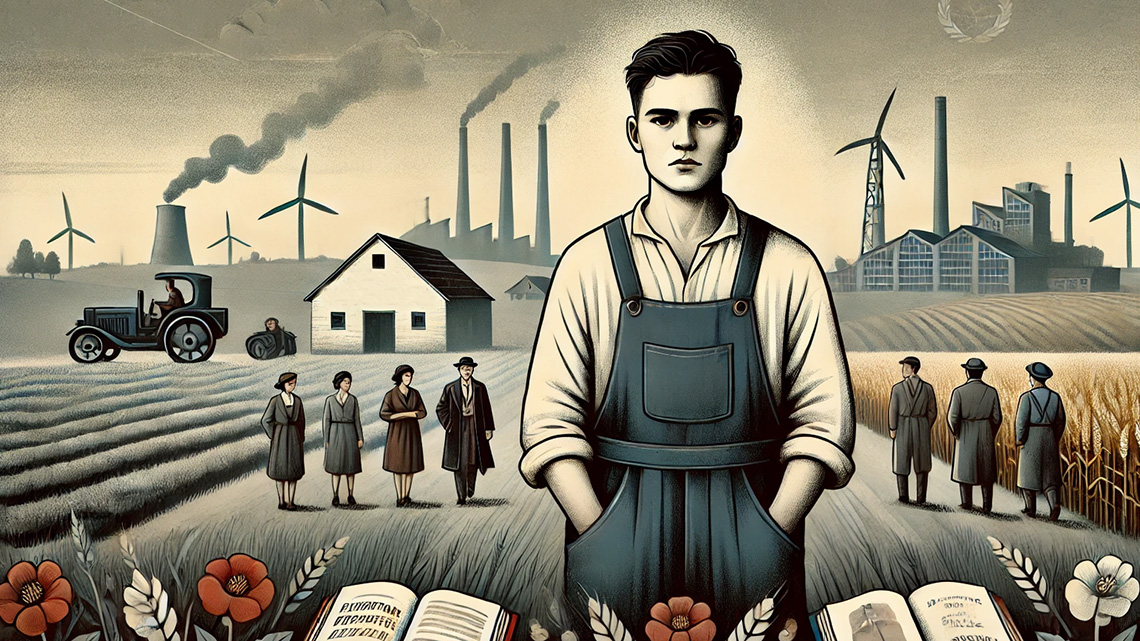
The name of this worker fighter, a persistent and fiery revolutionary, became widely known among the people of Novi Bečej after he was no longer alive – on the day of his funeral. His life, both as a man and as a revolutionary, was not long: he passed away at the age of twenty-two, in the fifth year of his relentless struggle against injustice, arbitrariness, plunder, and the persecution of the working masses by the Great Serbian bourgeoisie.
He was born in the former Vranjevo in 1913. During World War I, he lost his father, and shortly after the war, he also lost his mother, who remarried, leaving Slobodan with his grandparents. After elementary school, in which he excelled both in intelligence and diligence, there was no one to further educate Slobodan, so he went to learn a trade in Stari Bečej. Here, among the workers, proletarians, and the poor, he underwent a life school that directly and thoroughly educated him for his future calling. In this "school," he encountered poverty and injustice, suffering, and simultaneously came to understand their perpetrators and causes, against which the working class of Yugoslavia rose and raised its voice. Slobodan Perić was among the thousands of new individuals who stood in solidarity with the underpaid and disenfranchised, strengthening the common front in the fight against the anti-popular regime and its actions.
As a metalworker, Slobodan went to Belgrade in search of work and, fortunately, found it quickly, thanks to the help of his comrades and the increased demand for castings in the labor market. In the capital, he became a member of the Communist Party of Yugoslavia (KPJ) and, as part of his political and propaganda activities, worked to bring the youth of the villages and towns closer together, helping progressive organizations in rural areas. On the Party's orders, he repeatedly visited Vranjevo and Novi Bečej, gathering progressive youth around him, organizing ideological and political work within their communities, and preparing them to become agitators in the framework of the progressive workers' and peasants' movement.
By the spring of 1931, metalworker Slobodan Perić, a member of the KPJ, laid the foundation for the work of the SKOJ (Communist Youth Organization). Although this initial organization was not large, consisting of only five members with Bora Glavaški as its leader, it didn't take long before it doubled in size. The activities of this group of young communists were well known but carefully disguised due to the relentless persecution by the regime. Its most notable success was the swift establishment of a mass youth organization – the Youth Agricultural-Cultural Movement (OKPOK), which was led by the SKOJ across most of Vojvodina through its prominent members.
Slobodan's contribution to the ideological and political education of the Vranjevo-Novi Bečej SKOJ members and other youth was immense. He not only spoke at gatherings, debated with them, and provided explanations, but he also regularly supplied them with illegal literature and other printed materials, bringing them from Belgrade. For four full years, Slobodan devoted himself to this task. From his meager earnings, he set aside money to cover transportation to Vranjevo and back, to buy a good, current book or brochure for his comrades in his native village, and he never thought of reimbursing those costs or accepting the help that his comrades offered, which he energetically rejected with offense. He was always modest, proud of his mission, and loyal to it and to his people.
When he was unexpectedly arrested by the gendarmes in August 1934, he was not particularly disturbed or worried. He had known for years that this fate would eventually catch up with him. Perhaps that is why his demeanor in front of the district chief and torturer Major Kovinčić was calm, measured, and calculated. However, neither he nor the other detainees gave away anything or anyone. The arrest was localized, and the organization was able to continue its activities.
Slobodan and his comrades were put on trial in Petrograd in November of the same year. For this staged trial of the regime, Slobodan was brought from the Belgrade prison, where he had been under investigation for revolutionary activities in the capital. Although there was insufficient evidence, this did not prevent the District Court from convicting these patriots for hostile activities against the crown and the state: Slobodan Perić was sentenced to 18 months, while the others, Bora Glavaški and Budisav Boškovo, were each sentenced to one year in prison.
In prison, Slobodan's frail body succumbed to illness, and the gendarmes escorted him to his hometown, Vranjevo, where he soon passed away from tuberculosis in the spring of 1935.
The funeral of this national fighter and revolutionary was attended by both the young and the old. The long funeral procession was a silent protest demonstration against the atrocities of the anti-popular regime, of which Slobodan Perić had been a victim. In his speech at the grave of this devoted worker-fighter, Fedor Kiselički made it clear to the regime through the present agents, gendarmes, and spies, that hundreds of young, progressive people from Vranjevo and Novi Bečej were following in Slobodan Perić's footsteps, and that for every comrade who perished in the revolution, tens of new ones would rise to take their place.
The revolution could not be stopped.
Comments