



From 1929 to 1931, party organizations in Vojvodina operated in isolation. The process of rebuilding and establishing connections between them took place during 1934 and 1935. At that time, district committees existed in Bačka and southern Banat, while in northern Banat there were party organizations only in Zrenjanin, Kumane, Melenci and several other places.
After the June Plenum of 1935, the Politburo of the Central Committee of the Communist Party of Yugoslavia (KPJ) established the Country Bureau, which, as an operational body of the Central Committee, directed the work of party organizations throughout the country. Its headquarters were in Zagreb.
The restoration of party organizations was closely associated with Lazar Milankov. However, he arrived at a particularly favorable moment, when the conditions for connecting communist groups throughout Vojvodina had already matured. Milankov frequently traveled illegally to Belgrade, where he reported on the work of the organization to Mihajlo Bumbulović-Panta. Among other tasks, Bumbulović instructed him to establish a Provincial Committee for Vojvodina.
Milankov assigned Mihalj Seleši, whom he had met while serving a prison sentence in Sremska Mitrovica, to make preparations in Zrenjanin for a provincial conference. Seleši found a suitable location at the home of Terezija Servo, a worker whose son Mihalj was also imprisoned in Sremska Mitrovica.
The conference was held on September 29, 1935, in Zrenjanin, at the home of worker Terezija Servo, at 50 Štrosmajer Street. Those present were Lazar Milankov and Svetozar Solarov from Kumane, Mihalj Seleši, who chaired the conference, Zoltan Vereb from Zrenjanin, Vojislav Zavišin and Peter Konti, the delegate representing the Germans, from Vršac, Ivan Munćan from Kruščica, Stanko Bradvarević from Kusić, and Aleksa Radosavčev from Kikinda.
Delegates from Subotica, Novi Sad and Pančevo were also expected to attend, but the reasons for their absence are unknown. Since Mihajlo Bumbulović-Panta was unable to attend, he was represented by his deputy from Belgrade.
The delegate from Kumane reported that the local organization had 40 members, enjoyed the support of almost the entire village and maintained connections with almost all the villages in the district. The delegate from Belgrade assessed the KPJ organization in Kumane and the surrounding area as the strongest in Vojvodina in terms of both organization and activity.
The conference established the Provincial Committee and the Provincial Secretariat. The Provincial Committee included one representative each from the organizations in Kikinda, Bela Crkva and Kumane, while Vršac and Zrenjanin each provided two representatives. The Provincial Secretariat consisted of three members: Mihalj Seleši, a construction worker from Zrenjanin; Zoltan Vereb, a carpenter from Zrenjanin; and Lazar Milankov, a carpenter from Kumane.
All members of the Provincial Committee were workers. It was decided that the headquarters of the Provincial Committee would be in Zrenjanin.
Upon returning to Kumane, organizational secretary Lazar Milankov wrote a report on the state of the party organization in Vojvodina and sent it to the Central Committee of the KPJ, which was then based in Vienna. The report, however, fell into the hands of the police, leading to mass arrests of members and associates of the party organization throughout Vojvodina.
Although Zrenjanin was formally designated as the headquarters of the Provincial Committee, Kumane was in fact the center from which party activities in Vojvodina were directed during 1935 and 1936. The organizational secretary of the Provincial Committee lived there.
Kumane was also the place where the confidential, illegal archive of the Provincial Committee was kept, containing a wide variety of illegal propaganda materials. The village served as a technical and propaganda center from which almost all parts of Vojvodina were supplied.
In order to carry out its tasks, the Provincial Committee had to establish a secure courier network connecting it with party committees. Thanks to members of the Kumane party organization, these connections were established, and party organizations were founded in many places. Members from Kumane acted as delegates and couriers, maintaining and establishing contacts, transmitting directives, illegal party newspapers and literature.
Sympathizers and women also frequently worked within the technical apparatus. Milena Bokanić, for example, transported illegal material from Belgrade to Kumane in a child's pram, together with her small child. Zorka Stančić, under the pretext of selling carpets in Belgrade, maintained a permanent connection between the Belgrade party organization and the Provincial Committee in Kumane.
Young people also worked in the technical apparatus of the Provincial Committee, carrying out various responsible tasks. Panta Miškov received confidential letters from the Provincial Committee at his address and served as a courier. Ljubiša Stančić-Lapada transported propaganda material from Belgrade to Kumane and then distributed it to surrounding villages. Illegal meetings of Provincial Committee members were held at his home.
Radivoje Trifunjagić transported illegal material from Belgrade for the secretary of the Provincial Committee, while letters intended for the Committee were sent to Slavko Mirkov's address. Andrija Kizur transported illegal material from Zagreb through Subotica in a suitcase with a false bottom. He handed it over to Ljubiša Stančić, who then delivered it to Laza Milankov.
Bogdan Teodosin, a member of the technical apparatus, maintained a permanent connection between Kikinda and Kumane. He transported materials from Belgrade to Aleksa Đomparin for duplication. Đomparin was in charge of the Provincial Committee's technical operations. After the materials had been reproduced, Bogdan Teodosin returned them to Kumane, from where couriers distributed them to other parts of Vojvodina.
Beginning in May 1935, the party organization entered a period of strengthening and expansion that continued until the major police crackdown in November 1936. The most active sympathizers were admitted to the Party.
In May 1935, Žarko Aćimov-Kalić expanded his cell by admitting Božo Titini and Milutin Stojanov-Bača. In September 1935, a new cell was established, with Mita Trifunjagić-Mića as secretary and Panta Miškov, Ivan Aćimac, Omer Vuletaš and Zoran Blažić as members.
Another cell was formed in September, headed by secretary Milivoje Marinac. Its members were Svetozar Ćurčić, Toma Tatić, Kariton Vuletin and Steva Stevanov.
Following the establishment of the new KPJ Provincial Committee for Vojvodina, party membership grew rapidly throughout the region. In Kumane, in December 1935, Sredoje Stančić became secretary of a cell whose members were Laza Čolić and Rada Milankov.
At the end of May 1936, Žarko Milankov established a new cell whose members were Maksa Kovačev, Svetozar Odžin, Ljuba Čolić, Aca Trifunjagić and Svetozar Čolić. Maksa Kovačev was later elected head of this cell.
In the spring of 1936, Dobra Gladić was elected head of a cell whose members were Boško Miokov, Branko Tatić, Marinko Marinkov and Cvetko Eremić. Žarko Aćimov-Kalić admitted Dušan Ćurčić and Joca Stojanov to his cell.
Most of the cell members were proletarians – agricultural workers who were considered intelligent, sober-minded and honest people, capable of gaining recognition among the local population through their work. There were also many semi-proletarians from among the poorer peasantry, while only the most militant members of the so-called “middle peasants” were admitted.
The strengthened party organization played an important role in the political and social development of the village during 1936.
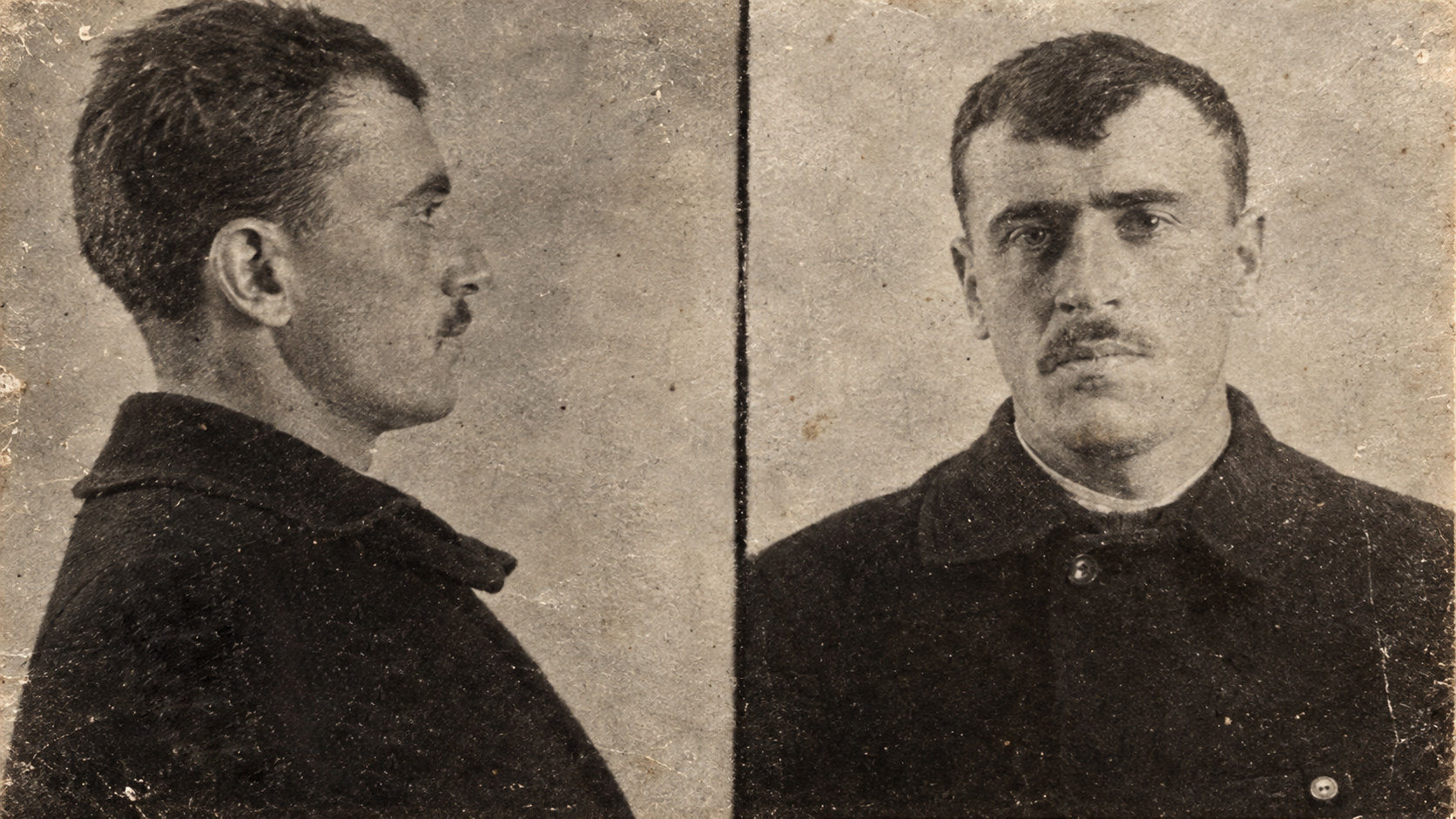
Police photograph of Ljubomir Čolić, a member of the KPJ since 1936.
Comments