



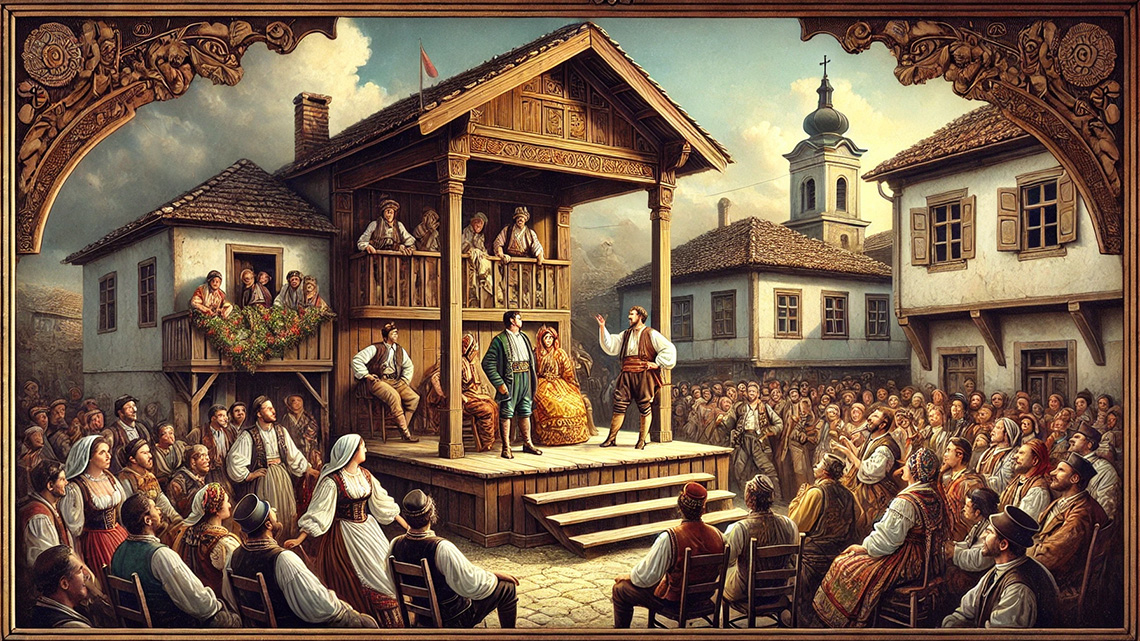
The theatrical work of Jovan Knežević is mostly known in fragments, particularly from the time he founded his renowned theatre troupe in the autumn of 1860. At that time, with the political climate shifting in Hungary and greater political freedoms and autonomy being granted (the so-called October Diploma of 1860), an active theatrical life among Serbs was revived after a decade of Bach’s absolutist repression.
This new wave of theatrical activity among Serbs was closely followed by the Serbian press, such as Danica and particularly Srbski dnevnik. Its editor, Jovan Đorđević, beginning on December 1, 1860, and on the occasion of Knežević’s troupe performing in Novi Sad, wrote several foundational, programmatic articles on the importance of theatre for advancing and preserving national culture and identity. These writings attributed a qualitatively new significance to Serbian theatre in the development of Serbian individuality within the Habsburg Monarchy.
Through the increased activity of the few traveling Serbian theatre troupes and the press articles, like those written by Đorđević, the awareness among Serbs in Hungary grew regarding the need to establish Serbian theatre as a national cultural institution. Leading this effort was Jovan Knežević's private professional Serbian Theatre Society, from which the first acting core of the Serbian National Theatre (SNP) in Novi Sad emerged.
A comprehensive and systematic overview of Jovan Knežević's life and work has not yet been undertaken, as far as is known, aside from somewhat broader fragments concerning his work leading up to obtaining a theatre license and the activities of his troupe during the establishment of the SNP, as documented in the existing literature.
However, it seems that Mečkić, in discussing the role and significance of Knežević’s theatrical contributions, may have been unintentionally biased, possibly overestimating his role for two reasons. The likely more important reason stems from an insufficient understanding of the stage of Serbian theatre development following the October Diploma of 1860, when theatre, in a cultural-historical sense, conceptually acquired a qualitatively new significance within Miletić’s national movement. This movement awakened and consolidated the Serbian political, cultural, and overall identity within the Habsburg Monarchy. These pivotal moments in the new phase of Serbian theatre development are reasonably emphasized by Prof. Dr. Božidar Kovaček in his book on Jovan Đorđević.
The second reason for Mečkić's somewhat partial assessment of Jovan Knežević’s significance in Serbian theatre history may stem from local patriotism. Lazar Mečkić himself has roots in central Banat. He was born in Kumane and spent his early childhood in the neighboring village of Novi Bečej-Vranjevo, where Knežević also hailed from.
Without diminishing Jovan Knežević’s undoubtedly significant role in the embryonic phase of Serbian theatre development in the mid-19th century, it must be noted that Mečkić’s evaluations and assessments of Knežević have resulted in negative connotations about Jovan Đorđević, unjustly disputing his reputation as the father of Serbian theatre and favoring Knežević in that regard.
The study includes a chronological overview of significant excerpts from newspaper reviews of the numerous performances presented by Knežević’s troupe during their extensive tours, primarily across Vojvodina.
Also presented are new, previously unknown biographical details about Jovan Knežević, derived from an unused source: a business letter from Atanasije von Rajić, the municipal head of Vranjevo, addressed to Derfel, the district chief in Veliki Bečkerek. This letter sheds light on details of Knežević’s rebellious episode in 1848 and the immediate consequences for his subsequent theatrical work. It also clarifies other biographical details and the reasons why, in a way, Knežević contributed to the breakup of the Serbian theatre troupe in Čanad to ultimately form his own.
Jovan Knežević undeniably left an important mark on the history of theatrical life among the Serbs in Vojvodina. Some opinions suggest that, due to various circumstances, his significance has perhaps not been sufficiently recognized or highlighted.
Through a more complete reconstruction of Knežević’s theatrical work in the context of mid-19th-century social conditions, based on a comparative analysis of the aforementioned literature and unused materials, an attempt has been made to better understand his role and position in the development of Serbian theatre. This includes its transition from amateur and semi-professional status to a professional theatre, and soon after, to a new quality—a nationally institutionalized theatre. At the same time, the study does not diminish the undoubtedly immense significance of Jovan Đorđević in the establishment of Serbian national theatre identity and the first Serbian national theatre.
Sofija Košničar, "The Theatrical Destiny of Jovan Knežević"

Comments