



Northeast of the settlement of Novi Bečej lies Arača, a significant monument of past centuries and one of the oldest examples of medieval architecture in the region.
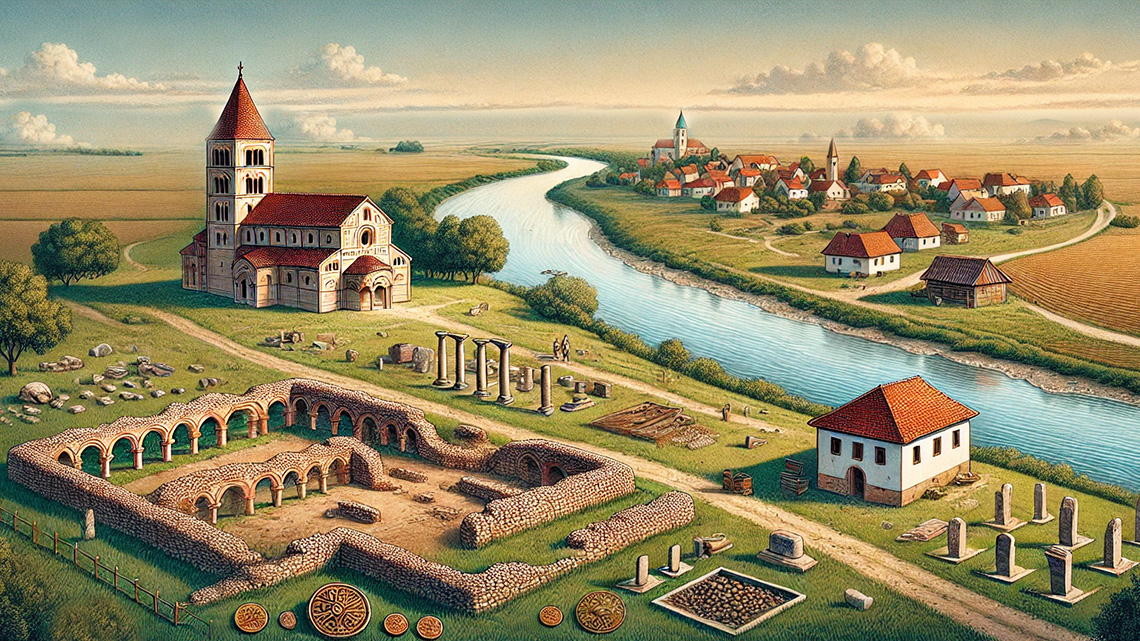
By its appearance and function, Arača was a Benedictine abbey (a church-monastery) and, in terms of architectural style, a Romanesque basilica. Due to its favorable geographical position, the area where the church is located was inhabited as early as the prehistoric and Roman periods.
From the original church, likely built in the 11th century, visible traces of decorative stonework remain, featuring motifs of triple interlace typical of pre-Romanesque sculpture. The present church was built around 1228 by an unknown Hungarian nobleman.
Arača was an imposing Romanesque structure with three semicircular apses divided by arched supports on half-columns. Its building materials included brick, carved stone, and marble. The capitals of the columns were adorned with various decorative elements, such as leaves and human heads.
The church, damaged during wars in 1280, was restored in 1370 by Hungarian Queen Elizabeth, who added a bell tower to the altar area during the reconstruction.
Today, the church is largely in ruins, and many decorative elements have been scattered across surrounding villages and farmsteads. No traces remain of the fortified town that once surrounded the church.
During preparatory work for its partial restoration and conservation in 1965, graves were discovered in a shared burial site about two meters deep in front of the church's entrance. It is believed that these are the graves of dignitaries and other prominent citizens of the former settlement.
As a settlement, Arača is first mentioned in 1420, much later than the construction of the church. Novi Bečej, on the other hand, is first mentioned as a settlement between 1332 and 1337.
Both settlements (Arača and Novi Bečej), along with a series of others in southern Hungary, were part of the possessions of Serbian despots by the early 15th century, known collectively as the Bečej Estate.
In 1404, Hungarian King Sigismund granted the Bečej Estate—with the title of Grand Župan of Torontal County (based in Bečkerek, today's Zrenjanin)—to Despot Stefan Lazarević, son of the late Prince Lazar Hrebeljanović. Stefan's deputy, Brajan, whose seat was in Arača, managed the estate from 1417.
After the death of Despot Stefan Lazarević, the Bečej Estate returned to Despot Đurađ Branković, who also settled Serbs on the estate, as his predecessor had done.
From Political History
Sigismund’s successor, King Ladislaus, confiscated the Bečej Estate in 1440 from Despot Đurađ Branković, citing alleged betrayal but motivated by Hungarian nobility’s territorial ambitions. However, he restored the estate around 1444 due to the looming Turkish threat. Đurađ later separated Arača from the Bečej Estate and gifted it to his relative Pál Birinyi.
After the fall of the Serbian Despotate to Ottoman rule in 1459, the Hungarian crown confiscated all properties of Serbian nobility in southern Hungary, including Đurađ's possessions, and awarded them to Hungarian nobles.
With the fall of the Despotate, the Ottomans gained access to southern Hungary, leading to frequent incursions. For instance, the Bečej Fortress was attacked by Ottoman forces around 1482 but was successfully defended by Serbian soldiers, the “living shield” of Hungary's southern borders.
In this defense, the forces of Novi Bečej Fortress were commanded by Zmaj Ognjeni Vuk (Dragonfire Wolf), the grandson of Despot Đurađ Branković and the illegitimate son of Grgur, who had been blinded.
In the first half of the 16th century, following the Battle of Mohács in 1526 and the death of Hungarian King Louis II, Novi Bečej (fortress and estate) became a site of conflict between Austrian King Ferdinand Habsburg and Transylvanian Duke John Zápolya as they vied for the Hungarian throne.
Comments