



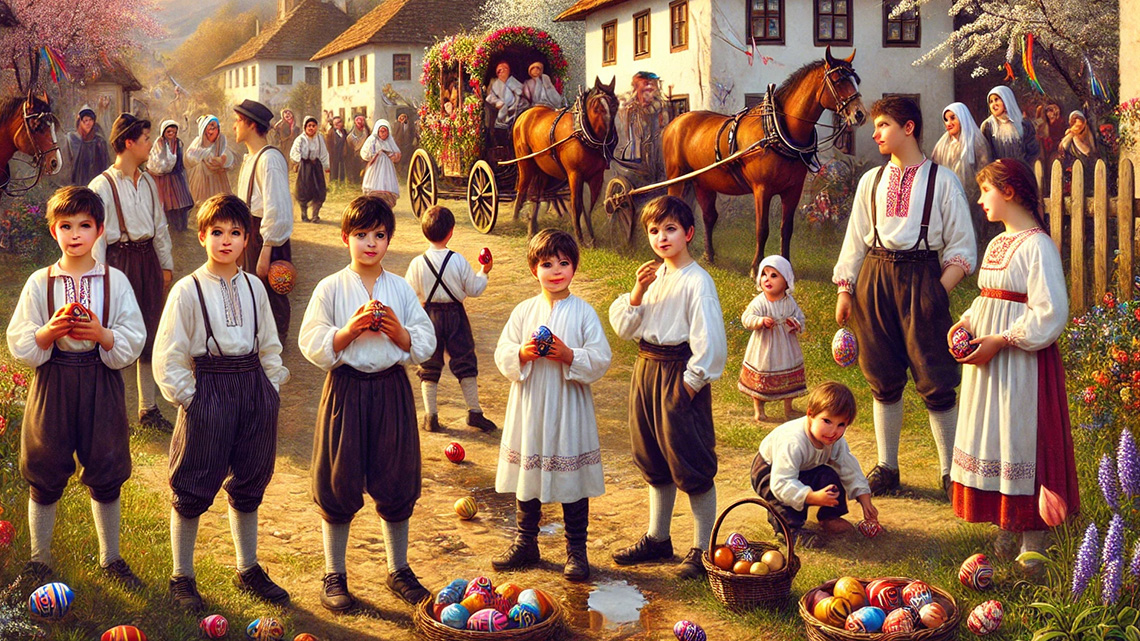
The memories of Easter and Christmas traditions are beautiful—customs that our children, especially our grandchildren, no longer know, yet they remain etched in our memories.
Before saying more about Easter traditions, I must first highlight what was difficult for us as children.
On Easter, our mothers would dress us in clean, festive clothes and crisp shirts. Even those who had no other clothes except their everyday ones would put on a clean shirt before stepping outside among other children. For us village kids, accustomed to sitting anywhere, leaning against walls or trees without concern for stains, this was pure torture.
These new or freshly cleaned outfits meant we had to be careful about what we did and how we behaved—an obligation harder to bear than any chore, which at least would have led to the reward of playing afterward. We resisted this “parade” dressing, but our mothers were relentless, refusing to hear our protests. They even made it a condition for going outside. Their child could not appear worse than the others. If there was no possibility of a new suit, the old one was cleaned, patched, and paired with a spotless shirt. There was no escape from this rule, no way around it—we had to obey.
We all grudgingly accepted this burden, knowing our mothers' warnings would go unheeded, yet they felt it was their duty to remind us. And of course, what would happen if they didn’t? Exactly what was bound to happen anyway.
Before stepping onto the street, we would secretly stuff a few dyed eggs into our pockets—perhaps our mothers pretended not to notice—and with bulging pockets, we would leave the house. At first, we moved stiffly, unnaturally, as if meeting each other for the first time. It was frustrating not being able to sit on the logs we had trampled with muddy or dusty feet just the day before, only to plop down without a second thought about stains.
But today, on Easter, that was forbidden. For a while, we stood around, dressed up, stealing glances at each other, exchanging a few cold words, feeling like strangers. Each of us held a painted egg in our hand—and of course, our pockets were full of them.
The eggs, meant to be the source of greatest joy, became a burden. You couldn’t let a friend hug you, let alone push you to the ground—God forbid!—or your eggs would break in your pockets, staining your clothes and instantly ruining Easter. The biggest trouble came from eggs whose dye would rub off. Some housewives didn’t prepare the dye properly, or perhaps they forgot to set it in vinegar—I never knew exactly what was needed—but such eggs were a disaster waiting to happen. The dye would transfer onto our hands, and inevitably, we would wipe them on our pants or jacket pockets. Only when we noticed the stains did we realize the gravity of our mistake—too late. The punishment was guaranteed. Our mothers knew how difficult it was to remove dye from fabric, and that washing would only spread the stain further, making them even more distressed and angry.
So instead of starting the holiday with joy, we were burdened with worry. I know, dear readers, you may wonder—wasn’t it the same during Christmas, the greatest holiday of all?
Yes, in terms of dressing up, but Christmas falls in winter when there’s snow or mud outside. Everyone wears a winter coat, and back then, nobody had two coats, which made behaving outside no different from any other day. Snow doesn’t leave stains, so we could sit or even lie down in it, making “pictures” without fear. If there was mud, nobody would dare sit on a log anyway. Easter was different—a bright, sunny day, perfect for playing, yet we were “stiffly dressed.”
But Easter didn’t stay stiff for long. After just a few minutes—at most, half an hour—we forgot our mothers' warnings and threw ourselves into play. The moment a stain appeared, it didn’t matter anymore whether there was one or many. The punishment would be the same.
The egg-cracking game went on as if we were in our old clothes. We tapped eggs against each other, and whoever had the strongest egg won the broken one. Some kids, skilled in the game, would take home more eggs than they had brought—but at the cost of a stained outfit and the inevitable punishment.
It wasn’t just about cracking eggs. Another game involved holding an egg between thumb and forefinger, leaving a small gap, and challenging others to throw a metal coin through it. The smaller the gap, the harder the challenge. Depending on the size of the gap, the opponent might get three or four tries. If the gap was larger, they got only two. To win, the coin had to pierce and remain stuck in the egg. If successful, they took the egg; if they missed, they lost their coin. Since eggs were cheaper than a single dinar, players aimed to win at least two eggs per coin.
This game, or gambling with eggs, lasted all day. The streets were filled with boys and girls, laughter and excitement, especially for those who “earned” extra eggs. Even those who lost weren’t sad for long—some friend would share their winnings, and soon everyone would lament how quickly the first day of Easter had passed.
The tradition of dyeing Easter eggs endured in many families, but it was often done quietly, making it impossible for children to enjoy the old games.
Another beautiful Easter tradition was the custom of sprinkling girls with water.
On the second day of Easter, young men—known as “sprinklers”—would visit the homes of young girls in decorated carriages, wishing them happiness, prosperity, and the fulfillment of all their dreams.
From nine in the morning, you could hear the jingling of special bells tied to horse harnesses. In groups of six or seven, sometimes with an accordion player, the young men would ride through the village, singing, stopping at homes with unmarried daughters.
At the girl’s house, they would wait for the gate to be opened, which every household eagerly anticipated. The host would welcome them warmly, tipping his hat. The young men would enter the house, where the girl awaited them. Approaching her with a song, one of them—usually the one she liked most—would sprinkle her with scented water, a tradition that evolved from earlier times when they used regular water from a bottle.
As a token of gratitude, the host would offer the young men a drink, while the girl or a female relative would serve pastries. But since everyone had eaten plenty of sweets during the holiday, few accepted the treats.
The visits continued throughout the morning and early afternoon. Later, at the village dance, girls would proudly compare how many visitors had come to sprinkle them—the more, the better!
Christmas also had wonderful traditions, especially joyful for children.
I won’t recount them all—the Christmas Eve feast, the morning and midday meals, each household’s unique customs. But the most thrilling for children was caroling on Christmas Eve.
As soon as night fell, we would run through the snow—or, if there was none, wade through mud—going from house to house, singing under windows, hoping to receive a few walnuts from the hosts. It was a competition—who could collect the most? The joy wasn’t about wanting the nuts but about proving ourselves more resourceful than our friends, showing our parents we could “earn” something on our own.
Oh, what joy it was! Even as I write this, I am saddened by the thought that these beautiful traditions, the happiness they brought, have been forgotten and will never be experienced again.



Comments