



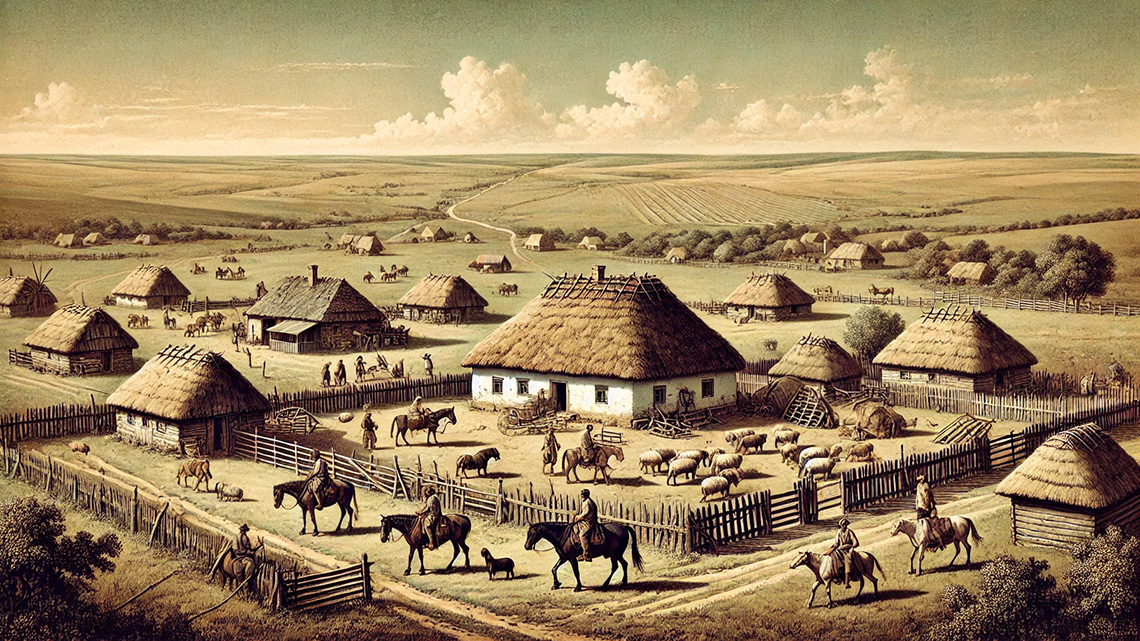
The way of life in Banat and Bačka differed under Ottoman rule and after their expulsion, up until the late 18th century. People initially lived in small settlements, but with colonization and land distribution, successful farming created the necessity for farmsteads (salaši).
The construction of farmsteads was influenced by the consolidation of land holdings and the size of the estates. Large land complexes and pastures, particularly those owned by the municipality of Vranjevo, played a crucial role. Until the agrarian reform following World War I, Vranjevo had the largest amount of municipal land in Banat after Vršac, covering 11,715 cadastral acres. This was one of the key reasons why Vranjevo had more farmsteads than surrounding villages.
As living conditions became more secure, farmsteads were built closer to roads and transportation routes, including railways. Their number grew so much that the railway established stops near certain farmstead communities in Northern Banat, such as Crna Bara near Vranjevo, Derić near Kikinda, and Ester near Padej. This significantly facilitated travel to and from farmsteads, improving connections with villages, towns, and broader social life.
The rapid expansion of farmsteads was particularly driven by the development of capitalist production relations and increased capital investment in agriculture.
Farmsteads were essential for the efficient cultivation of vast arable lands, especially those far from settlements. They were built near large grassy areas used for cattle grazing. The oldest ones were established along pastures and near watercourses, where fresh grass for grazing lasted longer. Later, they were also built on higher, drier terrain.
Until recent history, farmsteads were an integral part of life in Vranjevo and even Novi Bečej. Agricultural production on farmsteads, both in crop farming and livestock breeding, was crucial for supplying urban markets.
The original settlement of Vranjevo was located on Vranjak, as the population at the time primarily engaged in livestock farming. The area retained moisture longer than higher, more porous ground. Later, the village was relocated closer to the Tisa River, growing rapidly and becoming a large settlement with extensive land holdings, especially after the military border along the Tisa-Mureș region was abolished and the Großkikinda District was formed.
Since the village was located along the river, and the Tisa was difficult to bridge at the time, the farmland naturally extended on the same side as the settlement. This meant that the village was at one end of the estate, with the farthest fields being up to 18 kilometers away. Such distant land could only be efficiently cultivated from farmsteads. Consequently, Vranjevo had more farmsteads than villages like Melenci or Kumane, which were centrally located within their land areas.
Farmsteads were major centers for grain, industrial crop, and livestock feed production. They were also the primary breeders of large and small livestock. Besides growing animal feed, the vast pastures supported herds of cattle, large flocks of sheep, and groups of pigs with minimal effort.
Thanks to farmsteads, Vranjevo was among the leading producers of grain and livestock in Northern Banat. This was why Vranjevo’s fairs lasted for three days and were widely known for their livestock trade.
At a time when land was cultivated using horse-drawn or ox-drawn plows, farmsteads were a necessity, especially for those whose fields were located far from the village. Many farmers in Vranjevo owned land 10–15 kilometers from the village. Even with a rough estimate, an ox-drawn cart would take 3–4 hours to cover 15 kilometers one way, and the same for the return journey. This meant losing 7–8 hours of work compared to someone who had a farmstead near the fields. Horse-drawn carts were faster, but still required 5–6 hours for the round trip.
The loss of time wasn’t the only issue. Agricultural work had strict seasonal deadlines, and delays could reduce yields. Additionally, even when not pulling loads, draft animals still had to travel 30 kilometers, while farmstead horses or oxen could use that time for actual fieldwork. This applied to plowing, sowing, transport, and all other farming activities.
One can easily imagine the strain on draft animals after a full day of plowing, followed by a 15-kilometer journey back home. The driver, merely sitting in the cart, would be exhausted, let alone the horses that had to trot the whole way.
Besides saving labor time and draft animal strength, farmsteads played an essential role in the traditional division of labor. In extended families, where sons remained in the parental home after marriage, multiple families—those of the parents and married sons—lived together. This created a need for farmsteads as an outlet for the crowded household.
Farmsteads provided young couples with a degree of independence, even if temporary or symbolic, from the oversight of in-laws. Time spent on the farmstead was an enjoyable break compared to living in a multi-generational household.
Within such families, there was a structured work rotation. If a family had multiple married sons, they would take turns staying on the farmstead for extended or shorter periods. Special attention was given to ensuring that pregnant women stayed in the village before childbirth, where midwives or experienced older women could assist. Similarly, when children reached school age, they stayed in the village with their parents. Newlyweds and young couples were typically the ones sent to live on the farmstead.
Only the fundamental advantages of farmsteads are listed here, but there were many more. Their role developed alongside the evolution of productive forces and living conditions of the time.
Farmsteads harmoniously integrated economic activity with living arrangements, in tune with nature—a quality sorely missing in modern urban life.
Scattered across the plains, farmsteads symbolized the region’s landscape and distinctive way of life. Some experts describe them as "picturesque witnesses of architectural craftsmanship." Indeed, most farmsteads were skillfully designed, balancing functionality with aesthetics, adapting seamlessly to both the land and climate.

Comments