



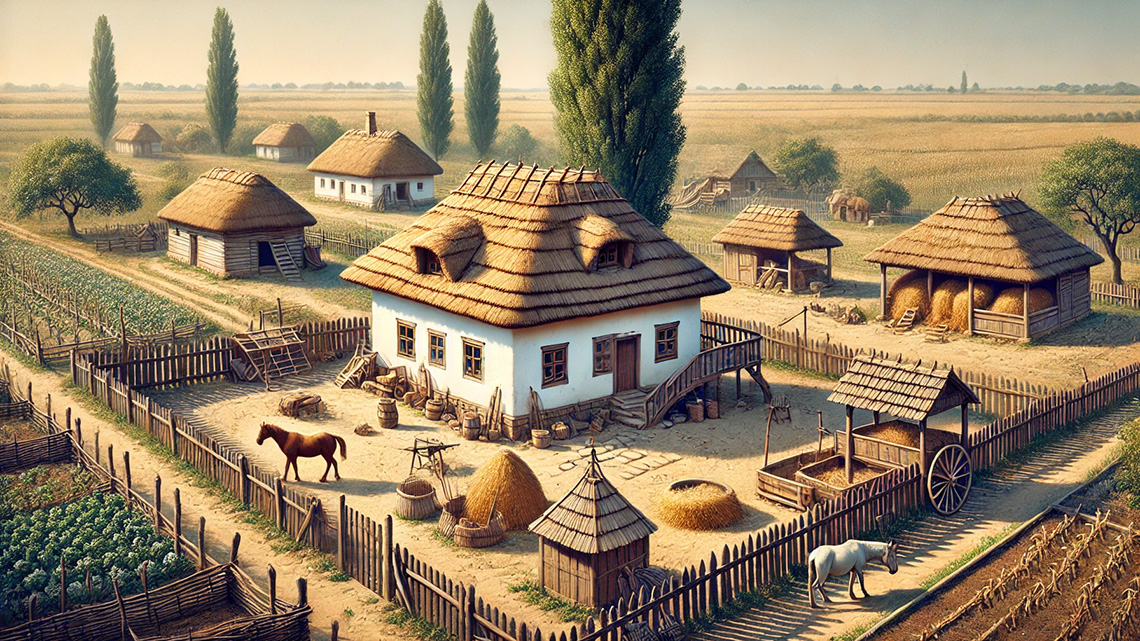
As part of presenting the role of farmsteads in the lives of our fellow citizens from the not-so-distant past, it is useful to describe the general appearance of a farmstead yard, along with the arrangement of buildings and rooms within them. This is even more relevant because village house yards were similar in layout, making this account valuable for documentation purposes as well.
I assume that younger generations are largely unfamiliar with this, so this description will help preserve details of a unique way of life in the fields of Banat.
The farmstead yard, surrounded by economic buildings, is enclosed by dense black locust trees, making the farmstead resemble a small grove from a distance. The yard is often fenced with wooden slats or wire. Around the main farmstead building, large mulberry trees provide shade, protecting it from the intense summer sun and shielding it from autumn and winter storms.
Farmsteads generally resemble one another in appearance. The houses are almost identical in construction, room arrangement, and positioning. They typically follow a similar layout: two rooms and a hallway—known as a "konk." The entrance to the house leads from the yard into the "konk," which is often entirely open. From there, one enters the kitchen, which provides access to the left-side room and the right-side room.
Some authors classify farmsteads into two, or even four, types. The first type consists of farmsteads where living quarters and stables for livestock are under a single roof, considered an older type. The second type includes those with a separate residential building and a separate structure for livestock, regarded as a more modern type.
Since I do not consider this classification scientifically valid in terms of historical development, I will not burden readers with the remaining two types. I would accept this classification as a categorization of farmstead types, but not as a chronological distinction. I believe it merely indicates that the second type belongs to wealthier households with more livestock, for which a stable within the main building would not suffice. The claim that the second type represents newer farmsteads is not well-founded. A separate livestock building requires a large number of animals, as a stable housing only 4-5 horses and 2-3 cows would not meet the necessary warmth conditions in winter. This means such a building must accommodate at least 8-10 horses and an equal number of oxen and cows. While cattle can endure lower winter temperatures, horses require warmth, and a large stable cannot be kept sufficiently full to maintain heat.
From my knowledge of neighboring farms, two large farmsteads near Novi Bečej—Miloš Števkić’s, built in 1927, and Branko Cukućan’s, built in 1934—had stables under the same roof as the living quarters. I would even argue that the need for separate stable buildings decreased in the years leading up to World War II. By then, oxen were disappearing as draft animals, and the reliance on horses increased, requiring fewer animals for the same workload.
However, I am not trying to argue against existing claims, but rather to highlight the weakness of this classification in terms of the time of origin of particular farmstead types. Ultimately, everything stated about farmsteads also applies to agricultural houses and yards in settled areas. Only particularly wealthy households with extensive livestock had separate stable buildings.
Most farmsteads in Vranjevo and Novi Bečej were built using "naboj" (rammed earth), with later additions made of "čerpić" (mud bricks) and, in more recent times, brick. Before World War I, most of these farmsteads were covered with reed thatch, which was the cheapest option and had excellent insulation properties: it prevented excessive heating in summer and retained warmth in winter. Only between the two world wars were thatched roofs replaced with small "beaver tail" tiles, later followed by interlocking tiles.
The residential building usually had two, sometimes three, windows on its front side. If the farmstead was near a road, the windows faced the road; if it was further away, the front was oriented east or west, with the "konk" always positioned to face south. The "konk" was an open hallway along part of the house. It was often enclosed by a low wooden fence or a one-meter-high wall. From the hallway, one entered the kitchen, which was centrally located, providing access to the front room (living quarters) and the "back room," typically reserved for guests. The back room had a single window facing the "konk."
Rooms were heated by masonry stoves made of clay (shaped into large "strudels" and covered with mud) or "čerpić." Behind each stove was a "zapećak"—the space between the stove and the wall, usually 50-60 cm wide. The stove was positioned in a corner, with its firebox accessible from the kitchen. To prevent heat loss through unnecessary heating of two walls, one side was set away from the wall, creating a "zapećak," thus ensuring that three sides and the top of the stove radiated warmth into the room. Although its main function was heat efficiency, the "zapećak" also served practical purposes.
It was used for storing miscellaneous household items to prevent clutter. A basket with knitting supplies, needles, crochet hooks with balls of yarn, and a spinning wheel often found their place there. It was also a favored sleeping spot for children, as it remained warm throughout the night, even in the harshest winters. This made it a practical alternative to a bed, as children could not roll off and fall. At that time, farmsteads did not have cribs with railings—children usually slept on wooden planks supported by stands, covered with a straw mattress and a "krpara" (woven rug).
The "zapećak" was the children's favorite winter play area—it was warm, out of the way, and allowed adults to engage in long conversations ("divani") undisturbed. This likely led to the expression "put in the zapećak," meaning someone is excluded from a discussion or removed from a position.
Fuel for heating was typically corn stalks stripped of leaves, bundled and stacked for winter use. Straw was sometimes used as an alternative, though housewives preferred corn stalks because they were easier to handle and lasted longer.
Farmsteads with three windows on the front often had a portion of the "konk" converted into a small kitchen or "sobica." This room contained a stove with an oven for cooking and baking, along with a bed for the farm owner and his wife, while the children slept in the main living room. The stove in this small kitchen also served as the firebox for the room’s heating stove. The "sobica" usually had one additional window facing the yard, like the "konk."
Lighting was provided by kerosene lamps, or earlier, lanterns. Table lamps were placed on tables, or if needed, on the stove. In side rooms like the kitchen and pantry, as well as in the stables, wall-mounted kerosene lamps were used.
Extending from the main building were storage rooms like the "špajz" (pantry) or "komora." On farms with many sheep and cows, a portion of the "konk" was enclosed to create a "mlečara" (dairy room) for storing milk and dairy products. Some farmsteads also had cellars.
Beyond these spaces were stables for horses and cattle, followed by a shed with a single-slope roof for carts and farm equipment. Opposite the house stood the corn crib ("kotarka"), elevated on wooden stilts, with a pigsty underneath. Next to the pigsty was often a chicken coop.
Every farmstead had its own well with a "đeram" (counterpoise well) and a large watering trough. The well was enclosed by a fence, and the area where the "đeram" stood was called "soja." Water was drawn using a long wooden beam with a bucket attached by a chain. A pit at the end of the trough served as a bathing spot for geese and ducks and a wallowing area for pigs.
The yard stored stacks of straw, husks, and corn stalks. Some farmsteads also had an open shelter for livestock during summer and a sheep pen in winter.
Comments