



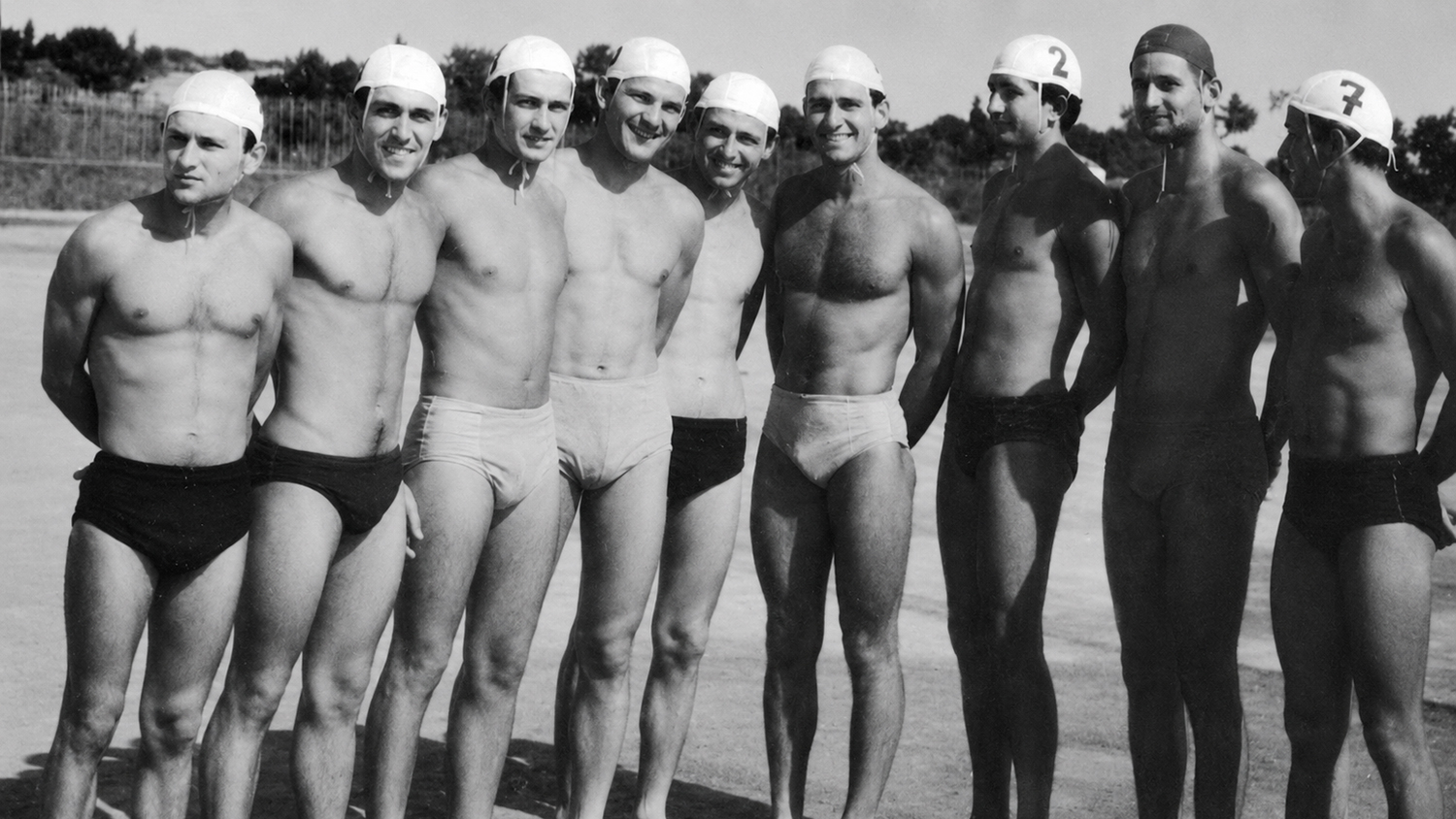
With great ambitions and the strongest squad in its history up to that point, PVK Jedinstvo entered the 1962 competitive season. Most of the players were in their prime sporting years, between 19 and 22 years old, while valuable experience was provided by Sava Ivanić (29) and Petar Fa (25).
Training sessions were held twice a day. The water at the Novi Bečej “Spa” was pleasantly warm, and even Miroljub Matić and Ivica Kovačev never hesitated to be among the first to jump into the pool. New water polo caps were made for the season, and the club acquired two new leather “Berger” balls. The younger players carefully maintained them, treating them with beef tallow and floor wax to keep them in excellent condition.
The team’s first test came in early July at the “Spa,” where Jedinstvo faced Odred from Kikinda (formerly known as Kikinda) and Železničar from Belgrade. Although these were friendly matches, the Novi Bečej team recorded convincing victories in both encounters, revealing considerable potential for the upcoming season.
In mid-July, the first qualification tournament was held in Kikinda, featuring Jedinstvo, Jezero from Bela Crkva, Odred from Kikinda, and Proleter from Zrenjanin. Jedinstvo defeated both Jezero and Proleter and drew 3–3 with Odred.
Jedinstvo and Jezero qualified from this group for the final qualification tournament of the First Republican Division, which from that year onward was officially called the Serbian “A” League. Jezero secured its place by defeating both Odred and Proleter.
From the Bačka qualification group, Bečej and Student advanced to the “A” League. Student had strengthened its squad that season with several players from Partizan Belgrade.
At the Opening of Kikinda’s New Pool
On Sunday, August 10, 1962, Kikinda officially opened its municipal swimming complex and a new Olympic-sized pool, built on the site of the former Stevančeva Bara in the town center.
It was a major celebration, and the water polo players of Jedinstvo, considered the strongest team in Banat at the time, were among the invited guests. Club officials, supporters, and female fans accompanied the team. Unlike previous trips, they no longer had to walk four or five kilometers from the railway station to the venue.
The Novi Bečej delegation was greeted by persistent drizzle that felt more like November than August. Nevertheless, the hosts and nearly 1,000 spectators patiently awaited the start of the festivities. The Vice President of the Municipality of Kikinda delivered a brief speech, taking into account the unusually cold weather conditions.
After the ceremony, preparations for the match began. While the players tried to warm up in the cold water of the new pool, club officials and local politicians gathered in the newly built buffet area. It was therefore no surprise that during halftime, while the players shivered at the poolside, Jedinstvo president Miloš Rauški jokingly suggested that instead of the sugar and lemons they used as a form of “doping,” they might benefit more from a small shot of brandy.
The hosts eventually claimed a deserved 4–3 victory.
A Missed Opportunity for Promotion to the Second Federal League
The final Serbian “A” League tournament took place in Bela Crkva on August 15 and 16, 1962. Jedinstvo defeated Student and drew 4–4 with the host team, Jezero.
The remaining results set up a decisive showdown between Jedinstvo and Bečej. The winner would become league champion and earn the right to compete in the qualification tournament for the Yugoslav Second Federal League.
The score was tied 2–2 at halftime. Five minutes into the second half, referee Miško Stefanović from Belgrade sent off Jedinstvo player Živorad Berbakov for the remainder of the match, without the right to a substitute, citing the intentional striking of an opposing player.
Forced to play with one man fewer for nearly five minutes, the Novi Bečej side eventually lost 5–3. Bečej secured first place and advanced to the qualification stage for the Second Federal League.
One memorable moment occurred after Berbakov’s dismissal. Despite being a player down, Jedinstvo defender Petar Fa managed to score and give his team a 3–2 lead. Since it was the only goal he scored for Jedinstvo that year, it later became known among teammates and supporters as the “diamond goal.” Unfortunately, even that remarkable effort could not prevent defeat.
Following the final whistle, almost the entire Jedinstvo team was in tears, carrying with them the bitter feeling of sporting injustice and a missed opportunity.
As a consolation, Živorad Berbakov was selected as Novi Bečej’s Athlete of the Year by local journalists and sports officials in the annual poll organized by the newspaper Sport.
At the end of the season, Berbakov transferred to Red Star Belgrade, a First League club, where he continued his successful playing career. Between 1962 and 1967, Red Star achieved notable results and had players representing both the senior “A” and the young “B” national teams of Yugoslavia.
Source: “Kikindska komuna,” No. 16, August 19, 1962.
Photo caption: PVK Jedinstvo’s strongest lineup during the final tournament in Bela Crkva in 1962. From left to right: Miroljub Matić, Pavle Sauer, Sava Petraškov, Milorad Kiselički, Ivan Kovačev, Živorad Berbakov, Petar Fa, Zlatoje Marić, and team captain Sava Ivanić.
Comments