



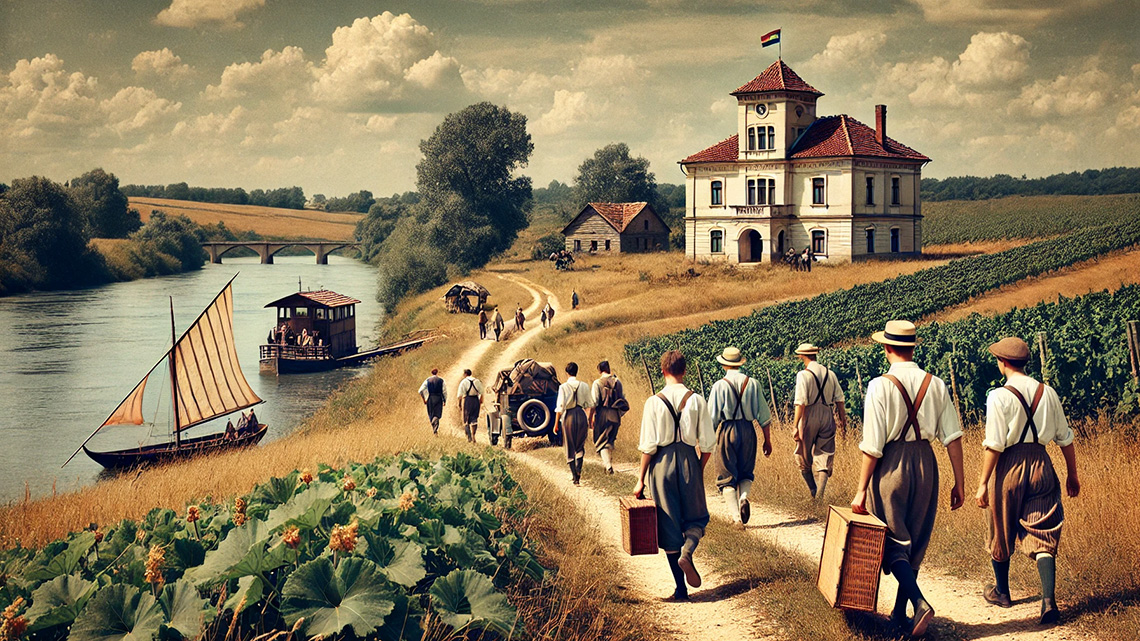
No more than three or four days had passed since our excursion to the Ivanović estate, and by Sunday, we were off on another one—this time much longer and more exhausting for walking. From Novi Bečej to the Rohonci estate in the Bečej marshland, or as it is known today, Pearl Island, it is at least eight kilometers one way. If you're counting the total distance for both directions, then maybe this trip isn't for you!
The estate was alluring because, aside from the two or three of us, no one had ever been to Pearl Island, though everyone had heard only the best about it. Even those who hadn’t been there knew it was famous for its special melons, exceptional grapes, wonderful pears, apricots, and other fruits. Everything grown on Gide Rohonci’s estate—any fruit, melon, or grape that bore the R.G. mark on its crates—was 40–50% more expensive than the highest-quality produce from other farmers. The owner’s name was a guarantee of exceptional quality. The same applied to the estate’s wine and brandy—everything except wheat and corn.
This almost magical production enticed everyone who had never been to the marshlands to experience it for themselves. That would have been easy if some transportation had been available, but for many, walking was out of the question. Because of the distance, we ourselves discouraged our girlfriends from joining us, and once they weren’t coming, many young men lost interest as well.
At the time of our trip, the estate belonged to Gide Rohonci’s daughter, whom everyone addressed as "the Baroness." Whether she actually held that title, I don't know. I remember her well—she was either widowed or divorced—and she usually went shopping alone, though occasionally with a lady of similar age (about fifty) from the Hungarian community.
Before the economic crisis, the Baroness lived in Szeged or Budapest, but during the crisis, she moved to Novi Bečej. She mostly lived in the family house on the square, located where the building of the agricultural cooperative "Pearl Island" stands today, on the highest part of the square, at the corner. Her mother, the widow of Gide Rohonci, lived on the estate in the marshlands, where she passed away in either 1935 or 1936. She was buried in front of the manor, in the section facing Bačko Gradište. I remember that we visited her grave, which was overgrown with ivy and had a rather high mound.
The Excursion
Returning to our excursion—there were about ten of us, including all the members of the Tamburitza Orchestra of the Merchant Youth, who brought their instruments (though without a bass). Since Senji Janoš had married and stopped leading the orchestra, Radivoj Markuš had taken his place. He didn’t play an instrument, but he arranged the sheet music for various instruments, ensuring that the orchestra could continue performing and remain the main ensemble to introduce new hits and musical novelties in Novi Bečej and Vranjevo. Markuš also organized an octet within the Merchant Youth, which was active for a little over a year. Most of its members were from the Tamburitza Orchestra, with additional singers like Steva Jovčić, Laza Stankov (Pinćin), and Košta Velisavljev.
We set out early, around 6 AM on Sunday, taking the embankment road toward the "Berečka" ferry. The ferry at Berek was about five kilometers from Novi Bečej, and we covered this distance rather quickly and easily because the morning was still fresh, and we were well-rested. Before we knew it, we had passed the road leading to the Ivanović estate and the guardhouse of Uncle Maksa Dragić, whose twin sons were already out herding cattle near the embankment. Soon after, we passed the Water Cooperative's pumping station and arrived at the ferry, still full of energy, almost as much as when we started.
While waiting for the ferry—which had just departed toward the Bačka side—the octet sang, "Oka na momka sve na sat, pismo do zore za inat..." After the song, the Tamburitza Orchestra played, and the ferrymen, eager to hear more, rowed back with all their might to get to our side faster and see what kind of merry company we were.
The ferrymen got so carried away with the music and singing that they nearly forgot their job of pulling the ferry across. If not for us non-musicians and other passengers eager to reach the other side, the crossing could have taken as long as our entire journey ahead!
Once on the right bank of the Tisa, we followed the embankment, then a dike along the Old Tisa, until we reached the Rohonci estate.
At the Estate
Unlike at the Ivanović estate, where we were allowed to stay in the park and even on the manor’s terrace, here we were only permitted to walk through the park and observe the manor from the outside. We spent the rest of our time in an acacia grove near the Old Tisa.
After breakfast, two of our group went to the cellar to buy wine. It was the largest cellar we had ever seen, and an even greater surprise awaited us inside—two massive barrels so large that a person could walk into them to clean them for the new harvest. When our friends returned and described what they had seen, we all wanted to see the cellar for ourselves.
The cellarman let us sample different wines, hoping someone would get carried away and drink too much, but we were familiar with this trick and didn’t fall for it. We were all in awe of the cellar’s size and the enormous barrels, which stood open, ready for the next harvest’s wine. The cellarman, holding his lantern, let us admire their immense size.
It seemed that nothing else interested us anymore. We saw the beautifully arranged park, the manor with its tower—used only for observing the surroundings—and we were enchanted by the wine, which, when tasted later in the acacia grove, seemed even better than in the cellar. Music, singing, and jokes made our time there very enjoyable.
The Journey Back
After lunch, everyone dozed off in the shade of the acacias. Upon waking, a dreadful thought struck us all—we would soon have to walk eight kilometers back home.
We tried to keep the music and singing going on the way back, but it quickly faded. Jokes stopped too, replaced by tired remarks. Instead of walking as a group, each person became lost in their own thoughts, and our column stretched out. By the time some reached the ferry, the most exhausted ones were nearly a kilometer behind.
When we finally gathered at the ferry, the ferrymen started teasing us: "This isn’t for gentlemen—this is for us, for the farmers! For you, the main street and a stroll to Gradište is plenty!"
I won’t bore the reader with the remaining five-kilometer walk from the ferry to Novi Bečej—it’s easy enough to imagine. In the end, we all arrived home, each heading off without a word of farewell. Only the toughest—or the most stubborn—showed up on the embankment that evening, not to walk, but to collapse onto the first empty bench and watch others stroll by, while they wouldn’t trade that bench for anything—except maybe a bed.
And so, our second excursion into the beautiful surroundings of Novi Bečej came to an end. The next day, and for many days after, we joyfully recounted stories and laughed about how some had handled the journey. It was an extraordinary experience—an entire day of camaraderie in nature. Some who seemed strong had tired more quickly than those we had thought weaker, and this led to plenty of jokes at the expense of the "tough guys."
All in all, it was a great trip. We were all satisfied, and had there been another organizer, we would have gladly gone on another excursion the following Sunday.
Unfortunately, these two trips were the last of their kind, but they sparked a lasting desire for shared outings and gatherings.
Comments