



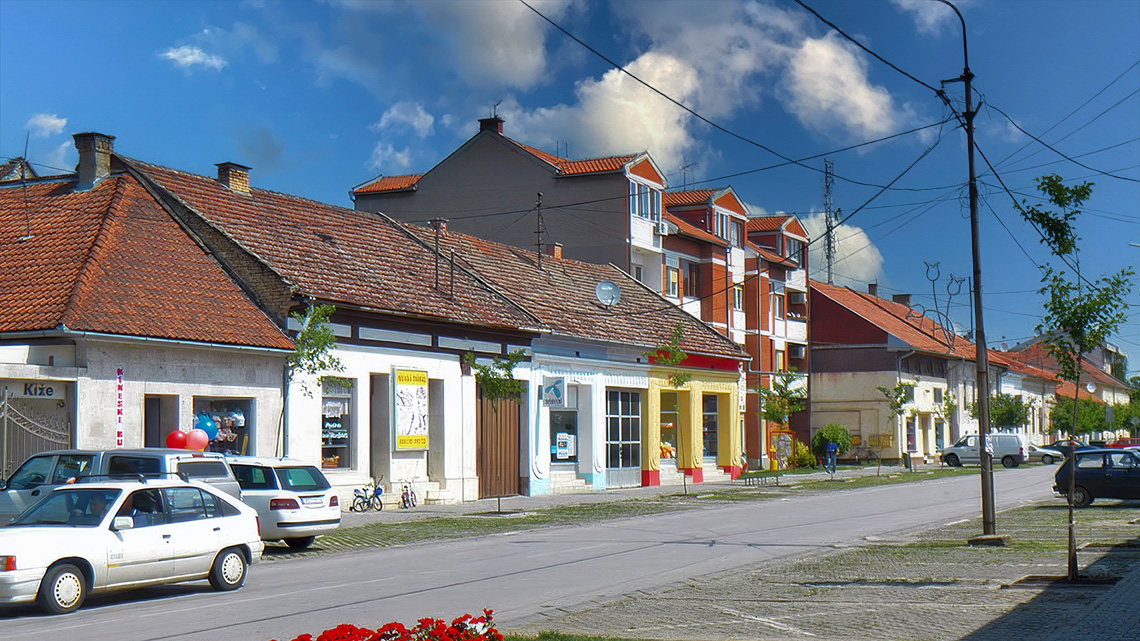
I begin to feel my homeland even on the road to Novi Bečej, right after leaving Kumane. On that road from Kumane to Novi Bečej—whether by train or bus—I start recalling everything that once existed there or what ties me to that path, from the time when my love for my homeland was most deeply growing.
When I travel by bus, I remember how, as an eleven-year-old boy, I first walked alone from Kumane to our farmstead, which was located near Novi Bečej. Every part of that road, from back then, is still present in my thoughts. The road lined with trees on both sides, and “dangerous” right near Kumane due to deep canals. I remember being afraid while walking along the footpath close to one such canal, scared I might slip in, not daring to even look into its depth. Today, that canal has nearly disappeared, and the place where it used to be deepest is now just a shallow ditch about one meter deep.
I look for the trees and the three poplars that stood where a small bridge crosses the canal cutting through the road. I know exactly where those poplars stood and I vividly imagine them in all their height.
A little further, on the right-hand side heading toward Bečej, there used to be a large well with a "đeram" (a traditional well with a lever) and a long concrete trough. I remember that well, where my father, whenever we traveled by horse-drawn cart, would water the horses on the way back from Bečej, and even drink a few sips himself from the worn wooden bucket used for drawing water. I always felt a sense of joy when we reached that well on the return trip—it meant the majority of the journey was behind us.
A hundred meters further, on the right side of the road, was the roadkeeper’s house. I loved that modest house, and the roadkeeper who lived there with his family. I liked both, especially the roadkeeper, who showed respect to everyone—at that time, travelers were rare—and was always ready to help.
The road from the roadkeeper’s house is nearly monotonous, but even on that stretch, I have memories. I always look for the path that leads to our field. Eventually, I reach the lane that marks the boundary between the lands of Kumane and Novi Bečej. Even today, as in the past, three or four willows grow there, and this lane is also the turnoff for the road to Taraš—when coming from Novi Bečej.
Not far from that lane stood three long stables and two thatched houses for the farmhands. These were part of the Prečka area, near Ivanović’s meadow.
My memories unfold at the pace of the moving bus. Midway from Kumane to Bečej begins Ivanović’s meadow, stretching on both sides of the road. That meadow held a special meaning for me. I might sometimes forget other parts of the road, but never the meadow and its herds. There, I saw what seemed like the endless wealth of the landowner Ivanović: a large flock of sheep and a herd of over a hundred horned Podolian cows with a bull, whose fiery head, dark eyes, thick muscular neck, and massive horns inspired awe—though there was always comfort in knowing the herder was nearby.
There are still two wells on the meadow, with the old lever system, but the shepherd huts are gone. The small wooden cabins on wheels are no longer there.
I loved that meadow more than any other part of Novi Bečej’s fields. I enjoyed taking our cows there to graze on the rich grass before the summer sun scorched it. I did this secretly, because if the field guard (whom we called "subaša") caught me, my father would be fined for the damage caused by our cattle. But our four cows couldn’t possibly eat more than a few square meters of grass in an hour or two, and that was nothing compared to the vast stretches the sun would soon dry out.
Every time I pass that meadow, I feel a small thrill and a renewed desire to stop, to mentally be there again with our cows on that wide expanse where they didn’t even need watching—they had nowhere to wander.
I have unforgettable memories of mushroom picking. One June day, a day or two after a heavy rain, I took the cows to Ivanović’s meadow, and while they grazed, I noticed a multitude of mushrooms near the railroad. I had never seen anything like it before, and haven't since—I started shouting with joy, the field was full of mushrooms. I finally understood the saying “sprouting like mushrooms after the rain.” Everywhere I stepped, clusters appeared. Wading through the soggy grass, I quickly filled a bag and proudly drove the cows back, hurrying the 3–4 kilometers home just to show my mother my find.
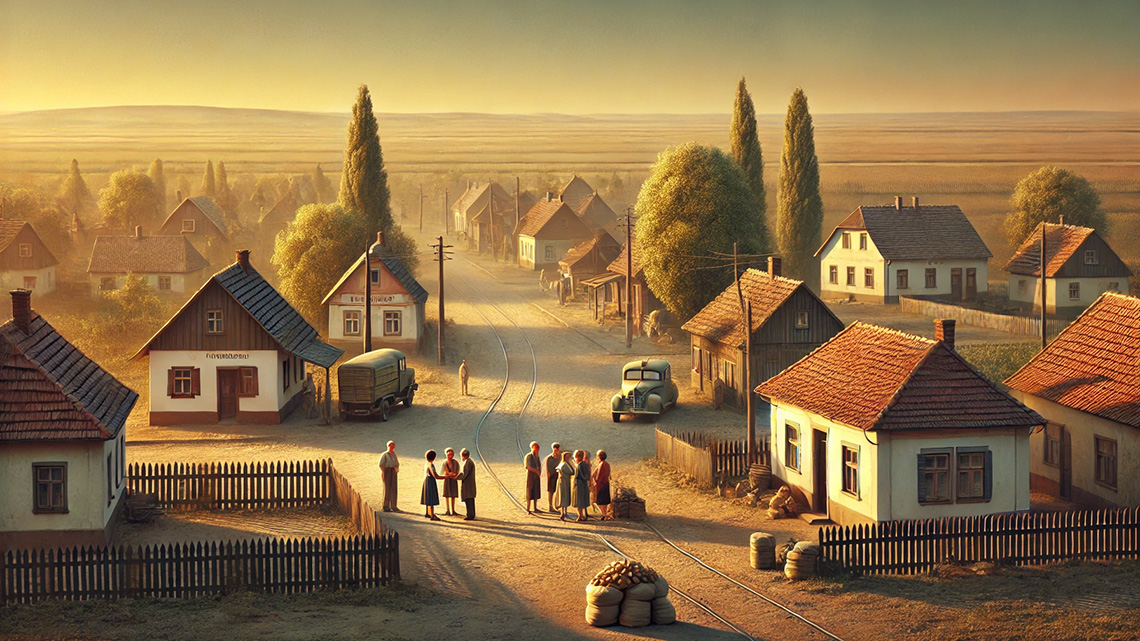
At the edge of the meadow, toward Novi Bečej, I remember the old farmsteads that used to border the pasture—just like other municipal grazing lands.
Less than a kilometer further, the new road veers left, crosses the large Danube–Tisa canal over a bridge, and rejoins the old route just before entering Novi Bečej. The canal and bridge are recent additions and hold no memories for me, so even if they’re a nice addition to the outskirts of town, I have nothing to say about them.
On the old road, just a hundred meters before entering Novi Bečej, stood my father’s farmstead, also surrounded by a deep canal, part of a drainage network for the waterlogged soil.
It was there I grew up with my parents. In early spring, I tended 20–30 piglets, and from May to November, the cows. We had two or three dogs I played with daily—they waited for me to come out and followed my every step. They’d forget they were supposed to guard the house, and I’d have to yell at them to go back, letting only the one trained for herding come with me.
Along the entire road from Kumane, I awaken memories and hardly notice when I’ve arrived in Novi Bečej. When the bus stops at the station, I almost regret the interruption of my pleasant recollections.
Similar feelings arise when I approach Novi Bečej by train. The difference is that here, the memories awaken only halfway—around where Ivanović’s meadow begins, just like when I travel by bus. On the right side of the track, starting from the track guard's house about a kilometer before today’s railway bridge over the Danube–Tisa canal, I see the vanished farmsteads.
That part of the ride I spend recalling all the disappeared farmsteads, which used to stretch up to the common pastures. Today, there’s no trace of them, but it doesn’t stop me from seeking the exact spot where each once stood.
As this perhaps not-so-interesting account shows, I begin to feel my homeland long before entering Novi Bečej. Naturally, the closer I get, the more intense the emotions, as can probably be felt from everything said in this book.
To conclude this reflection on my homeland, I’ll share a true experience from 1941. It might be the clearest proof of what my homeland meant to me, even at the age of 24. Over time, that meaning only deepened.
After Yugoslavia’s occupation during World War II, in November 1941, a Ljotić movement leader, Duško Marković—a lawyer from Novi Bečej—held a conference at the “Royal” tavern (today’s “Jadran”). Notable citizens of Novi Bečej and Vranjevo, including my father, were invited.
Marković presented the wartime situation, claiming Russia had lost the war, as German troops were already near Mozhaisk—about 40 kilometers from Moscow. He insisted we Serbs must secure our “place under the sun” in Hitler’s New Europe. Thus, he urged them to send their sons to join Ljotić’s troops to fight communism in Serbia. For now, this would be voluntary, but if necessary, conscription would follow.
Returning home, my father, afraid for my life, decided to send me to Ljotić’s military unit.
As soon as he arrived and sat at the table where I was already seated, he dejectedly relayed what he had heard from Marković and finally said:
“Get ready,” he told me, “to enlist in Ljotić’s unit before conscription begins.”
Shocked by his request, I jumped from the table and said immediately, “That’s out of the question! Do you realize everyone in Bečej knows I was just released from a German prison as a suspected communist sympathizer? And now they should see me in a Ljotić uniform? I’d rather die than do that!”
At the very moment he made the request, it struck me that accepting it would mean losing Novi Bečej forever. I would never again be able to face my people. He responded loudly:
“I want to save your life, and you stubbornly won’t even listen! ...Well then, let the devil take you!”
I replied: “Under those conditions, I don’t want to live.”
Insulted by my defiance and overcome by fear for my safety, he stopped speaking to me. He couldn’t understand how strong my pride was, and that without Novi Bečej and Vranjevo, life held no meaning for me.
Our strained relationship lasted about ten days. Luckily, in December 1941, the Russians launched a counteroffensive and recaptured Rostov-on-Don, which the Germans had taken only days earlier. When he heard the news on Radio Moscow, my father came to me and said:
“Hey, it’s good you didn’t listen to me and join the Ljotić troops—see, the Russians haven’t lost the war and won’t!”
I hope no one interprets this story as bragging—I’ve never told it before, not even when it could’ve helped me professionally. I have even less reason to share it now, in old age, when some might even see it as a political misstep.
But thanks to my great love for my homeland and respect for my fellow townspeople, I found the strength to resist my father’s demand and remain true to myself. Fortunately, that was the right decision, and thanks to it, I’ve lived to see my 74th year.
Comments