



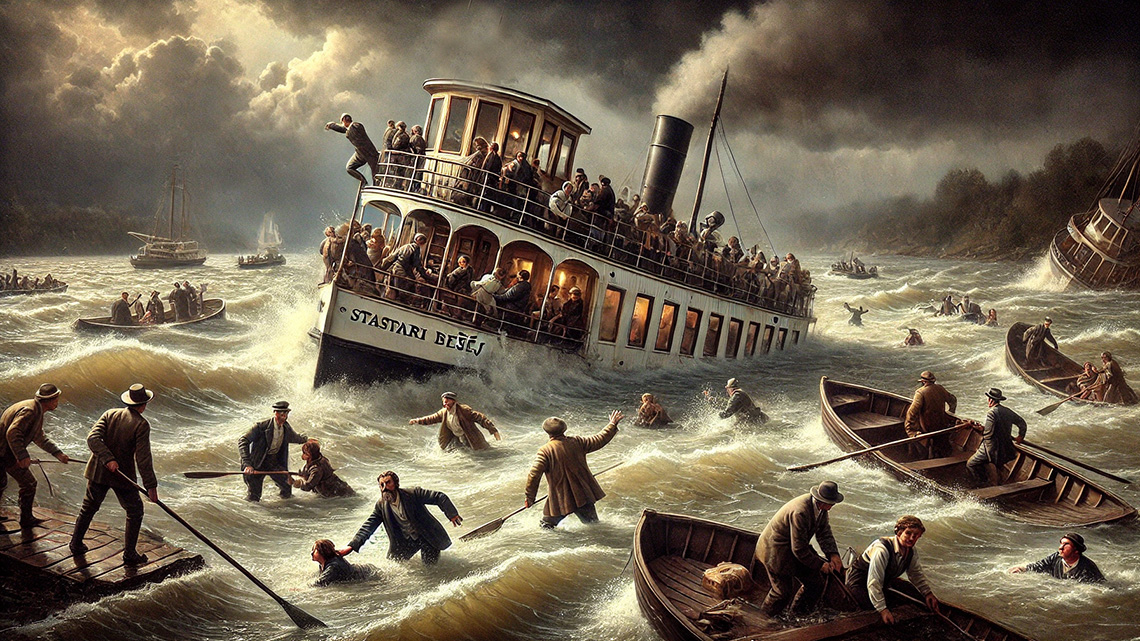
After World War I, and likely even earlier, Novi Bečej and Stari Bečej were connected by a small boat named Stari Bečej, which made multiple trips daily between the two towns. I remember that until the establishment of a private high school in Novi Bečej, students from Stari Bečej used this boat to travel to the upper grades of the high school. At that time, Stari Bečej only had a lower-level high school, covering up to the fourth grade.
Every morning, 30 to 40 students would travel on the boat, returning in the afternoon, forming a significant part of the vessel’s load along with other passengers. The boat’s capacity was not designed for more than 70 to 80 passengers.
The captain and helmsman of the boat, starting in March 1931, was Mladen Krstonošić. Unfortunately for him, on September 12, 1931, less than six months after taking command, Stari Bečej was caught in a powerful storm on its route from Stari Bečej to Novi Bečej. About halfway through the journey, the boat was overturned by the hurricane-force winds, resulting in the tragic deaths of around thirty passengers.
I previously described the sinking of Stari Bečej in my early recollections, The Charms of Bygone Days, but here I wish to share the story of one man who survived by sheer luck. I heard his account firsthand when he told it to my father, and I remember it in nearly every detail.
The man in question was Kosta Radić, a retired gendarmerie major. After his early retirement, he bought a glass greenhouse in Novi Bečej near the sluice at the canal’s exit into the Tisa River. He acquired it from the former landowner Šojmoš in 1927 and cultivated vegetables there. Later, after 1934, Radić moved to Belgrade, where he established a stenography and typing school, which he ran well into his old age.
On the day of the accident, Radić had traveled to Stari Bečej in the morning to enroll his son, Ivan—nicknamed Vanja—into the local high school. Unfortunately, he chose to return at precisely the time when the boat would be caught in the storm.
Here is how he described his terrifying experience:
“The boat departed from Stari Bečej on schedule, in what seemed like a calm and even pleasant September afternoon. Alongside the students, there were about forty other passengers, and everything seemed completely normal. The water level was low, as the Tisa often was at that time of year, and the boat glided smoothly over its calm surface.
Shortly after departure, we saw dark clouds in the distance, moving rapidly from the direction of Stari Bečej. The helmsman, Mladen—known as Mlađa—Krstonošić, was a young and strong man, and we passengers, likely like him, believed we could outrun the approaching storm. But as it neared, the cloud mass appeared increasingly menacing.
The boat sped ahead, but the storm was even faster. When we reached the midpoint between Stari Bečej and Novi Bečej, the cloud loomed over us, plunging everything into near darkness, even though it was early afternoon.
Realizing the severity of the situation, Mlađa attempted to steer the boat toward the Banat shore, hoping to dock safely, but it was too late. The hurricane-force winds, accompanied by hail, struck with brutal force, pushing the boat toward the river’s center like a fragile nutshell. Panic broke out among the passengers as the helmsman struggled in vain against the raging elements.
The boat no longer obeyed his commands—it was at the mercy of the storm. It picked up speed, and when it reached the middle of the river, nature played a cruel game with it and everyone aboard. With ease, the storm capsized the vessel, plunging all passengers into the furious waters of the Tisa.
People tried to save themselves however they could. Those who could swim attempted to reach safety, and all the students managed to survive. Some non-swimmers jumped into a small rowboat tied to the main vessel. However, the overloaded rowboat was soon overturned by the waves, throwing about ten people into the water. Some were tossed to the surface by the waves, but only a few managed to survive.
Many remained trapped inside the boat, unable to swim, or perhaps too late in trying to escape. Darkness engulfed them, sealing their fate. Others who ended up in the river but couldn’t swim drowned after struggling for only a few minutes—just long enough to grasp for air a few times before succumbing to the relentless water.
Kosta Radić was among them.
When the rowboat capsized, the survivors nearby tried to cling to its upturned hull, but the first powerful wave washed most of them away, leaving them helpless in the stormy waters. The same happened to Radić.
Fortunately, among the passengers were two traveling merchants—peddlers—who carried their goods in large satchels strapped around their necks. Among their wares were walking canes for the elderly. By sheer luck, one of these canes floated near the overturned rowboat, and Radić, unable to swim, grabbed it instinctively rather than consciously.
In moments of crisis, the human mind works at incredible speed. Radić managed to hook the curved handle of the cane onto the boat’s submerged side while lying on its upturned bottom, gripping the other end tightly. This allowed him to hold on until the storm passed—an ordeal that lasted several hours.
It took nearly an hour after the storm subsided for word of the tragedy to reach Novi Bečej. Someone had to run the five or six kilometers to spread the news, and then a rescue effort had to be organized. At the time, there were no motorboats in Novi Bečej—or, as far as I know, in Stari Bečej—that could have rushed to help the victims.
In those moments of desperate struggle for survival, Radić later recalled, he heard nothing—he was deaf and blind to the cries of the drowning. His entire being was focused on staying alive. Only days later, when he finally recovered, did he start to process what had happened.
He remembered the screams and pleas of those who perished—a true ‘cry in the wilderness.’ But at the time, lost in the chaos, he had been incapable of hearing or helping anyone.
Even if he had, what could he have done? As a non-swimmer, trapped in the raging river amidst a violent storm and pelting hail, there was nothing he could have done to save anyone.
In the end, his survival came down to luck. The presence of that cane at the right moment was what saved him. Others might have found a similar chance, but panic overwhelmed them.
Radić’s fortune was that those two merchants had been aboard, though tragically, they did not survive.
At the same time, another passenger, Milosava Marčić, met a different fate. A skilled swimmer from Novi Bečej, she was a devoted member of the Sokol athletic society and a noble person. When the boat capsized, she initially saved herself. But upon reaching the shore, she saw a child struggling in the water and swam back to rescue it. She managed to bring the child to safety, handing it to the rescuers on the riverbank—only to be swallowed by the waves immediately afterward.
I never learned for certain what caused her drowning—some said it was a heart attack, others suggested a cramp.
Luck plays a crucial role in life, as our folk saying goes: “Mother, give birth to me lucky, then throw me on a garbage heap.” Perhaps a harsh sentiment for such a tragic occasion, but the real lesson is: “There is no death before one’s fated day.”


Comments