



Winters, in the times I remember, were harsh and long, with plenty of snow. These days, such winters occur roughly every 8-10 years, but back then, they were almost a regular occurrence. Frosts would start in November, and snow would arrive by mid-December, lasting until the end of February.
Temperatures would drop below minus 20 degrees Celsius and stay there for about twenty days. Even when it eased up, the temperature throughout January and February hovered between minus 12 and minus 8 degrees.
In such cold, all rivers—including the largest ones like the Danube, Sava, Tisza, and Drava—would freeze solid for a full two months. When the ice began to melt, it had to be blasted with explosives at the Iron Gates on the Danube to prevent catastrophic flooding caused by ice jams.
The winter of 1931/32 was particularly severe and long. The Tisza froze quite early. At the first sign of ice floes, the ship Srpče and its owner seemed almost eager to withdraw from the Novi Bečej–Stari Bečej route. Because of this, we students from Novi Bečej had to move to Stari Bečej for our schooling as early as the beginning of December.
Every Saturday, we would return home to change clothes and bring food for the coming week. During the first few weekends, we used a boat at Stari Bečej to cross the Tisza. The boat skillfully navigated between ice floes, making its way from one shore to the other. But this did not last long. Soon, the river froze completely, and we had to use the ferry at Novi Bečej. In the first days of the freeze, the ferrymen would cut through the ice to keep a passage open for the ferry.
However, this could not be maintained all winter. As the frost grew stronger each day, the newly formed ice in the cleared section became thicker and harder to break. Keeping the passage open required a great effort—almost an entire morning’s work—just to allow the ferry to pass. It was not worth the effort, especially since by 4 p.m., the freezing temperatures would return, quickly sealing the river again. The work became, as they say, "Sisyphean."
Crossing from Banat to Bačka and vice versa continued even under these conditions. The ferrymen resorted to the only possible solution: reinforcing the ice in the previously cut section and spreading straw or chaff over it. This allowed not only pedestrians but also horse-drawn carts to cross the ice. The fee for this crossing was the same as for the ferry.
For most of the winter, we students crossed the ice at Stari Bečej because the route through Ljutovo was much shorter to Novi Bečej than the one along the Bačka side. Most often, our father would wait for us with a sleigh on the Tisza’s shore, in front of Schumacher’s farmstead. He would pile as many students as possible onto the sleigh, and in no time, we would reach our homes. On Sunday afternoons, we would set off with him again, picking up another 7-8 students along the way, according to our prearranged plan. We had to reach the Tisza before nightfall to cross the ice in daylight.
This routine continued until the weather warmed, and the ice began to thaw. The melting started near the shores, while the middle of the river thawed the slowest. In such conditions, no one dared to cross the river at an unprepared spot. Instead, the established ice crossing near the Novi Bečej ferry was used.
I want to share with readers an unusual experience of crossing the frozen Tisza.
During the ice melt, ferrymen would place thick planks from the shore to the ice to create a safe passage over the water that pooled in areas where the ice had already melted. These planks also helped prevent the ice from breaking off near the shore. The width of this makeshift bridge was two planks joined together—enough for pedestrians. Still, children approached it cautiously, even though the only real danger was slipping and stepping into the shallow water above the ice.
Under such conditions, carts did not cross the ice until the ferry resumed operation, meaning until the ice completely cleared.
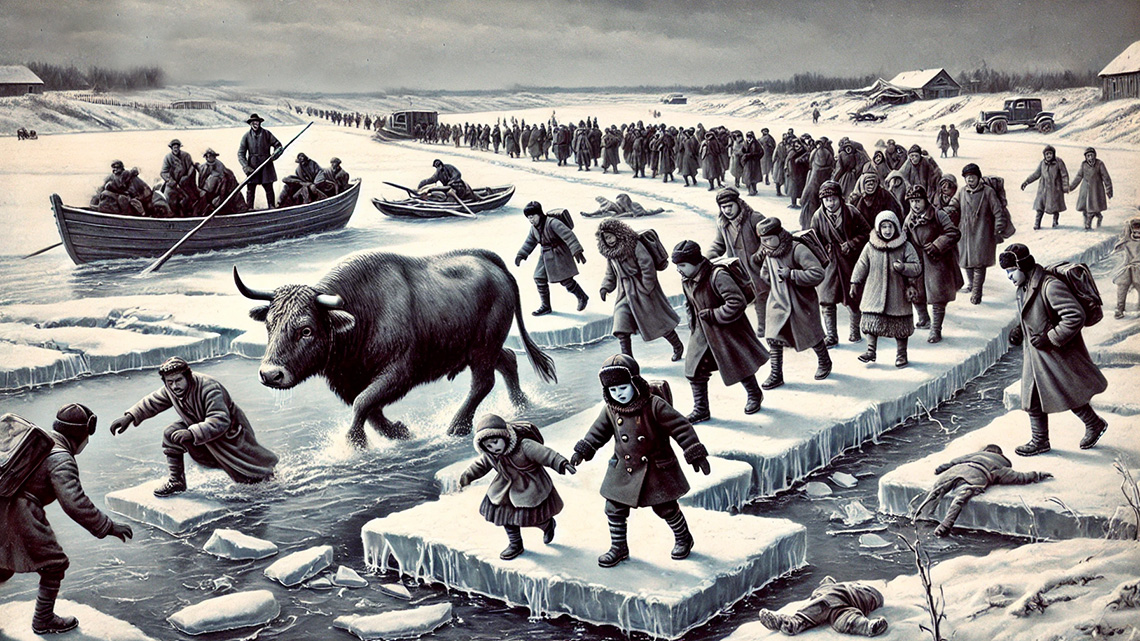
One Sunday afternoon, when the ice was already nearly detached from the shore, and the planks served as an approach to and from the ice, the ferrymen let two farmers with a large bull cross before us. This proved to be a reckless decision.
We children were already hesitant to step onto the planks, seeing the water beneath them near the shore. We were even more alarmed when we saw how the farmers struggled to get the frightened bull to step onto the planks. The bull eventually leaped onto the ice in panic. Fortunately, the ice held, and the ferrymen, relieved, began shouting at us for hesitating, claiming there was no danger.
Our parents, who had come to see us off, sensed our fear and waited to see us reach the other shore safely. We hesitated, waving to them—not just to say goodbye, but because we sought comfort in their presence. Most of all, we wanted to distance ourselves from the bull. We feared how they would get it back onto the planks and were unsure if the ice in the middle of the river was strong enough to support its weight.
The bull was massive, weighing around 700-800 kilograms. If its weight pressed on a small area—like a hoof—the weakened ice might not hold. If just one hoof broke through, the bull’s inevitable struggle could shatter the ice around it, endangering everyone nearby.
We students were consumed by this thought, fear gripping our bones. We exchanged nervous glances, trying to calm the younger ones. And then—it happened!
As the farmers reached the shore and tried to guide the bull onto the planks, it resisted. Just before stepping on the planks, or perhaps beside them, one of its legs broke through the ice. The terrified animal tore free from its handlers and began thrashing in the water, breaking the ice around it with every desperate jump.
We all instinctively ran toward the opposite shore, while our parents shouted in panic. Some people rushed onto the ice to calm us, while the ferrymen yelled at us to stop causing a commotion. In the end, we reached the middle of the river and stopped, watching anxiously to see what would happen next.
The bull, after much struggle, managed to climb onto the Bačka shore, though I do not recall exactly where it stopped. However, we later overtook it on the road to Stari Bečej.
The commotion lasted for over half an hour. Our parents and the ferrymen discussed how we should cross safely. Some mothers, who had come to see their children off, were more distressed than their already somewhat spoiled city children. They took them back home.
We, the village children, whose fathers had come to see us off—if they even accompanied us at all—crossed the ice with them, using newly placed planks about ten meters upstream from where the bull had broken through.
Our parents saw us off at the shore on the Bačka side. Though they parted from us physically, they followed us with worried gazes until we disappeared from sight.
Our father merely patted my sister and me on the head and gently said, “Hurry along so you don’t get caught in the dark.”
It was an unusual farewell for us. We were not used to his tenderness, nor do I recall him ever kissing us. Even when I left for the army, and later for war, I kissed his hand, while he only patted my head and said, “Safe travels.”
Such was the rural upbringing—not to show emotions, even when it was impossible to hide them. He had to remain reserved and composed, even in this situation.
Yet, despite that upbringing, his gentle words stayed with my sister and me all the way to Stari Bečej. They were with us constantly, and we obeyed. We hurried, but night still caught us near the Šlajz on King Peter’s Canal before reaching Stari Bečej. Still, we pressed on and made it safely to our lodgings.


Comments