



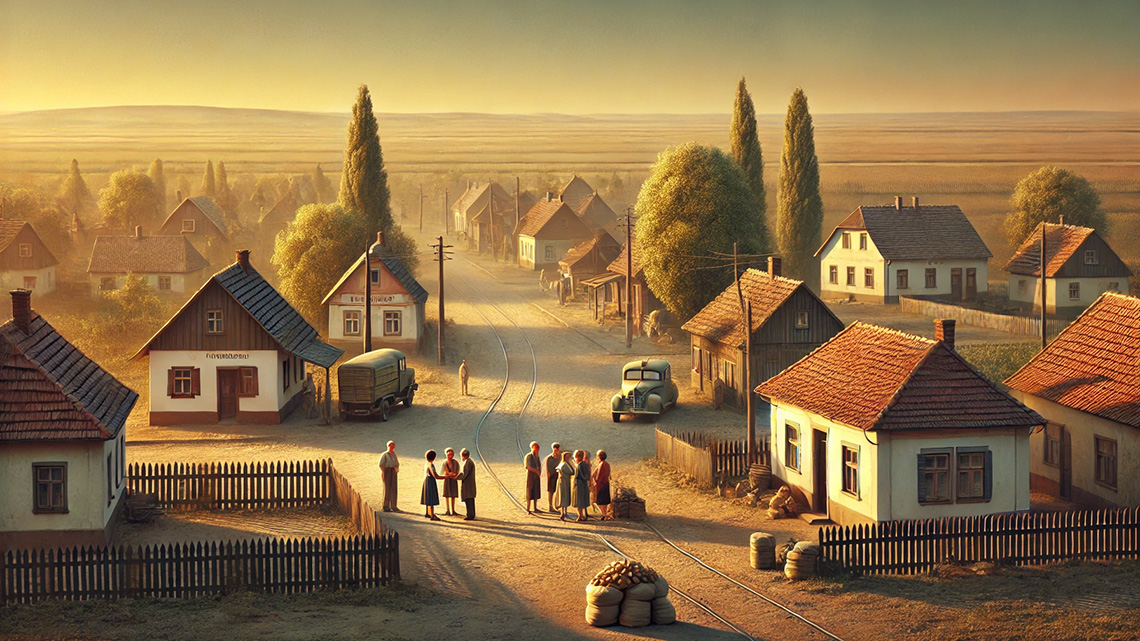
The memories of the people who surrounded me in my hometown are especially dear. Many of them have long passed away, but the beautiful memories remain, and I fondly and respectfully remember them.
Of course, I most often recall my friends from my youth. Our closeness was so great that we almost lamented the daily parting, even though we knew we would meet again the next day. Every outing to the streets of Novi Bečej or Vranjevo meant encountering familiar faces, whose warm greetings brought joy and satisfaction with every meeting.
Encounters with my dear friends, with whom I spent my boyhood and later youthful days, fill me with special joy, as we always reminisce about some delightful event from our long-past youth. Great pleasure also comes from meeting my peers from the area, such as Ivo Mišić, Dejan, and the now late Mile Gurjanov, even though such encounters are rare—perhaps making the joy even greater.
Unforgettable was my meeting at the Veliki Bečkerek (Zrenjanin) railway station on a July night in 1941 with the long-departed Uncle Vasa Mišić. I, traveling clandestinely, arrived by a night train around 10 PM from Belgrade, heading toward Novi Bečej. Uncle Vasa was waiting for a train to Belgrade, sitting on sacks of potatoes. Surprised to see me, his first words were: "Where are you going?!"
When I told him I was heading to Novi Bečej and then to hide in Dragutinovo with my sister, he was appalled at my naivety, exclaiming: "Don’t you know you can’t even step off the train without being arrested by the police? They’re waiting for you!"
He went to great lengths to explain the situation in Novi Bečej and convinced me to return to Belgrade, saying: "Only there can you save your life." I listened to him, and I’m grateful! Even now, fifty years later, I am still alive, perhaps thanks in part to Uncle Vasa’s help.
During the times I recall, the way we addressed older people was a reflection of warmth and closeness. For us, Uncle Vasa Mišić, Uncle Nova Trbić, or Uncle Arsen Pecarski could never be just "Mr. Vasa" or "Mr. Nova." At that time, in our hometown, we unconsciously did everything to bring each other closer, even in how we addressed one another.
Every older woman was called "Auntie," regardless of blood relation. This wasn't just about closeness but also reflected life’s realities. "Auntie" might not be a direct blood relative but could be someone who became close through marriage, unlike "aunt," who was always a parent’s sister and thus a blood relation.
I have never received a more beautiful, unforgettable greeting than the one from my neighbor. In my neighborhood lived an elderly man named Josimović. He was a church cantor, and his son, Stojan-Braša, was my childhood friend.
Old man Josimović often sat on a small stool at the corner of today’s Lole Ribara and Miloja Čiplića streets. Perhaps he sat there reflecting on his life, welcoming rare passersby with kindness. Whenever I greeted him, he responded warmly, saying: "May God grant you good health, my boy!" These words left such a deep impression on me that even today, when wishing someone well, I often use his phrase: "Good health."
Everything I have said about my hometown remains with me constantly. Even during times of concern for survival or family, and especially in these years when memories sustain us, I hold on to the people of Novi Bečej and Vranjevo with love. It pains me that I couldn’t show them this love more visibly.
It seems my attachment to my hometown has even wearied my sons. In 1988, my younger son, then 42, remarked:
"Well, Dad, if you love Bečej so much, why don’t you move there?"
He doesn’t understand that the Novi Bečej and Vranjevo I long for no longer exist. Most of the dear faces I cherish live only in my thoughts.
The Novi Bečej and Vranjevo I loved have mostly disappeared. Gradište is gone, as are Dudara, the old harbor, and its bustle. The clear waters of the Tisa, its rich fish life, the wildflowers, and the fragrant chamomile are no more. Progress has replaced well-loved traditions with modernity, and while I understand its inevitability, I cannot fully accept it.
Materialism now governs life, with profit outweighing humanity and emotion. This, perhaps, deepens my sorrow for the beautiful, warm way of life that is no more.
Still, my memories persist, keeping alive the Novi Bečej and Vranjevo of my heart.
Comments