



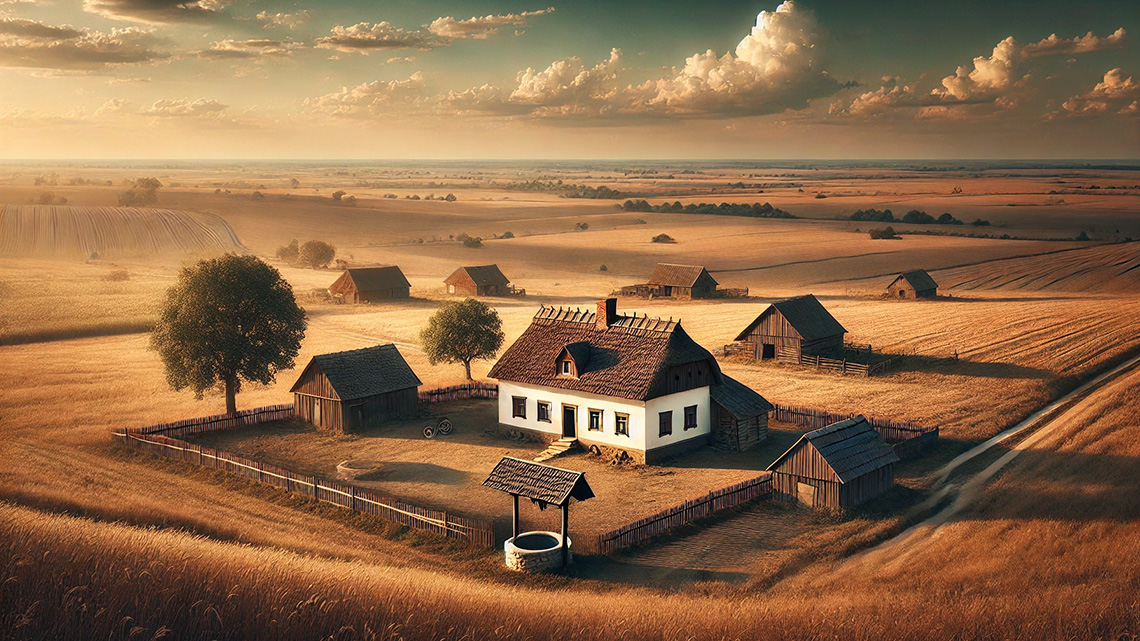
The word salaš is of Hungarian origin (szállás) and has been in use since the 13th century. Even today, numerous settlements in Hungary bear the suffix -szállás in their names, such as Kisújszállás, Jakabszállás, Kunszállás, Fülöpszállás, Szabadszállás, and others.
The term salaš refers to a rural dwelling with the necessary farm buildings, located away from settlements. Today, almost all Slavic nations use this word for such types of rural residences, while Hungarians adopted the Slavic term tanya, albeit with a different meaning. This word has likely been in use since the first half of the 18th century.
The earliest salaši were winter shelters for livestock, consisting of a hut where shepherds lived and an enclosure made of reeds and rushes for the animals. Over time, these winter shelters evolved into more secure and stable structures.
With the transition to agriculture, huts and dugouts were gradually replaced by adobe buildings, eventually expanding into multiple structures required for agricultural households.
The vast expanses of marshes, forests, and meadows, the sparse population of Banat, and the general insecurity under Ottoman rule forced people to live away from main roads, leading a kind of nomadic lifestyle. This way of life was unique in that even farmers lived in a semi-nomadic manner, as the term "nomadism" generally refers to livestock herding. Accordingly, the Hungarian dictionary A Magyar Nyelv Értelmező Szótára VI (Budapest, 1980) defines szállás as a "mobile settlement of a people leading a nomadic way of life."
This lifestyle persisted for quite some time after the expulsion of the Ottomans, lasting until the late 18th century. To facilitate easy relocation and settlement in new areas, people built temporary shelters such as huts and sheds made of wattle and reeds, as well as dugouts. These structures could be easily abandoned and quickly rebuilt elsewhere with minimal effort. There was no attachment to specific locations, as settlement was seen as temporary, lasting only until the land or pastures were exhausted. This mode of life may have been the precursor to the later salaši.
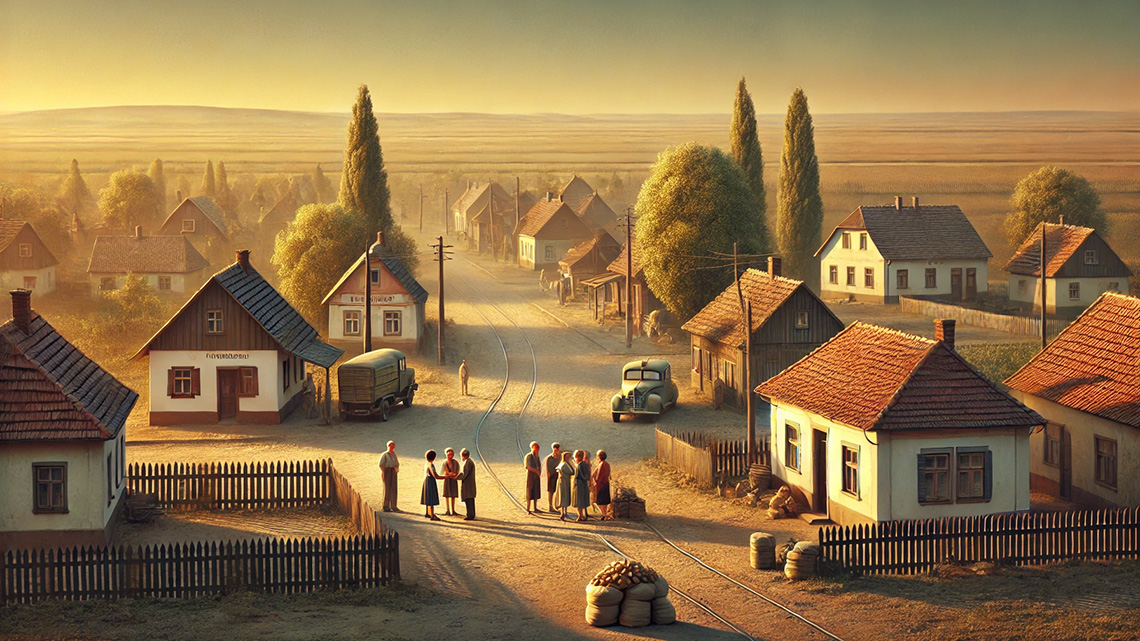
Following the expulsion of the Ottomans, the colonization of Banat aimed to establish planned settlements. Villages were arranged in rows (ušoravanje) and built on elevated terrain to avoid flooding, ideally positioned in the center of the surrounding farmland (hatar).
However, the idea of placing a village in the middle of its hatar was not always feasible, especially near large rivers. Many people settled along rivers due to the advantages they offered for livelihood, forming smaller or larger communities on the riverbanks. Since rivers made crossings difficult, especially for horse-drawn carts, settlements near rivers typically had their hatar on the same side of the river. As a result, such villages were often located at one end of their hatar, meaning that the opposite end could be more than ten kilometers away.
Significant changes in settlement construction occurred in the 1770s when authorities sought to standardize the layout of villages (ušoravanje). Baron Kotman, one of the planners of the colonization of Bačka and Banat, proposed that larger villages with more extensive hatar areas be created to reduce construction costs for churches, schools, and other public buildings. However, Empress Maria Theresa rejected this idea. Her advisors argued that farmland should be as close as possible to villages, making fields more accessible to their owners and facilitating easier cultivation.
According to a study by István Rácz, the economically viable radius for farming is up to five kilometers from a settlement. Any land farther than this requires the relocation of farm operations closer to the fields.
Although the Empress's directive was generally accepted, it was not universally implemented, particularly among the indigenous population. The rule was more strictly followed during the colonization of Germans, Slovaks, and Ruthenians, but less so for Serbian, Romanian, and Hungarian settlers, who often migrated spontaneously. As a result, many of their villages and hatar areas were larger, with fields located farther from settlements.
Land was allocated based on family size and was divided into whole, half, and quarter sessiones (sesije). A full sessio covered 37 jutra (a unit of land measurement), consisting of:
- 24 jutra of arable land,
- 1 jutro for housing,
- 6 jutra of meadows, and
- 6 jutra of pasture.
A half sessio had 21 jutra, while a quarter sessio had 13 jutra, following a similar division of land use.
To ensure land was cultivated, the authorities stipulated that if a recipient failed to work their land for two years, their holdings would be reduced to the next lower level (e.g., from a full sessio to a half sessio, or from a half to a quarter). In Banat, Serbs and Romanians were granted full sessiones regardless of family size, provided they cultivated the land within six months. If they failed, their holdings were reduced to the next lower level. This policy reflected the fact that Serbs and Romanians were more experienced farmers than the newly settled colonists and that they lived in large family cooperatives (zadruge), ensuring sufficient labor for farming.
It is worth noting that in places such as Novi Bečej and Vranjevo, land was not particularly sought after at the time. There are records of cases where even fertile land that had never been flooded was forced upon certain families. This was done not only to encourage land cultivation but also to secure state revenue through taxation, particularly toward the end of the 18th century when Austria was at war with France.
There were instances where individuals sought to rid themselves of allocated land, transferring it to others for minimal compensation—or even for free. Later, when land became highly valuable, their descendants tried in vain to reclaim it. One such case involved Živan Krompić from Vranjevo, who, on May 29, 1802, petitioned to reclaim a full sessio he had given to Timotej Janković of Vranjevo in 1794, eight years earlier, before the economic benefits of landownership became apparent.

Comments