



Our prominent writer, Isidora Sekulić, says about the homeland:
“Where is the homeland for people? It’s where others around them understand, completely and deeply, what they say, from the last external and internal tremor of their language, they understand what delights them and what hurts them.
If a people speaking another language takes over our field and village, the homeland for us is over; those who understand each other deeply and fully in their native language, when the pain becomes unbearable, move away. Where do they go? To a place where the local people understand, completely and fully, what the settlers are saying… The emigrants left their villages and fields, houses and cemeteries, but they carry their language in their bitterly clenched mouths, and wherever a word is spoken that is understood deeply and completely, that place becomes their homeland, and life."
With these inspiring words, our writer explained the concept of the homeland from a broader, national perspective.
It is my desire to express my own view of the homeland, as well as my feelings towards my homeland.
The homeland does not necessarily have to be what the poem says – the place of birth: where we first saw the world, took our first steps, and uttered our first words; where we began to discern and experience the sources of light and sound, and everything else that we first experienced in life. These are not remembered experiences, and thus we cannot perceive these places as something elevated and above all, our dearest.
If we soon after those first experiences left the place, it would never impose itself on our subconscious, nor would the memory of it stir us in any way. These first encounters are remembered by our parents and other older people in the household. They often recount these moments, reviving the memories, and it’s possible that some of us, still young but old enough to remember, subconsciously adopt them as memories.
There is no shortage of those who only think of their birthplace when they need to fill in the place of birth on a form. These are all those who left those places shortly after birth.
My experience tells me that the homeland is not the place of birth where I spent my first eleven years and where I finished primary school. All my memories of my birthplace – Kumane – are still fresh, and exclusively beautiful, yet Kumane is not my homeland. I love Kumane, but it mostly appears in my memories when I consciously wish to reflect on an event, which is not the case with Novi Bečej.
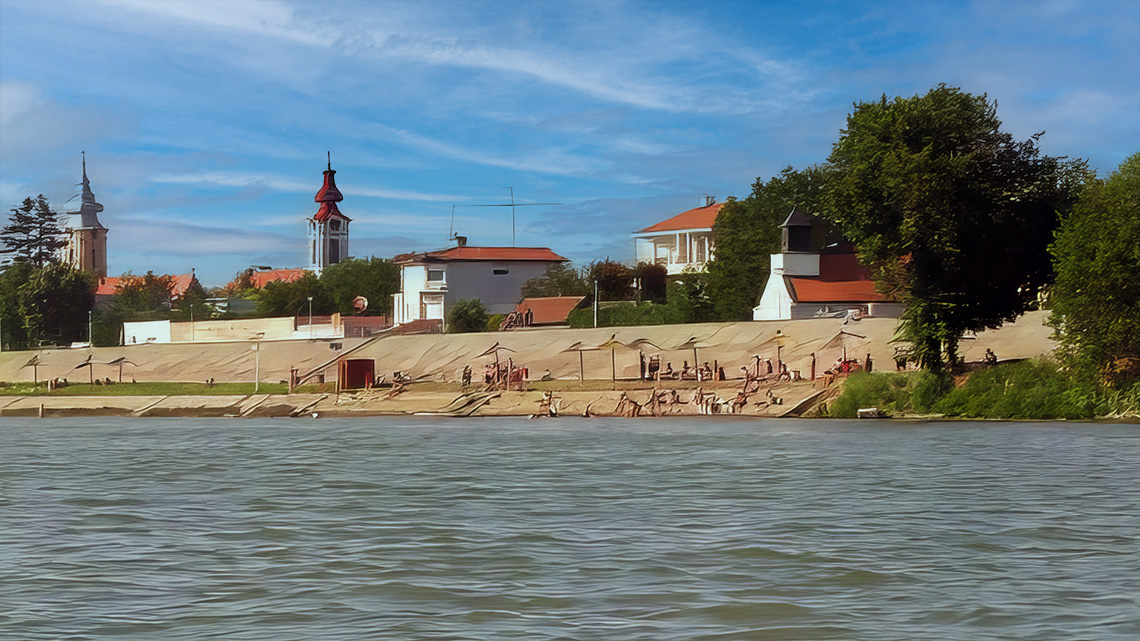
As for Novi Bečej, where I moved with my parents at the age of just under eleven, I feel more deeply connected, and thus I consider it my homeland. It is tied to me by all the visible, and even more so by the invisible threads, which are unbreakable for life. These threads wrap me so lovingly that I do not wish to free myself from them.
As the years go by and as I become more relieved from the “race” of life, the soothing comfort in these threads becomes more present and more pleasant. The older I get, the more the desire grows for Novi Bečej to be constantly with me, even when I cannot be there.
In moments of greatest exhaustion from worries or work, memories of my homeland and all the beautiful moments experienced there provide complete relaxation, and even more so, they act as a balm on a wound, a comfort that only a mother could offer with her gentle hand and even more soothing words.
A mother’s love, everyone would agree, is irreplaceable. However, there is an age, around twelve or thirteen years, until the formation of one’s personality, when we want to become more independent as quickly as possible, to free ourselves from our mother’s constant concerns. At that point, perhaps we give a part of our love to everything that surrounds us. This is certainly not tearing away from the love we have for our mother, but with age, our love likely grows and develops, and we offer this new, expanded part of it to: friends, hobbies, sports, writing, reading, fields, rivers, and everything beautiful that surrounds us. I believe that it is during this time that the love for our homeland develops most intensely.
Therefore, the homeland, simplified, is the place where we spent those years when we became independent and free from our mother’s embrace. Those years are etched deepest in our memories, and it is that strong embrace whose warmth and sweetness no one can, or wants, to free themselves from.
To confirm what I have just said, I will tell you about a meeting I had with one of our emigrants in Turkey. It was a Turkish man from Kosovska Mitrovica who, after the First World War – more precisely in 1921 – emigrated with his family and neighbors to Turkey and settled in Izmir. He became a religious official in the city administration, and the surrounding villages in Izmir were populated by our Muslims from Bosnia. There, many older women, even after thirty years of living in Turkey, still hadn’t learned Turkish, and even in 1953, they spoke Serbian-Croatian.
This former imam from Kosovska Mitrovica agreed in 1953 to be at the door of the Yugoslav pavilion at the Izmir fair, just to be with us. His presence was valuable because he also served as a translator during communications between our exhibitors and the regular visitors of the pavilion.
In a conversation I had with him, he once said to me:
- Ah, if I could just save up enough money to visit my homeland one more time before I die.
To my remark – isn’t this your home?! – referring to Turkey and Izmir, where he had lived for over thirty years, he sighed and answered – No! This will never be mine! My home is there, in Kosovska Mitrovica!
I believe that this is the most striking confirmation of my understanding of the homeland. I used this man from Kosovska Mitrovica as a foundation for my own opinion on the matter.
Everyone feels love for their homeland, although there are those who hardly feel it, because they weren’t lucky enough to stay in one place for long during the mentioned age, instead moving from place to place. Their love is “parcelled” and tied to individual places where certain experiences occurred.
Attachment to the homeland is not expressed with the same intensity in every person. It depends not only on the emotionality of the individual but also on many other factors: how long and how far one lives away from the homeland, age, family life, and so on. One thing is certain: the older a person gets, and when their perspective has mostly shrunk to waiting for the end of life, memories become their main companion, and the homeland becomes ever more present.
Those who live in their homeland do not feel its warmth fully because they do not think about it. They do not need to, as everything around them in their daily life is their homeland, and its blessings are continuously present.
Comments