



Reflecting on my journey aboard the "Miroslav" ship, I recalled two uncomfortable moments I experienced on the Tisza. They weren’t tragic, but they were thrilling enough to remain unforgettable to this day.
In my memories published in the book "Charms of the Past", I wrote about the Tisza, of course, focusing on its beauty, but I also mentioned that almost every second or third year, it would flood our beautiful Gradište, spilling over into Ljutovo, transforming it into a kind of sea. From Stari Bečej to Vranjevo, everything was underwater. During these times, the residents of Vranjevo, who usually walked to Stari Bečej via Ljutovo, had to take a detour by boat across the Tisza near Novi Bečej. The route via Ljutovo was a significant shortcut, halving the distance from Novi Bečej to Stari Bečej compared to the one taken by boat or along the Tisza riverbank from the Bačka side. When the Tisza swelled and flooded Ljutovo, there was no other way but to take a boat at the ferry in Novi Bečej and then walk along the Bačka riverbank to Stari Bečej.
Similarly, when the Tisza was frozen, or when the boat didn’t operate for any reason, we students would walk through Ljutovo, racing to reach Vranjevo as quickly as possible. The route from the Vranjevo dolma to our farmstead was longer than the one from Stari Bečej to Vranjevo.
In the spring of 1932, the water was exceptionally high, and the boat couldn’t dock at the Novi Bečej pier. During this time, we stayed in Stari Bečej, and only on Saturdays would we go home, returning on Sundays.
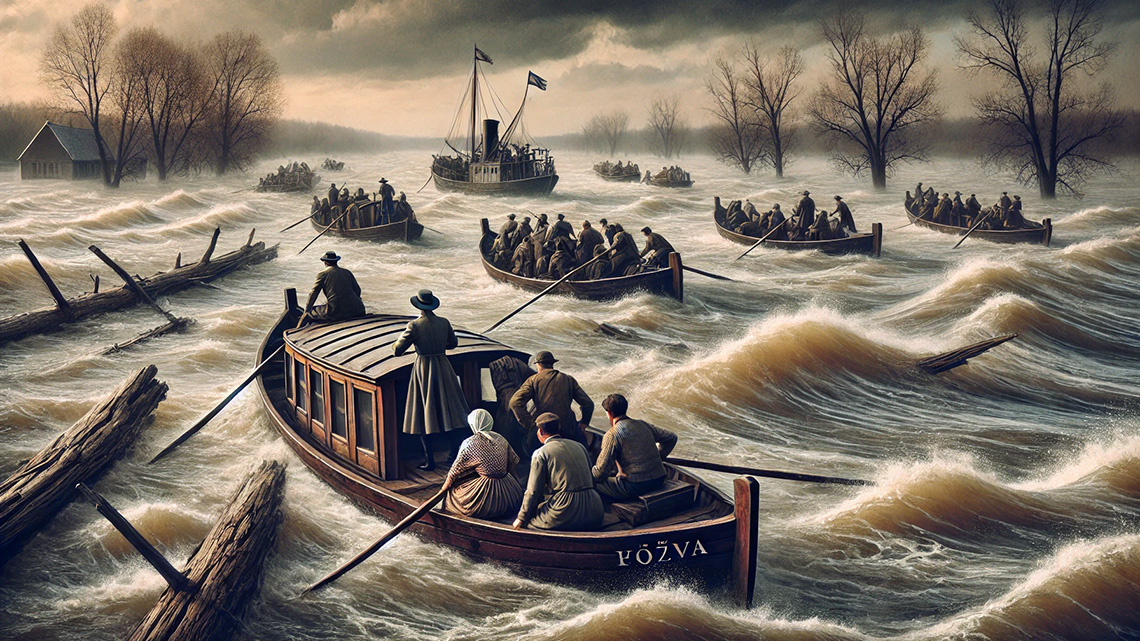
It was March, a sunny day, though it couldn’t be called pleasant because an exceptionally strong košava wind was blowing. The Tisza had flooded from one dolma to another, and near Novi Bečej, where the ferry usually crosses, the width of the river was 1,680 meters. The wind was howling, the water was high, and the waves, especially near the shore, were enormous, perhaps even over a meter high.
As soon as school ended, on Saturdays we only had morning classes, we waited for each other, and in a "crowd," we set off against the strong wind, heading towards Novi Bečej. We hurried to cover the long distance of ten, maybe even eleven kilometers. The younger students, from the first and second grades of high school, struggled to keep up with us, crying because they couldn’t match our pace. They ran after us, whining, but we were relentless, determined to reach the ferry as quickly as possible, and this time, the boat.
When the water was this high, the ferry didn’t operate, and pedestrians were transported by boat. A large ferry boat was waiting for us, capable of carrying around fifteen passengers, but this time, only us students were there, and others who had been waiting for a while. The boat also carried the owner of the ferry, Paja Janković, who was there for his son Ivica, one of our schoolmates.
We boarded first, but the others didn’t want to stay on the shore, as the wind was cold, and the boatmen weren’t eager to sail across the wide Tisza in such weather with such big waves for only one dinar per person. As a result, the boat was overcrowded, carrying double its capacity. It sank so low in the water that only about twenty centimeters were left above the surface.
Before we had even left the shore, everyone held their breath, and we feared the worst. The waves seemed to grow larger the farther we got from the shore. It wasn’t just our imagination; they really were bigger because all the water in the flooded part of the river was stirred and in motion. The force was immense, and our boat, so small and fragile in comparison, seemed powerless against it. Even under normal conditions, and especially now, when nearly every wave splashed over the passengers and settled in the boat.
We were all nervous! The girls started crying, and Paja Janković cursed: “Shut up, for God’s sake, don’t scare the other kids!” Imagine the irony! He wasn’t thinking about the danger when he was accepting passengers, securing the boat’s stability. No, he feared that if someone moved too freely or panicked, it could lead to a disaster.
We endured and feared what awaited us when we reached the Tisza’s bed. What would the waves be like in the middle? We trembled, but also reassured ourselves, reasoning that if the older ones weren’t scared, we shouldn’t be either. They weren’t complaining, so why should we? We waited, anxiously, expecting something even worse, and figured that only then would we all start crying together.
The boatmen were experienced and knew how to steer the boat to avoid the side impact of the waves, reducing the splashing. If they hadn’t had that skill, I doubt many of us would be alive today. I’m not talking about now, but about that moment. We were all wet, but no one was cold. What is cold compared to the fear of what each of us expected in the middle of the Tisza?
Then, miraculously! As the boat entered the riverbed, it seemed as though the wind had stopped, and the waves became smaller than in the flooded shore area. We couldn’t believe we had reached the riverbed because the fear of encountering it had confused us so much that we lost all sense of direction. The dread of the worst was still with us. We listened carefully to what the older ones were saying and heard the boatmen talking to each other: “Only when we reach the riverbed!” That meant they weren’t afraid of the river’s depth, but of the flooded part where the wind stirred the water from top to bottom, making the waves bigger and stronger. In the riverbed, where the depth was 9.7 meters during high water, the boat could only move the surface layer of water, while the water below just swayed, acting as a kind of shock absorber, reducing the turbulence.
What we heard—the boatmen’s sigh of relief when they reached the riverbed—was not only calming but utterly soothing. We weren’t afraid of the hazard in the flooded part because the water there was only about one to one and a half meters deep, but in the riverbed. We all brightened up at once, even though there were still about two hundred meters of flooded water before the Novi Bečej shore. We were proud that we hadn’t complained and even felt satisfied that all of this had happened to us. While our parents embraced us tearfully when we reached the shore, we felt like little heroes in trouble.


Comments