



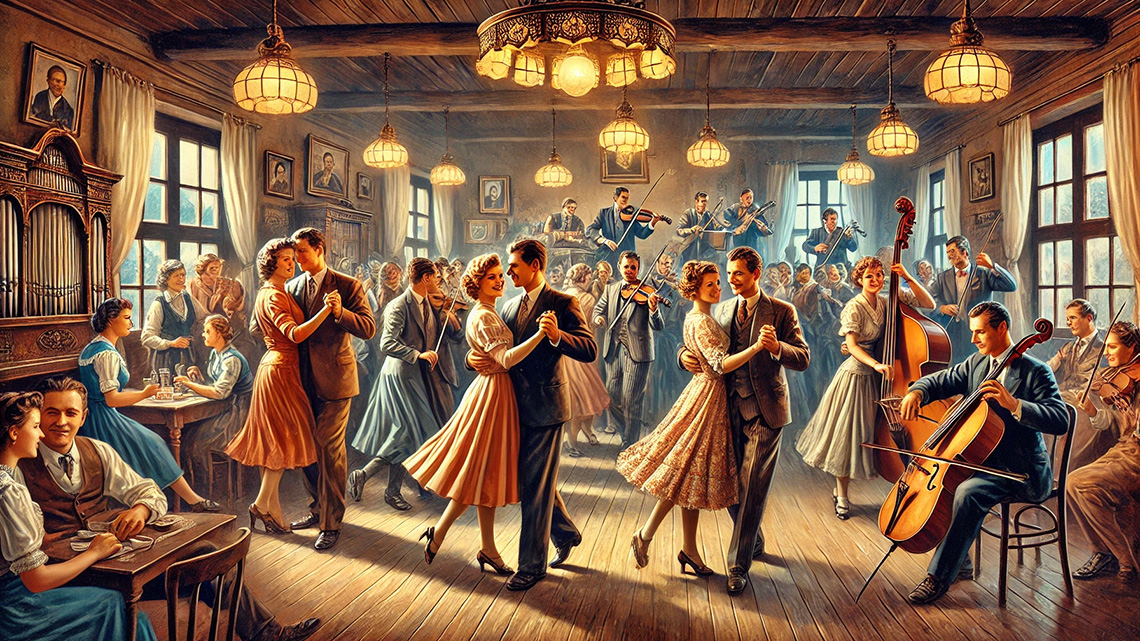
It’s pleasant to recall the wonderful and unforgettable dances at the Sokolana, or at the “kolo”—as the dances held in taverns were called—at Uncle Arsen Pecarski's and Uncle Nova Trbić's place in Vranjevo. It was so beautiful that now, I feel as though in those youthful years, we lived for nothing else but that.
The dances were held every week, but that wasn’t enough for us; we eagerly awaited a holiday in the middle of the week, just to have another dance. We enjoyed the music of two great orchestras. I don’t know if the orchestra led by Milan Krompić—Krompe, at Arsen Pecarski's place, played better, or if the Trade Youth Orchestra, led by Janoš Senji, at the Sokolana did.
The Trade Youth Orchestra felt more intimate, and with almost every tango, waltz, or foxtrot, the members of the orchestra also sang the appropriate lyrics, creating a special atmosphere. Their songs were “hummed” by everyone who danced. Of course, those who could sing well, whether men or women.
What the professionals in Milan Krompić’s orchestra could not do was create that kind of mood. They were more suited for those who liked to party, but usually, that also marked the end of the dance.
There was one more orchestra, even better than the two, and that was the string orchestra of Pišta the Gypsy, but it mostly played Hungarian Gypsy music and would play a few dance tunes late into the night. This orchestra performed every evening, except Mondays, at the “Vojvodina” hotel tavern.
In addition to the attraction of a good orchestra, the Sokolana also had an exceptional hall with a well-maintained, polished parquet floor, which was sprinkled with paraffin before each dance to make it even more slippery. None of the mentioned taverns had that, and I wouldn’t even mention the others. Still, the Sokolana was not as attractive as the dances—the kolo—at Arsen Pecarski's tavern. This kolo had its own unique charms.
The kolo at Arsen’s offered a showcase, not only of modern fashion but also a more significant display of beautiful, healthy, village girls. In those years, the young women in the surrounding villages were not as beautiful and elegant as those in Vranjevo. I’m not biased, especially not today, but having known the kolo in Kuman, Beodra, Dragutinovo, and even in Melenci, not just in the tavern but also in the hall of the Rusanda spa, I can say that the girls from Vranjevo were the most beautiful, the most elegant, and probably the proudest as well.
There were more than a dozen true beauties at the kolo at Arsen’s, and even today, I wouldn’t be able to decide who was the most beautiful. I could say which one I liked the most, but that doesn’t mean she was the most beautiful.
How beautiful and elegant were the two neighbors and inseparable friends, Gordana Glavaški and Jelka Nešić, but they were by no means outdone in beauty, especially in elegance, by Draginja Gedošev and Nevenka Nešić, or Dada Milankov, Zorka Bunjevački-Čanadski, Milena Cvejin-Gačić, Jelka Mišić, the two Kovačev sisters, and many others.
Because of their beauty, above all, and their elegance in dressing, their modest but proud posture, one had to attend the kolo. They were so beautiful that they inspired awe, especially among the younger ones, whenever they decided to approach them and ask for a dance. They seemed aware of their virtues and behaved accordingly—proud, but not to discourage, and certainly not to humiliate their dance partner, only to convey that mutual respect was the only acceptable behavior.
Many of them had their boyfriends or admirers, but that didn’t prevent them from politely accepting a dance invitation from anyone else. It was as if they all knew that only by respecting others’ dignity could they ensure respect and admiration from everyone in the kolo.
Vranjevo also had its share of strong, healthy young men who behaved decently at the kolo. Even when they were partying, they were on the level—just as the people say—“they knew how to party.”
What these Vranjevo beauties meant to the kolo, I’ll try to express through the lens of my emotions at the time, if I can still recall them faithfully. Most of the men at the kolo, as soon as they arrived, first looked around to see if the mentioned beauties had already arrived, and they knew who was still expected. Because of that, many eyes were often fixed on the entrance doors. The absence of any of them wasn’t just noticed; it meant a diminished charm of the dance. This was especially apparent when the dance was held on a smaller holiday, and for whatever reason, some of them were absent. In such cases, the dance lost its appeal. A good number of the young men would leave the dance, head to the card-playing area, or leave Arsen’s tavern and head to Novi Bečej for a stroll.
It may seem exaggerated, the role of the beauties of Vranjevo in the richness and charm of the dance, but that’s how it was, and this impression was probably also influenced by my own clumsiness in portraying it more realistically. Perhaps with a more moderate outpouring of enthusiasm, but even after fifty-plus years, when I think about it, I can’t seem to find the right measure, and I feared that even when I started describing the dances.
That the role of these girls was decisive for the charm of the dances, I can confirm with the example of the Novi Bečej Sokolana. If the following girls were at the dance in the Sokolana: Ljubica Kiselički, with her constantly smiling and bright face, Slavica Igrački, Melanija Garčev, Zorka Velisavljević, and some of their other close friends, the hearts of all the young people, especially the members of the Trade Youth Orchestra, were filled with joy and satisfaction. The orchestra played with great enthusiasm, almost without interruption, but if they were absent, the orchestra’s mood would also fall, and it seemed that the dance itself lost its true charm and cheerfulness.
It wasn’t just their appearance that gave the dances their charm, but their cheerfulness, and especially their camaraderie and friendship that could be felt at every step. They treated everyone who approached them and invited them to dance (or to the kolo) with such warmth.
This was likely true at Sele Nićina, Laslo, Kruna, and all the other taverns where dances were held.
With these memories, I wanted to present the dances I attended most often, and how I experienced them, or rather, how I remember them today, more than fifty years later.


Comments