



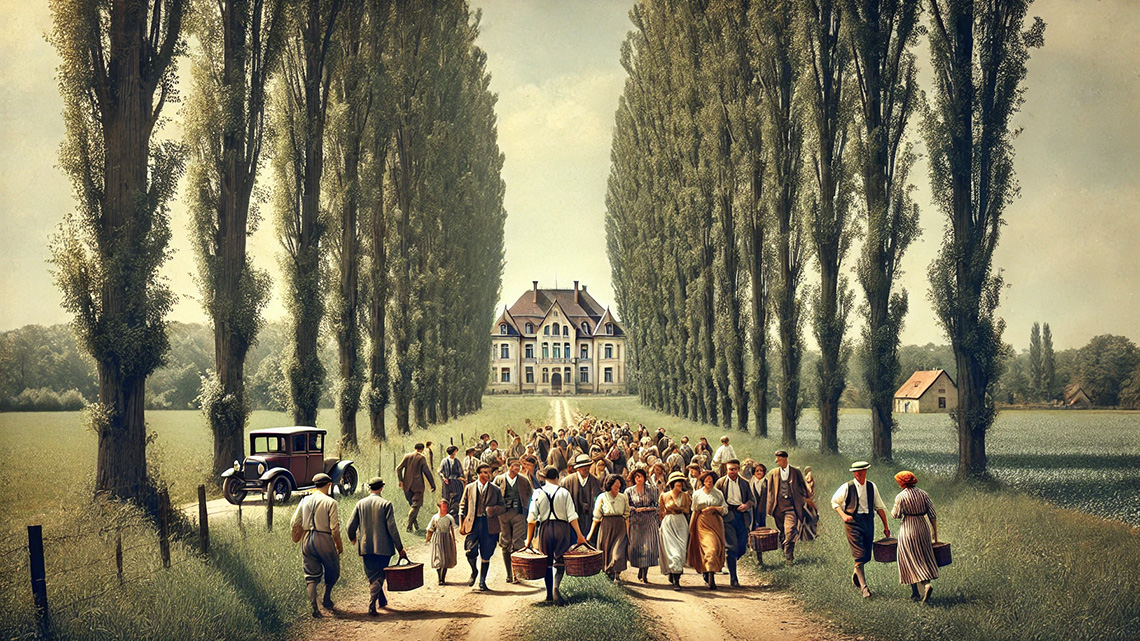
As the years went by, I wanted to pass on my love for nature to my older friends and join together for excursions around the surroundings of Novi Bečej and Vranjevo. However, it wasn’t easy, as, as I mentioned earlier, there were no established traditions.
My persistence eventually paid off. First, our friends from the Sokolana joined: Ljubica Kiselički-Boškov, Melanija Garčev-Boškov, Zorka Velisavljev-Petrović, Slavica Igrački-Jovanović, Nada Peskarov-Velisavljev, followed by members of the tambura orchestra of the Trade Youth: Joca Ćurčić, Branko Petrović-Cifrić, Mile Jovčić, Slavko Kiselički, Miša Tašin, and later the octet members and many others.
Thus, in the second half of May 1937, organized by some members of the Trade Youth and the Sokolska society, we visited the estate of Emilija Ivanović (Sokolac). The estate was more than 4 kilometers away from Novi Bečej, which meant we had to walk about 10 kilometers, both on the way there and back. Although not accustomed to such long walks, everything ended joyfully, beyond all expectations.
This successful trip opened up the prospect that such excursions would become a regular part of the lives of the youth from Novi Bečej and Vranjevo, but unfortunately, not for long.
The group of about forty of us left for the Ivanović estate at 1 PM from the Novi Bečej Sokolana, on a beautiful and sunny May day. Before we left, we were given snack packages, two sandwiches each. When registering for the trip, every participant paid 2 dinars, which were used to buy salami and bread, from which the girls made about eighty sandwiches. Even those 2 dinars per person were more than enough to cover the cost of the sandwiches, and the remaining money was used to buy 10 liters of wine from the Ivanović cellar.
With singing and music, we walked past the Novi Bečej municipality, then the bakery of Mladen Nastić (where the Workers’ Home is now), climbed the dolma, and continued briskly down the dolma towards something that was, for many, unknown. The sun and walking did not tire our travelers, nor did they sway their hopeful spirits. Everyone hurried to reach the estate as quickly as possible because most had never been there and couldn’t imagine how nice and prosperous the estate would be.
With singing, jokes, and cheerful teasing, we left Novi Bečej, surprised by how quickly we found ourselves in front of Marković’s homestead. We passed Vase Glavaški’s farm even faster, then the vineyards with modest but charming little vineyard houses (shacks), which stretched nearly all the way to the road leading to the Ivanović estate.
The cheerfulness was enhanced by the beauty of nature. To the right, the Tisa river with its willows, the scent of freshly mown hay along the entire dolma, and to the left, the vineyards. If you looked south, the view opened up all the way to Kumanovo.
On that vast expanse, our eyes could rest on the endless green of the wheat fields and rows of newly sprouted corn or sugar beets. Everywhere, diligent farmers were working tirelessly, despite the May sun, to tend to the corn. There was no choice for them; every task had to be finished on time, so they were eager to make the most of every beautiful day.
Just as the sun’s rays began to tire our travelers and the song grew quieter, we reached the Ivanović road. This road, though not what one would call a “wide royal road” as Mitke describes in the play Koštana, was exceptionally beautiful. It was so romantic that it could be said it was rarely seen. As one turned left from the dolma and stepped onto this wonderful road, one began to breathe differently, as if stepping into another world full of freshness and silence.
On both sides of the road were centuries-old poplars, whose trunks were 1.5-2 meters in diameter, and their crowns intertwined over the entire length of the road, shading it completely for over 2 kilometers. One couldn’t decide what to admire more: the thick trunks of the individual poplars, their even larger and more beautiful crowns that shaded a vast area, or perhaps the very road and the fresh air.
On this road, the sun never dried the path enough to create dust, and the dust from the dolma road couldn’t fall on the Ivanović road due to the density of the crowns and leaves. These beauties could not leave our travelers indifferent, and they eagerly ran down from the dolma to reach the shade of the poplar trees.
We joyfully walked along the road, which was so well packed by the wheels of carts that it was even more pleasant to walk on than asphalt since it was somewhat softer. However, the road seemed to stretch on. Yet, despite the unfamiliarity of such long walks, no one complained of fatigue, though it slowly, but inevitably, overcame each of us. The jokes and songs continued but became quieter and less intense.
Fortunately, the greenery of the estate with the mansion and the surrounding forest was almost within reach, which was a great encouragement to maintain the cheerful mood.
We arrived at the estate yard. The singing stopped, and we all became speechless, amazed by the large, beautiful park and the mansion surrounded by boxwoods of unprecedented height and various types of fir trees. We breathed deeply, and perhaps the fresh air “cleared” us, for we suddenly felt hungry. Everyone unpacked their sandwiches and ate them as the greatest delicacy. Sitting or lying on the grass in the park, we all shouted together: “Music, music!” Music played, and the singing resounded so loudly that the whole forest around the park echoed.
Unfortunately, it soon became cloudy, and a real spring rain began to fall. But even that didn’t spoil the cheerful mood of the travelers. We took shelter under the large covered terrace of the mansion and enjoyed watching the heavy and frequent raindrops bending the tree branches under their weight. Soon, little streams began to form, flowing down the paths of the park toward the road, where they were directed by a designated ditch into a large canal behind the park.
Luckily, the rain didn’t last long; after all, these spring showers are usually brief. After the rain stopped, the first 5 liters of wine arrived, bought from the estate, further encouraging music and dancing.
The music for dancing, as usual by the Trade Youth orchestra, was accompanied by songs for tango, waltz, or foxtrot, and this time, everyone sang, including the orchestra, the couples, and even those standing on the side, just like in the Sokolana. It turned into a real celebration.
The dance party lasted until 6 PM, which was when the planned departure time was. The music stopped shortly after 6 PM, and we all shouted in unison, “More!” Everyone wished that the joyful mood would continue forever. But everything has its end, and so did the beauty experienced on our first big excursion.
The organizers of the trip had visited the estate a day or two before and made arrangements with Uncle Šandor Živanović, the “Išpan” (manager), to allow us to spend time in the park in front of the mansion, to tour the estate, and to buy 10 liters of wine, which they normally didn’t sell on the estate. Of course, Uncle Šandor conditioned all this on our respectful behavior. That he was pleased with our conduct is shown by the fact that he allowed us to use the mansion’s terrace after the rain for the dance party.
On our way back, along the wet and muddy road, the jokes and songs continued. Perhaps, thanks to the freshness and half-muddy road, the fatigue didn’t seem so overwhelming. We arrived in Bečej at dusk. We hurried to our homes to clean the mud off our shoes, wash up, and meet at the promenade. There, in smaller groups, we recounted the events, the beauty, and the little mishaps caused by the rain, before everyone gathered at the Sokolana, where we continued the dance.
Everyone spoke with enthusiasm and vividly recounted their experiences from the trip. What excited our travelers so much? There’s no doubt that the beauty of our fields in spring, the Tisa riverbanks, and the unforgettable scent of freshly mown hay along the dolma were at the top of the list. Then, the previously unseen towering poplars that shaded the “royal road.” The pleasant surprise was the wealth and well-maintained estate, the forest, the beautifully maintained park, and the luxurious mansion. The large barns and buildings where the workers lived left a lasting impression. The impressive oxen with their large horns were also unforgettable. Everything was unusual and left such a mark that it was discussed for many days after the excursion.

Comments