



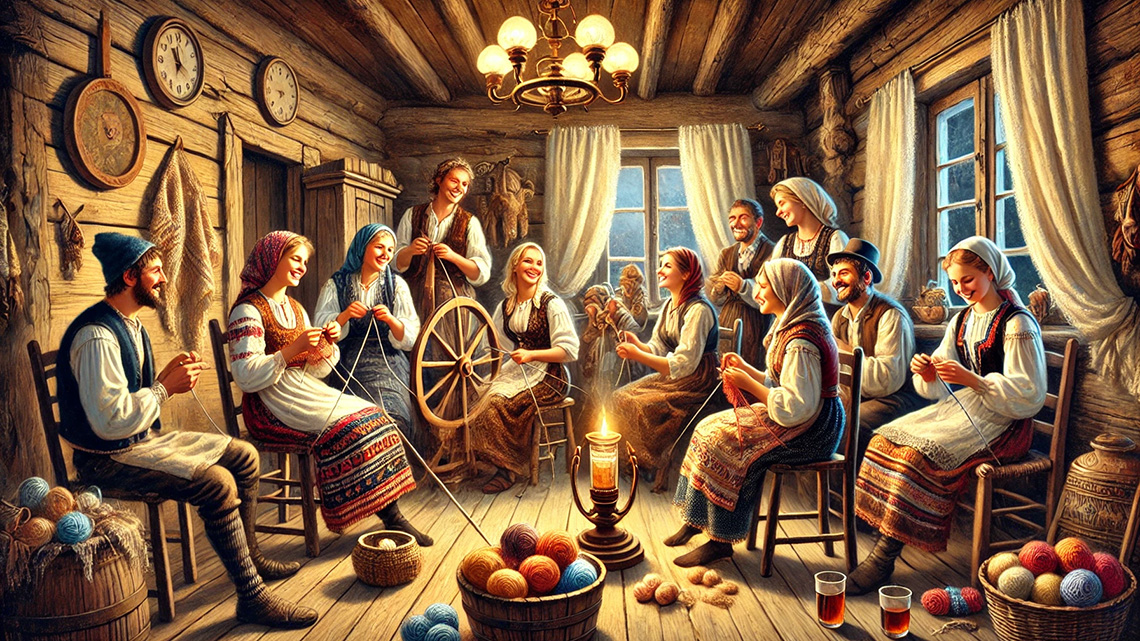
The very name of these gatherings suggests that they were created so that women could gather in the autumn and winter evenings to talk about everything that had happened in the village while spinning with a spindle. Once they exhausted the stories of events that had taken place during that time, they would tell folk tales. When the storytellers "ran out" of stories, the conversation would turn to songs, and this cycle continued from one gathering to the next.
Later, during the prela, socks were knitted, and sweaters were crocheted, meaning that the gatherings also became open to younger women: girls, newlyweds, and other young women. As soon as young girls and women began to attend these prela, they became attractive to young men, particularly. They came to entertain the young women with stories and jokes while they spun, knitted, and crocheted, and later sang together.
This went on for years, with jokes and songs increasingly replacing the women's handwork. The women wanted to be as active in telling jokes, singing, and participating in the games that the men played while they knitted and crocheted.
Over time, prela completely changed their purpose. Not only did the spindles and knee protectors disappear, but so did the knitting needles and crochet hooks, and the prela became solely a social entertainment for the young people.
Besides economic benefits, prela also had an educational role, as books that had been read were recounted and songs were learned. Later, they became social gatherings where new acquaintances were formed, often leading to marriages.
My goal is not to analyze this transformation of the prela, but to show how they looked in the time I am recalling, and to convey the modesty of these and similar gatherings, preserving them from being forgotten.
Prela were held in the autumn and winter evenings to welcome a bride-to-be as a guest. The hosts, with the help of the girls from the neighborhood – who would later be the hostesses, friends during walks in the promenade, dance events, and so on – would organize the prelo.
The girls and boys invited were those closest to the bride-to-be, or the girls who were considered the hostesses, meaning they were the ones practically organizing the prelo. Typically, about 8-10 boys and a similar number of girls would gather.
The host of the house where the prela took place – usually the person who hosted the bride-to-be, would prepare a bottle of homemade rakija, and the hostess, along with the bride-to-be, would cook corn and prepare a bowl of popcorn to welcome the guests. On occasion, the hostesses might also prepare doughnuts, though I was usually unlucky to attend those particular prela. It seemed that on those occasions, when I was absent, either by choice or by the organizer's will, doughnuts with apricot jam would appear, which were a rare treat at the time.
A typical prelo would last from 6 to 9 PM. It began with jokes, as people settled into their seats, deciding who would sit next to whom, with the boys giving compliments to the bride-to-be, often accompanied by humor and laughter.
A prelo would not be successful or unforgettable without a young, skilled person in the group who directed the mood. Based on personal experience, they knew how and when to start an activity, when to stop a particular type of entertainment, and when to start a new one. They did not act based on their own desires, but on the wishes and moods of the others, meaning they knew the group well, or were excellent psychologists who could sense the mood of the crowd and tailor the entertainment accordingly.
In our group, that was Vasa Martić, an assistant in the ironmonger's trade, known as Vasa Knefeli in Novi Bečej and Vranjevo. Everyone knew him as Vasa Knefeli, although he had recently worked at Janko Glumac’s ironmongery before leaving Novi Bečej. Vasa was very adept in social settings, a member of the Sokolski Society, and a leader for future generations. He played football, excelled in traditional folk dancing, and was, in short, a cheerful and social person, well-liked and respected by both young women and men.
We never started a prelo without Vasa, and his role was appreciated by all the girls in our group. Because of this, he could never be left out. I still remember one prelo where Vasa was the "conductor" – it was unforgettable. It was held in honor of a charming girl from Melenac, Olgica Šoljina. We eagerly awaited her arrival because she was lively, always smiling, and could talk to anyone in a way that suited them. If it was a joke, she would accept it, but we all knew it had to be in good taste, as Olgica would not hesitate to "polish" anyone who tried to take advantage of her friendliness and sense of humor.
Melanija Garčev, later Boškova, organized the prelo at her parents' house, and I believe Olgica was their guest.
After telling the latest stories and jokes about the boys present, much laughter followed by dancing would begin.
Vasa would take his handkerchief, twist it into a whip, and ask the hostess for a button from a shirt. We would each place our fists on the table, thumb and index finger pointing upwards. Vasa would take the button and place it between his thumb, index, and middle fingers, then move from one fist to another, leaving the button in one of them. Of course, no one but Vasa and the person whose fist held the button could know where it was.
After completing the circle of fists, he would open his hand to reveal the button had been left in one fist, and one of the boys would have to guess which fist it was in. This required careful observation of body language to detect any signs of nervousness, though everyone pretended to be nervous, while the person with the button tried to remain as calm as possible.
Most of the time, the guesser would be wrong, which was statistically logical. With ten people playing, there was only one person with the button, so the guesser had an 8 in 9 chance of being wrong.
For the wrong guesser, Vasa would deliver a humorous speech, accusing the "innocent" person, and they would have to "wash away the shame" by determining how many times they would be whipped with the handkerchief.
The game would continue until the correct guess was made, and then the person holding the button would take their turn to guess.
Another popular game was the "poor uncle" game. Small slips of paper would be cut, each labeled with a role. For example, one would say "poor uncle," another "thief," another "gendarme," and so on. Vasa would mix the slips in a hat, and each person would draw one. The person with the "poor uncle" slip would lament, "I am poor, my ox was stolen..." and the others would try to guess who the thief was, a game of probability with the same rules as the button game.
The most cheerful game was the "fota" game. Each participant would place an object on the table as a "fota," and one person would face away from the table. This person would then pick an item and assign a task to the owner of that object, such as fetching water from the well or kissing someone three times on the cheek. This game was the most lighthearted, especially when the person assigning tasks was witty and skilled in creating fun.
The time at the prelo would pass so quickly that everyone would be surprised when Vasa would announce, "It's half past eight, time to thank our hosts for their hospitality and wish the girls a pleasant sleep, as tomorrow we need to get up for work!" Although the girls, especially those who felt like hostesses, would try to stay longer, Vasa would insist on ending the evening. Perhaps the charm of the prela was precisely in knowing when to end, at the right time.


Comments