



In Novi Bečej, even before the establishment of the Yugoslav Bowling Federation in Belgrade, there was already a very active bowling section. There is no written record of when the bowling section was originally formed, but based on documentation preserved and made available by the well-known collector from Novi Bečej, Andre Karolj, it is evident that since 1948, within the Unified Physical Culture Society “Zvezda,” in Vološinovo (the post-war name for Novi Bečej), alongside football, basketball, table tennis, swimming, and chess sections, there was also a very active bowling section.
Bowling Club “Zvezda”
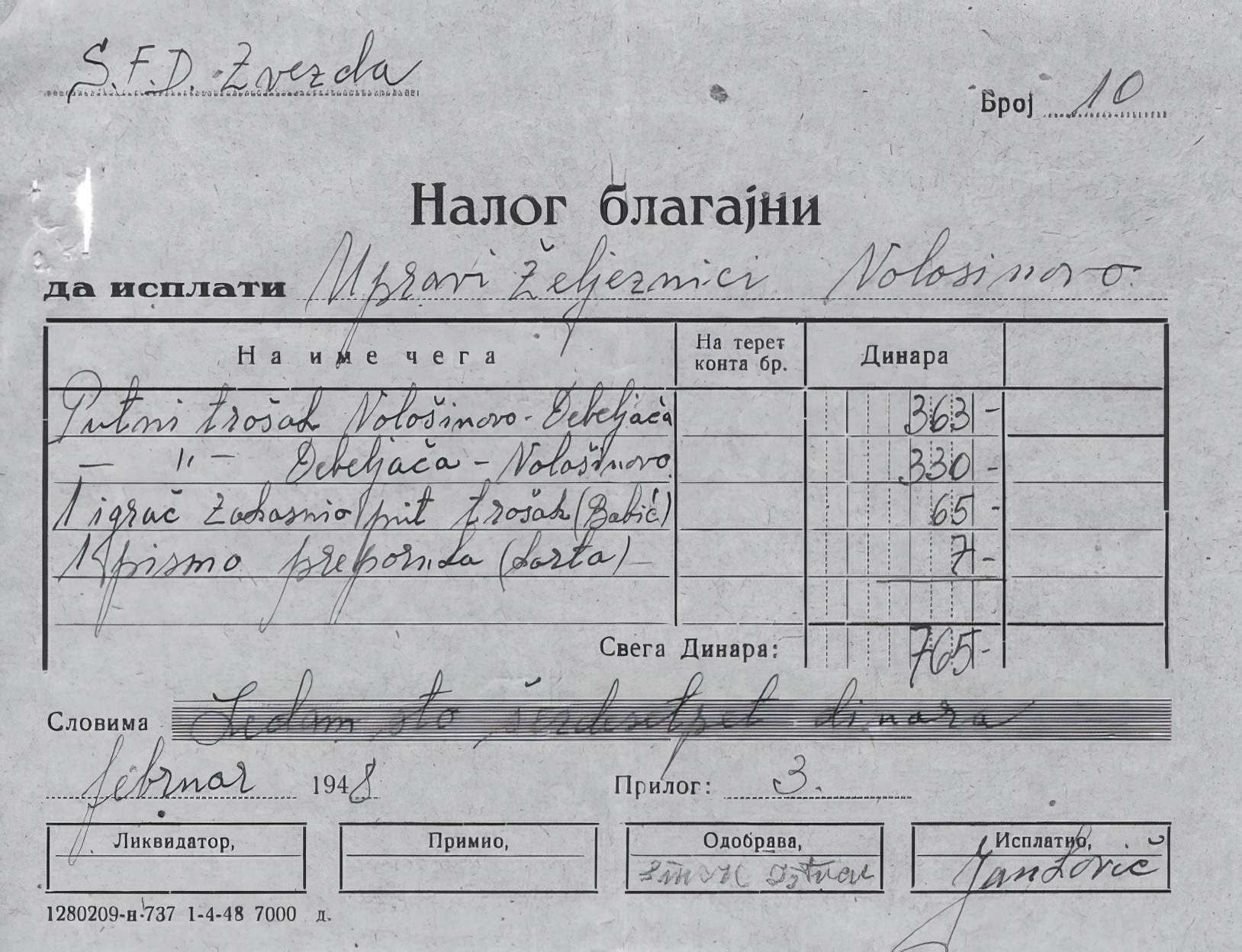
In the accounting archives of JFD “Zvezda,” carefully maintained by accountant Franja Janković, there is written evidence of bowling activities already at the beginning of 1948. It is a receipt for travel expenses of the “Zvezda” bowlers dated February 22, 1948, when they played a friendly match in Debeljača. Travel was by train, and 11 return tickets cost 363 dinars. The receipt also notes that player Babić missed the train.
That competitions were not limited to friendly matches is confirmed by the fact that the “Zvezda” bowlers participated in the Northern Banat championship in Zrenjanin on November 7, 1948.
Three weeks later, on November 21, 1948, a match was played against Proleter from Zrenjanin on the single-lane bowling alley of the “Laslo” tavern in Novi Bečej, owned by István Laslo.
The financial records show that the club operated successfully, as this match generated revenue—most likely from the buffet—in the amount of 350 dinars, which István Farago handed over to accountant Franja Janković. On the other side, total expenses amounted to 175 dinars. The tavern owner, István Laslo, received 60 dinars for the use of the bowling alley, the pin setter received 75 dinars, and Joca Iličić received 40 dinars for a dinner with guests.
On November 28, 1948, the “Zvezda” bowlers played a match against a team from Novi Sad. On that occasion, the visitors brought two bowling balls, which the club purchased for 2,400 dinars through the Physical Culture Association of Novi Sad. The same receipt also shows that the travel expenses for the match delegate amounted to 550 dinars.
New Year’s Tournament
During the winter period, the bowlers were highly active and organized numerous competitions. For a tournament held on December 5, 1948, at the “Laslo” bowling alley, a rich prize fund was prepared. Among the prizes were a goose, 5 liters of wine, a cake, sandals, and 100 cigarettes.
The end of 1948 was marked by a New Year’s tournament at the “Laslo” bowling alley, which lasted for five days: December 25, 26, and 27, 1948, as well as January 1 and 2, 1949.
The income of the bowling section amounted to 18,953 dinars, expenses were 15,878 dinars, and the net income was handed over to accountant Franja Janković.
At the beginning of 1950, the Unified Physical Culture Society “Zvezda” changed its name to the Trade Union Sports Society “Zvezda,” which continued its rich sporting activity.
“Polet” Forms a Sports Society
In the largest factory in the municipality, “Polet,” on January 1, 1950, a Trade Union Sports Society was formed, consisting of several sports sections. The most active was the basketball section, which had both a men’s and a very strong women’s team. The women’s team twice competed in qualification tournaments for entry into the First Federal League. Wrestling, boxing, chess, and bowling sections were also very popular.
The “Polet” bowling team was very active during its two years of existence. It joined regional competitions, as confirmed by the fact that on February 17, 1952, Slobodan Lalić attended a bowling committee meeting in Zrenjanin.
At the beginning of March 1952, a new bowling alley was officially registered, and the “Polet” team played several friendly matches. They competed in Zrenjanin, Elemir against Bratstvo, Bečej, and other places. Archives of the SSD “Polet” also contain receipts for travel expenses, including transport by boat to nearby Bečej and trips to Novi Sad for matches against Vojvodina.
“Zvezda” Becomes “Jedinstvo”
The existence of two sports societies in a small town such as Novi Bečej likely represented a significant financial burden. By decision of the political leadership at the time—something that, according to contemporary witnesses, was not particularly welcomed by the athletes—in 1952 the Trade Union Sports Society “Zvezda” and SSD “Polet” were merged into a new organization under the name “Jedinstvo.”
There are no exact records of when the founding assembly of the Trade Union Sports Society “Jedinstvo” was held, but it can be stated with certainty that from November 1, 1952, the society began functioning under its new name.
In the archives of SSD “Zvezda,” a record has been preserved stating that on October 31, 1952, the transfer of duties took place between Aleksandra Živković, who handed over the treasury, and Franja Janković, who took it over. The handover included a balance of 18,788.50 dinars, one gold wristwatch valued at 9,500 dinars, as well as complete financial and accounting documentation from 1950, 1951, and 1952.
A few days later, on November 6, 1952, a formal transfer of financial documentation of the former “Zvezda” sections was carried out, covering the period from 1948 until October 1952. The documentation was handed over by accountant Franja Janković and received by Mašan Milačić, a financial officer of the District People’s Committee.
The following day, on November 7, 1952, the financial records of SSD “Polet” were also transferred. The documentation was handed over by accountant Borislav Igrački, who had managed accounting from January 1, 1950, to September 24, 1951, and by Ilona Senji, who had taken over the treasury from that date until November 7, 1952.
At the end of 1952, stamps (official seals) were ordered for the Trade Union Sports Society “Jedinstvo” from the rubber stamp workshop of Obren Mojić in Zrenjanin. Ten round seals were produced for all clubs within the new society, allowing the organization and its sections to officially operate under the new name.
First Competitive Season
The first written record of competition under the name “Jedinstvo” was found in the newspaper Zrenjanin dated June 20, 1953. It shows that during the 1952/1953 season, the team from Novi Bečej competed in the Northern Banat Zone League.
The championship was highly competitive, and the title race was decided only in the final round in Zrenjanin, where the leading team Zanatlija defeated Jedinstvo from Novi Bečej. With that victory, Zanatlija secured first place with 26 points and earned the right to participate in qualification matches for entry into the Vojvodina League. Jedinstvo finished in second place with 24 points.
Final Table – Northern Banat Zone League, 1952/1953 Season
| Rank | Team | Played | Wins | Losses | Pins | Points |
|---|---|---|---|---|---|---|
| 1 | Zanatlija (Zrenjanin) | 14 | 13 | 1 | 3,815 : 3,266 | 26 |
| 2 | Jedinstvo (Novi Bečej) | 14 | 12 | 2 | 3,271 : 2,974 | 24 |
| 3 | Kristal (Zrenjanin) | 14 | 10 | 4 | 3,846 : 3,351 | 20 |
| 4 | Petefi (Zrenjanin) | 14 | 5 | 9 | 3,232 : 3,254 | 10 |
| 5 | Drvodeljac (Zrenjanin) | 14 | 5 | 9 | 3,156 : 3,426 | 10 |
| 6 | Železničar (Zrenjanin) | 14 | 4 | 10 | 3,090 : 3,228 | 8 |
| 7 | Radnički (Kikinda) | 14 | 4 | 10 | 2,656 : 3,095 | 8 |
| 8 | Olimpija (Torda) | 14 | 3 | 11 | 1,564 : 2,033 | 6 |
Comments