



The social life in Novi Bečej and Vranjevo, fifty or more years ago, mainly took place in the Sokolana and taverns. Conferences, meetings, and gatherings of political or scientific nature were held there. In short, all entertainment and social activities happened indoors—either in the Sokolana or in taverns. The only exceptions were summer swimming in the Tisa River, football training, and matches in the Gradište grove.
It was as if the beauty of the surroundings did not exist. Perhaps this was influenced by the perception imposed by those from hilly regions, who often ask: What is beautiful in the plains? What can be attractive in its fields? They see it as monotonous, offering nothing to capture the eye, let alone touch the soul or inspire a desire to stay forever—or at least regret leaving it.
These were, however, prejudices held by both young and old, which no one attempted to break. Even schools did nothing to foster a love for our plains; instead, they likely accepted the notion that the flatlands were dull, monotonous, and uninteresting. But these were indeed just prejudices.
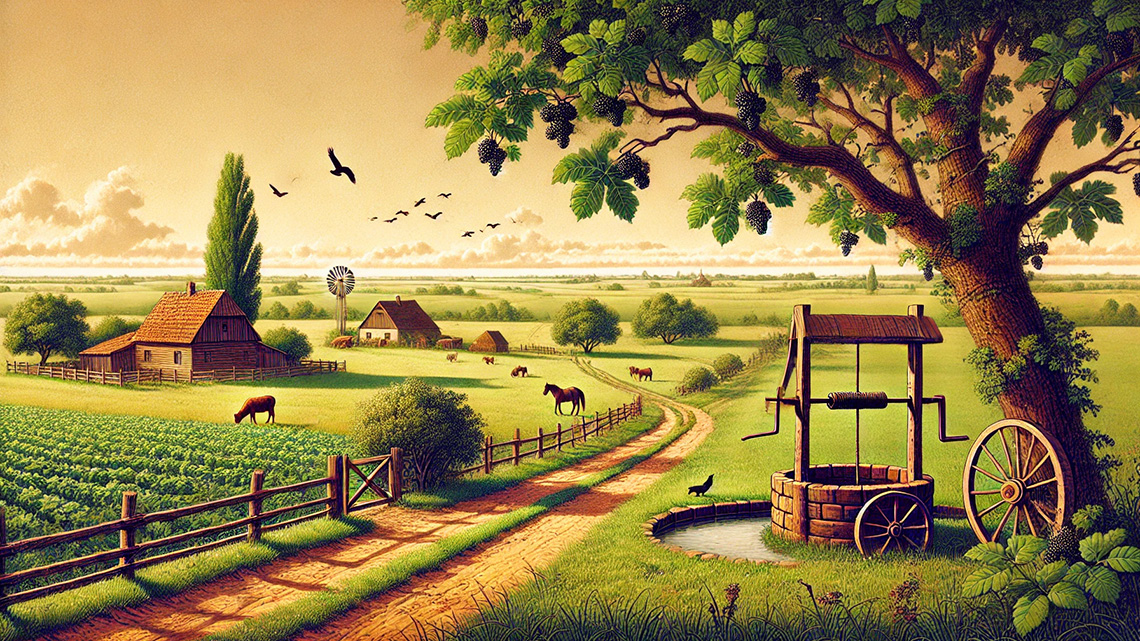
Every outing into our flatland nature on beautiful spring days revealed a wealth of colors and intoxicating scents from green fields and blooming meadows, adorned with wells and the long beams of field pumps—monuments to a rich life and hardworking farmers tirelessly toiling to reap the most abundant harvests.
It was a pleasure to see our roads lined with mulberry trees and occasional poplars on both sides of the pavement. A special delight came from the scattered farms, surrounded by trees, which appeared as green oases.
The sight of large herds of spotted village cows grazing on the lush green carpet of communal pastures was truly beautiful. It was also a pleasure to see vast groups of village horses on those pastures, with foals playfully frolicking in the open nature.
The roaming herds of cows, oxen, calves, groups of horses, and flocks of sheep were the true ornaments of these rich fields and pastures. All of this, infused with the fragrance of wildflowers and accompanied by the cheerful songs of larks and the chirping of other birds, created a true elixir of a life free from stress.
Here, in these fields and pastures, enriched with the real essence of plant and animal life, one comes to understand the full meaning of existence. In this tranquility and the immeasurable harmony and abundance of nature, a person simply realizes how burdened city life is with worries and stress, often exaggerating the importance of problems.
The greatest encouragement for complete relaxation is the harmony and silence in which life unfolds in our fields, and the satisfaction with which shepherds live amid this natural wealth. Though they may lack many material things, they do not dwell on it—except when it directly affects them.
Even shepherd dogs can provide a reason for relaxation. Though often half-starved, they are always cheerful and eager to obey their master's command to bring back a stray cow, horse, or sheep. They joyfully run back to their master, wagging their tails, as if aware that they have done a great service and expect to be rewarded with a gentle pat—the greatest prize for them.
When one sees and experiences all this, the question arises: how do these poor shepherds manage to create a life full of joy and satisfaction? They can often be seen and heard whistling, playing the flute, or singing loudly across the fields. Meanwhile, we, who have far better conditions for a comfortable life, do not know how to enjoy it. We are constantly tense and burdened by what we lack, yet we never consider nature and relaxation in it as essential.
Perhaps this attitude of city dwellers is the price of progress and material wealth. However, stepping into nature, into the fields and pastures of the plains, reminds us that the beauty and richness of life should not be sought solely in material prosperity.
I grew up on a farm (a picture of our farm is on the cover of this book). Although our farm, being close to Novi Bečej, did not offer the same charms as those located several kilometers away from settlements, it still taught me to seek joy and beauty in nature.
I fell in love with our fields, interwoven with various shades of green, crisscrossed by small irrigation ditches and canals, decorated with wells and diligent farmers. The canals, often carrying little water and overgrown with rushes and reeds, provided shelter and food for many birds. Frogs and snails created conditions for storks to settle—those graceful adornments of village chimneys and old straw-roofed barns.
Storks symbolized the kindness and gentleness of village life. Farmers did not mind having storks nesting on their houses; in fact, they raised their children to respect them. We all knew, from a young age, that if we disturbed the storks or swallows, "our mother would die." Because of this, it never crossed anyone’s mind to touch their eggs or chicks. Many of us climbed onto haystacks where storks had built their nests, but we were satisfied just to observe them closely. We never dared to touch them because we knew their mother would reject them, and that was considered a grave sin—one that could cost our mothers’ lives.
As an adult, every morning before heading to town, I would take a walk around our property, which was entirely surrounded by canals, and enjoy listening to the calls of quails and the chirping of other birds.
It is only natural, then, that I wanted others around me to fall in love with our fields as well. Whenever possible, I would encourage my school friends to take Sunday morning trips to Ivanović’s grove (today’s Sokolac), the Vranjevo woods, Matejski Brod, Stari Bečej via Ljutovo, and other places.

Comments