



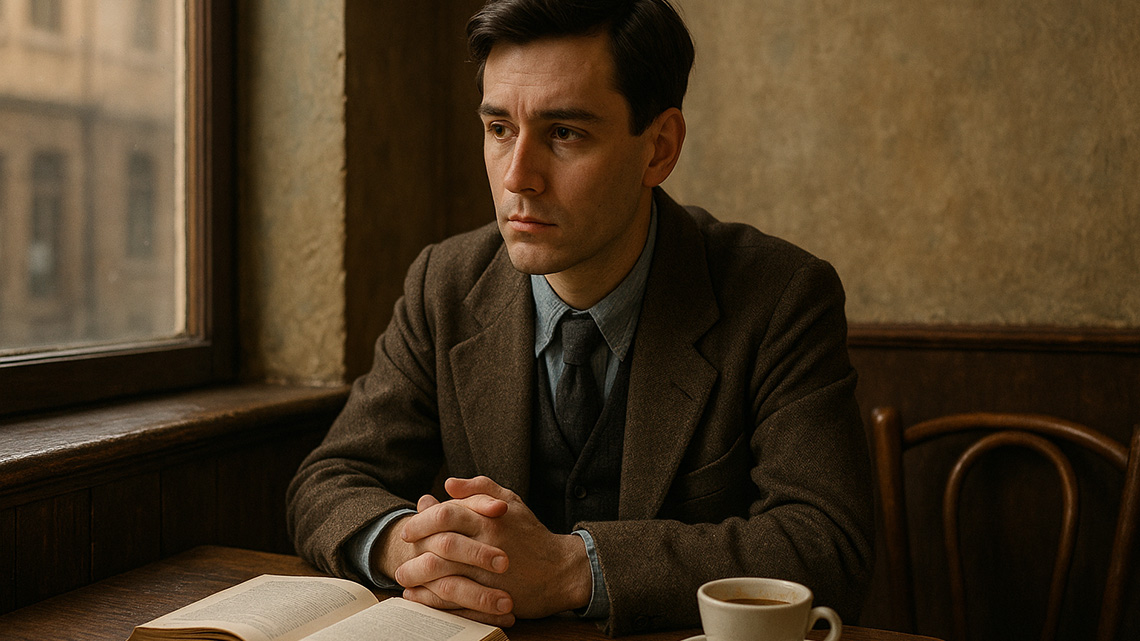
Even in his youth, Bogdan Čiplić was reserved and somewhat detached from social life, although he was a good conversationalist, open as a person, and musically educated. Because of that, he could easily fit into any tavern company. But he lacked one crucial thing—a desire for such a lifestyle. Just like the expression jokingly says: "but"—what ruins a girl’s happiness. That "but" steered Bogdan Čiplić’s life.
I had known him since I was a boy—he was seven years older than me—as a serious and withdrawn young man. I also knew him later as a young teacher at the Novi Sad gymnasium, but that was a distant acquaintance.
We became closer in the late 1970s when I began writing about Novi Bečej. I wanted him to review my manuscript in which I described life in Novi Bečej during the 1930s. He kindly accepted and reassured me that I didn’t need to worry he might use my ideas in his own writing.
He gave a positive evaluation of my book’s concept and praised the initial pages, especially in terms of style and grammar. He said, surprised, “I exclaimed—this man writes better than Veljko Petrović!” That enthusiasm, however, quickly faded when he encountered what he called an "office style" in later parts of my manuscript. This comment pushed me to preserve the tone of the opening pages in my next draft and remove the bureaucratic narrative. Whether I succeeded, I left to the readers of my book "The Charms of Past Days", where I describe Novi Bečej from 1929 to 1935. If I did succeed, part of the credit goes to Bodin’s critique. That marked the beginning of our friendship.
I was often Bogdan’s guest—he loved listening to stories about Novi Bečej, which he said were relaxing for him. I learned a great deal about Novi Bečej and its people from him. He had an exceptional memory and knew a segment of society unfamiliar to me. Many of my research initiatives were sparked by our conversations—especially for my book "Novi Bečej and Vranjevo Through History."
There’s so much I could write, but not everything would be relevant to Bogdan’s biography. I’ll focus only on the important. I believe that besides me and his admirer, Dr. Živojin Živojinović—his former student and now professor at the Faculty of Philosophy in Novi Sad—no one knows certain details that could shed light on Bogdan Čiplić’s personality and his later life.
Before delving into those conversations and events, I want to mention that we also exchanged letters while he was away in various places along the Adriatic coast. He liked when I wrote to him, and he would reply using postcards, maximizing the limited space.
I admit, I was nervous replying to his first postcard. I feared his judgment of my style and grammar. He once told me about his "professional deformation"—how he couldn’t sit at a tavern table without first correcting the spelling on the menu.
However, I was especially flattered when, on September 8, 1982 (my birthday, incidentally), he replied from Dubrovnik, saying:
"I received your letter full of beautiful thoughts and ideas, written not only in a lovely handwriting but also in literary language and with strong grammar—which delights me..."
Perhaps this compliment gave me the motivation to continue writing about Novi Bečej, to expand my memories of 1929–1935, and to start researching Serbian theatre history and writing the history of Novi Bečej and Vranjevo.
I must admit, though, that when he read the first fifty pages of my manuscript "Novi Bečej and Vranjevo Through History", he harshly criticized them. He adapted everything to his style, which—truth be told—was never quite to my taste, despite its simplicity and aim to sound like a local Banat dialect. He even went so far as to edit all the quotes, though they were clearly marked. That was just a momentary reaction; later, he praised my first two books with many kind words, especially regarding style and language.
To show this wasn’t unique to Bogdan, I’ll share his surprise when Zoran Petrović, a professor at the Belgrade Academy of Fine Arts, praised many of his paintings—including some Bogdan had once dismissed as worthless. This example serves to illustrate that we all have moments of being overly harsh—toward ourselves and others—but when we move past that, we return to realistic balance.
Bogdan helped many people—he made entire novels, written in poor language, publishable. In one case, he was practically a co-author of two novels, though he never sought recognition for it.
He spoke about people’s courage to write, especially poetry, not with disdain but with admiration, believing they deserved support.
He was the same in painting—he had two or three students (as he called them) and proudly referred to them that way.
Bogdan was a prolific writer, though he rewrote each piece many times. He told me he often retyped manuscripts 11 to 12 times due to revisions. He once regretted submitting a manuscript to a publisher without a twelfth revision—believing those were always weaker than his most thoroughly edited work. His productivity stemmed from diligence, not haste.
He simply couldn’t sit idle—this persistence he inherited from his parents.
His father, Žarko, was a hardworking and efficient man. Bogdan told me that when his father, at age 70, was told he had been retired, he died that very day—unable to imagine a life without work.
Comments