



Often, especially at night when I wake up, I find myself walking in my mind through the New Bečej and Vranjevo of the past, as I left them in my youth, and how they became dear to my heart.
I feel a special joy when my imagination takes me to the Tisa River, or Gradište, and brings me back to those magical days I spent there. Almost always, in these reflections, I travel from Buda's mill to the Great Warehouse.
I relive the beautiful moments of sunbathing on the stones by the river and swimming in the Tisa. The water is calm, as if tired, almost ceasing to flow, and for flatland rivers, it's clear because it doesn't stir up silt, just cool enough to refresh and delight us after "roasting" in the hot July or August sun.
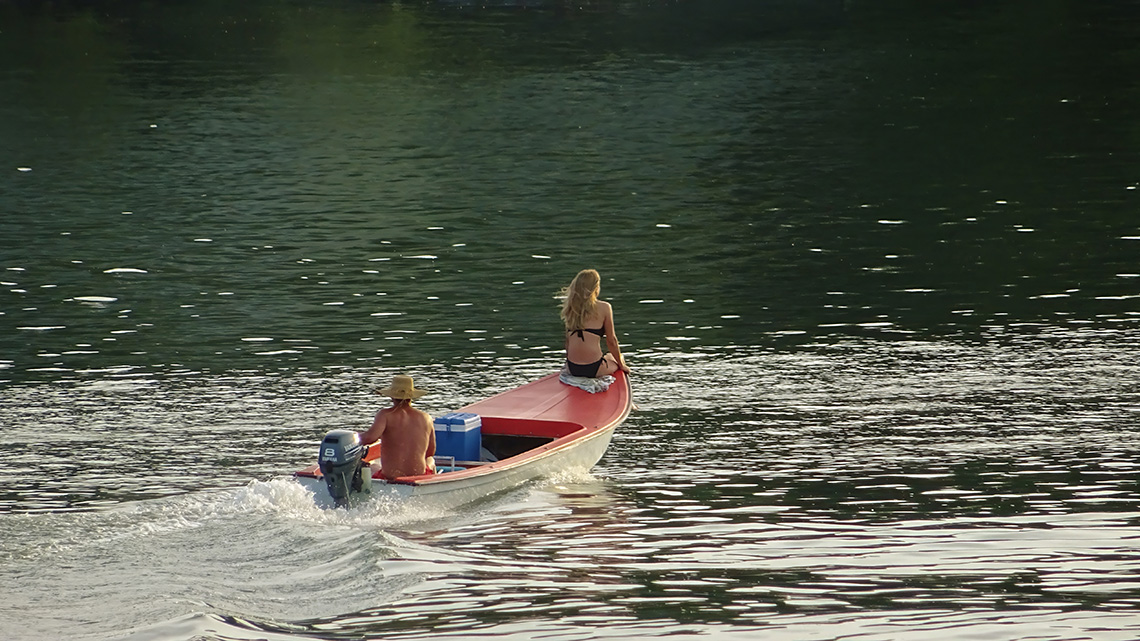
What joy one of those old, worn-out boats, owned by the good-natured merchant Šandor Šimon, gave us. We all called this boat "agrarian," as it was available to everyone, allowing us to cross over to the sandbar of the Tisa, where the noble beach was located.
We named Šimon's boat "agrarian" as a metaphor for the agrarian reform that was carried out. After World War I, the Serbian poor in New Bečej received a few acres of land through the agrarian reform, but despite this, they remained poor, now called "agrarians." Thus, someone named the boat "agrarian"—a boat for the poor.
It was an old fisherman's boat for four people, but this number was often exceeded, and there were always 7 or 8 young men and women on it, just as the water was about to overflow, which was a sign that the "norm" had been exceeded. Šandor, as a rule, would take the oars with him whenever he left the boat, but that didn't bother us. There was always a piece of wood or a board to use, and most often, we paddled with our hands, and the boat sailed in the desired direction. The Tisa was crossed in no time, and the group disembarked, while on the other side, a new group was already shouting "boat!" Someone would always find a relative in the newly arrived group, take the boat back, and in the next "round," they would also disembark on the noble beach. This continued almost indefinitely—certainly until sunset, when even the most persistent and loyal to the Tisa would return.
Not far from our beach on the stones, at the very dock, there was a great bustle and noise from the "vagandžija" (grain porters), who, running with sacks of grain on their shoulders, would shout jokes along the road, which was amusing to us as we lay on the stones "baking." Their noise was a welcome distraction, preventing us from falling asleep, as sleeping in the sun could lead to undesirable consequences. Instead, we would strain to listen and try to understand their words, thus driving away the drowsiness that, with the sun, would almost always overtake us when lying down. The vagandžija hurried and shouted from morning until evening—until sunset. They unloaded hundreds of wagons carrying grain from New Bečej, Vranjevo, Kumanovo, Melenac, Bašaid, Beodra, Dragutinovo, and even from Banatska Topola.
It is impossible to avoid thinking of the water carriers on the Tisa. I remember the women drawing water from the Tisa, balancing full buckets on their heads as they climbed up the riverbank, trying to keep the buckets full until they got home, swaying with every step. We enjoyed jumping into the water from the "water carriers," even though we knew every woman coming for water would chase us away up the embankment. We would quickly retreat and pretend to be ashamed, but as soon as she left, we'd be back at the "water carriers." I won't dwell on the "water carriers," as I have already spoken about them in my earlier memories ("The Charms of the Past").
I enjoyed thinking about the ferry, how it simply glides across the smooth water, transporting pedestrians, cyclists, and mostly horse-drawn vehicles. I have the feeling that when I think about the ferry, my thoughts slow down, so I don't disturb its quiet motion, as I want its journey to last as long as possible, just to enjoy the silence. I remember Pišta, the ferryman, and Slavko Josimović. Most of their day was spent conscientiously doing their work. They quickly greeted people, but sometimes there was uncertainty, especially at night, when waiting was long. The ferryman, on duty, would try to "steal" every free moment to sleep because another day awaited him in the same job, possibly until evening when someone else would take over, and then someone became the "victim."
The beauty of the vanished Gradište is often in my memory. This isn't only the case for me—Gradište was so beautiful and magnificent that everyone must remember it. But I have already said all I needed about it in my previous book of memories.


Comments