



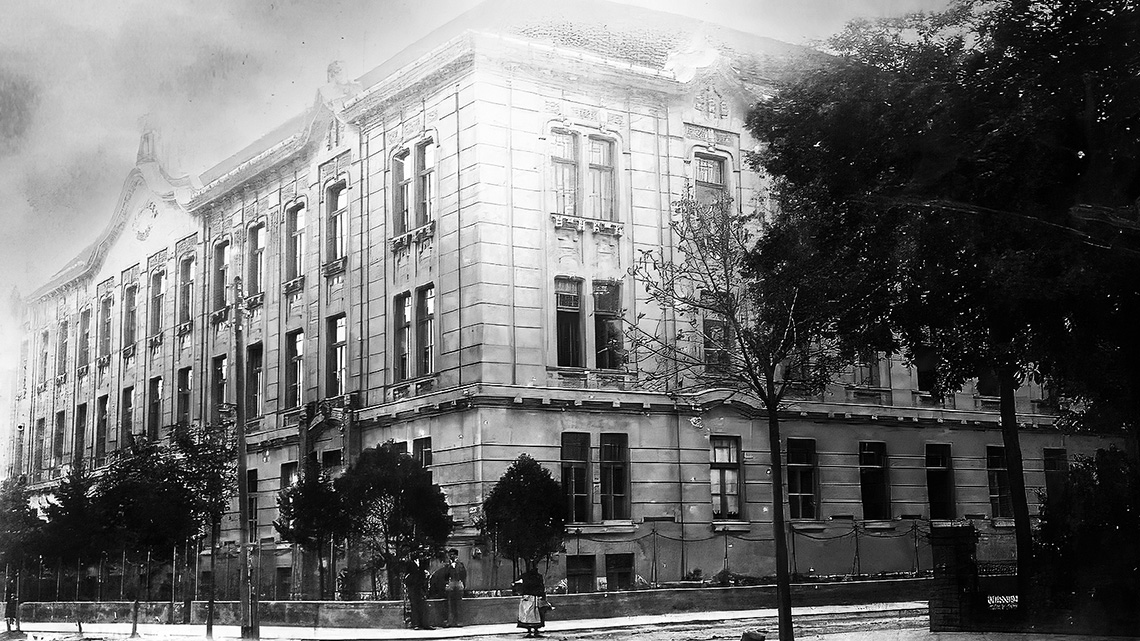
I will not delve into a historical account of the development of education in Novi Bečej and Vranjevo, as I have already provided such a description in my book “Novi Bečej and Vranjevo Through History”. Instead, I would like to highlight a turbulent and almost revolutionary period in the school history of Novi Bečej between the 1920s and 1930s.
I aim to showcase the efforts and endeavors of the cultural pioneers of the time, striving to turn their town into an educational center where not only the youth of Novi Bečej and Vranjevo, but also those from surrounding areas of Banat and Bačka, would be educated.
Since September 1908, Novi Bečej had a four-grade civil school, where children were primarily educated for the needs of the local trade and crafts. Those whose parents could afford further education would attend schools in nearby towns such as Veliki Bečkerek (Zrenjanin) and Velika Kikinda, or attend higher secondary schools in Novi Sad, Sremski Karlovci, and other places in Banat and Bačka.
Of course, education outside the town was limited to children whose parents had the financial means to support such schooling.
The foresight and initiative of our fellow citizens, dedicated to improving the overall cultural and educational level of their community, led to the establishment of a full high school in Novi Bečej, despite the fact that by 1920, the Harkov Institute had already been opened, which became an eight-grade female high school in 1922.
The government, considering its financial constraints, was unwilling to even consider opening a full eight-year high school in Novi Bečej, given the existence of schools in Veliki Bečkerek and Velika Kikinda, located about forty kilometers away. The realism of this can be seen in the fact that even Stari Bečej did not have a higher high school at the time, with the nearest being in Senta, Novi Vrbas, Novi Sad, and Sombor. However, our citizens were not satisfied with such a situation.
After the final border demarcation between the Kingdom of Serbs, Croats, and Slovenes (later Yugoslavia) and Romania in 1923, when Žombolj, previously part of Yugoslavia, was transferred to Romania in exchange for Jaša Toma and Pardanj, our fellow citizens took the opportunity to relocate the Serbian gymnasium from Žombolj to Novi Bečej.
The Ministry of Education initially refused to entertain the idea of relocating the Žombolj gymnasium, as it had already decided to shut it down, redistributing the faculty to other existing high schools in Vojvodina and Serbia.
Our citizens, led by Dr. Jovan Pivnički and the Vranjevo priest Stevan Krstonošić, went to the Ministry of Education and managed to negotiate the relocation of the Žombolj gymnasium to Novi Bečej, with the costs of the relocation and ongoing maintenance to be covered by the municipalities of Novi Bečej and Vranjevo.
After this agreement, the Ministry of Education granted the gymnasium in Novi Bečej all the rights and public recognition that state schools had. Representatives of our municipalities, in agreement with the former director of the Žombolj gymnasium, Dr. Vladimir Zdelar, who had previously been a long-time professor at the Second Male High School in Belgrade and had run his own private school, arranged for him and his faculty to move to Novi Bečej and establish a private high school.
The relocation took place, and the school began operating in the fall of 1924 under the full name: Private High School with Public Rights, Co-educational Full Real Gymnasium in Novi Bečej. Unfortunately, Director Zdelar passed away in 1926, and Dragutin Simonović from Belgrade succeeded him.
The gymnasium operated until 1931, when it was liquidated due to the economic crisis that had severely affected Yugoslavia, especially its agricultural regions. During its existence, the gymnasium was sometimes forced to eliminate lower grades if there were insufficient students, only to reopen them in the following year when enrollment numbers improved.
Despite these challenges, the Private Gymnasium remained dear to me, even though I had also attended the gymnasiums in Veliki Bečkerek and Stari Bečej.
I have fond memories of the organization and the teachers’ attitudes toward the students. The first year of high school was a major transition for me. Not only was I freed from primary school and entered subject-based classes, which meant a loss of continuous control over my learning, but it was also my first exposure to city life and children from more privileged backgrounds. Teachers, for me, a rural boy from Kumane, seemed like such distinguished figures that I trembled when I met them in the street. I remember how nervous I was in the first few days when a teacher looked at me seriously or called on me to answer. I could barely put together a sentence.
For a few months, I felt like one of the worst students, and this complex weighed heavily on me. Fortunately, our homeroom teacher, Milorad Motok, was a wonderful person with exceptional pedagogical skills. He taught Serbian, and his seriousness gave me the encouragement I needed, especially as he was kind to us rural kids. He rarely called me by my last name; instead, he would say, "Come on, Lazo, tell us about this or that." Thanks to him, I stabilized and began to understand the lessons, gradually becoming one of the solid students by the second term.
Another teacher who left a strong impression on me was Žarko Čiplić, who taught drawing and singing. He was a beloved figure, and I still remember how, as a school supervisor, he visited the Kumane primary school. His kind smile and calm demeanor were unforgettable. From him, we all learned how to draw a circle, a simple but essential geometric shape. His lessons taught us to make adjustments with a pencil before erasing with an eraser.
We also had a great teacher in religious studies, the Vranjevo priest Stevan Krstonošić, who treated all of us, including the rural children, with the same respect as the city kids. This approach helped us feel welcome and made the transition easier.
Some may argue that I favored those who were not even real gymnasium professors but only part-time teachers. Perhaps that's true, but this also reflects how important it was for us rural children to find teachers who could establish a connection and ease our fears of change. They helped us adjust, making it feel like a continuation of our education from elementary school.
The director of the gymnasium, Dragutin Simonović, also left a lasting impression on me. Short in stature, with a high forehead and gold-rimmed glasses, he was a kind man and a great psychologist who could make students feel at ease. He would greet us with a smile and sometimes ask, "What grade are you in?" or "What’s your name?" We all respected him as a director and loved him as a person.
There was also Ivan Podgornij, the math teacher, always smiling and treating students equally, regardless of their social background. You might think I’m simply nostalgic, but my fondness for the Private Gymnasium in Novi Bečej is genuine.
However, not all teachers acted as educators or psychologists. Some would even stop students on the street, asking why they were out and telling them to hurry home. But as I mentioned in the introduction, my goal here is not to focus on unpleasant or less pleasant experiences, but rather on those moments that bring me joy and satisfaction.
Lastly, regarding the organization of the school: it was funded primarily by the students' tuition fees. The amount of tuition varied depending on the property taxes paid by the students' parents. Some paid 60, 120, 180, or even 240 dinars per month. Poor students were exempt from tuition, but there were few of them, as most poor families sent their children to work or to apprenticeships to relieve the family budget.
The subsidies from the municipalities of Novi Bečej and Vranjevo were minimal compared to the total income from tuition. In the school’s annual report for the 1929/30 school year, it states: "The school was funded by tuition fees. The municipality of Vranjevo provided significant help with 8,000 dinars." This "generous help" amounted to less than 3% of the total income, which was 293,550 dinars.
This financial situation should be considered when evaluating the school’s position during the greatest economic crisis, and it helps explain why, despite all efforts to save, the school was forced to close in 1931.
The school had six, and at most seven, permanent teachers, including the director, and four part-time teachers. The weekly teaching load for regular teachers ranged from 24 to 29 hours, with an average of 26 hours. In contrast, the state four-grade civil school in Novi Bečej, with the same number of students (163), had eight permanent teachers in 1932, including the director, and four part-time teachers. However, their weekly teaching load was lower, ranging from 19 to 22 hours, with an average of 21 hours for regular teachers.
The difference in workload and lifestyle between the Private Gymnasium and the State Civil School is quite telling.
Despite the heavy workload of the teachers, discipline was maintained at the school, students behaved properly in public, and there was a high level of participation in all student clubs and organizations.

Comments