



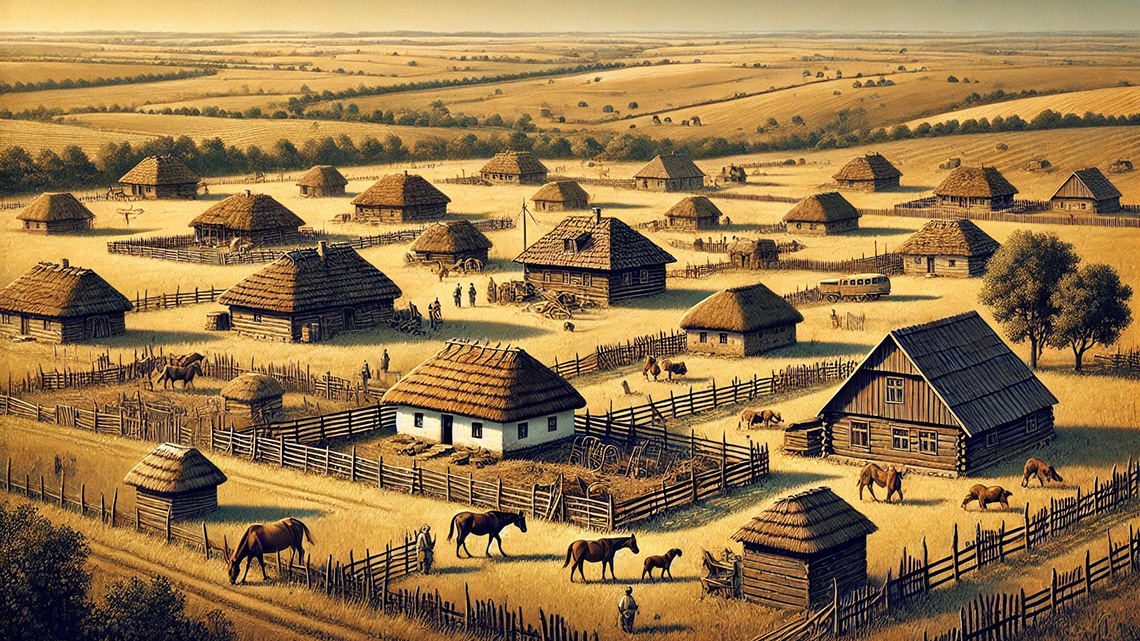
Up until about fifty years ago, farmsteads (salaši) played a significant economic role and were widespread throughout the cadastral areas of Vranjevo and Novi Bečej. According to data recorded in the book "Torontal County and Cities" by Dr. Samu Borovsky in 1910, Vranjevo had 285 farmsteads, and this number increased between the two World Wars. For Banat's conditions, this was a dense distribution, though in Bačka, particularly in the northern part, there were even more on similar land areas.
Before World War II, based on incomplete data from sections of the Geographic Institute of the Yugoslav People's Army (JNA) and my own assessment, Novi Bečej had approximately 170 farmsteads. In the area of Rit, on Biserno Ostrvo (Pearl Island), there were 47 farmsteads in addition to the large estates of Rohonci and Ivanović.
According to "The Serbian Orthodox Metropolitanate of Karlovci" by Mate Kosovac, in 1905, Vranjevo had 1,553 households with 9,308 inhabitants, averaging six members per household. If we multiply the 285 farmsteads recorded in Vranjevo in 1910 by six, it follows that about 1,710 people, or roughly 20% of Vranjevo’s population, lived on farmsteads. This alone justifies examining them as a distinct way of life and economic activity.
Given the significant role of farmsteads in the lives of our fellow citizens at the beginning of the 20th century, it is worth presenting their distribution across different rural areas (rudine) of the Vranjevo and Novi Bečej cadastral territories in more detail.
A large number of farmsteads in the Vranjevo area were naturally located in more remote parts, such as Šimuđa, Paktov, Velika Šuma, and Medenjače. However, many were also found closer to the settlement. While economic factors played a crucial role in their distribution, the need to save time and labor was not as significant for those near the village as it was for those situated over 10 kilometers away. The closer ones had better conditions for farming and livestock breeding compared to barns and yards in the village itself. Additionally, farmsteads often served to provide newlywed sons with some level of independence, and at times, owning a farmstead was perceived as a symbol of wealth and an easier farming life.
Concentration of Farmsteads in Vranjevo’s Rural Areas
The highest concentration of farmsteads in Vranjevo was in Šimuđa, with about seventy farmsteads. The municipality even established two elementary school classes (grades one and two) in an area where these farmsteads were arranged like a street. These structured farmsteads belonged to poor families who typically did not own houses in the village and only traveled there when necessary, such as to sell goods at the market, purchase supplies, or fulfill municipal and tax obligations.
In addition to smaller farmsteads, Šimuđa also had large and wealthy ones, where up to 30-40 cattle—cows or oxen—were raised per farmstead before the economic crisis. The cattle were mainly fed on pastures and corn stalks, used for plowing, breeding, and producing manure, which was the only fertilizer available at the time. Artificial fertilizers were not yet in use.
Notable wealthy farmsteads included those owned by Steva Glavaški, Toša Glavaški, the Bočarski family, Mladen Lalić, Steva Blažin, the Galetin family, Stankov-Bežunarski, Iva Neatnica, Laza Vaščić, Šandor Nešić, and others.
The next rural area with many farmsteads was Konice, with about forty farmsteads owned by families such as Mita Stanković, Danilo Avramov, Vrebalov, Palinkaš, and others.
Crna Bara, Paktov, and Podšuma also had over forty farmsteads. The Yugoslav Railway had a stop in Crna Bara, where a significant concentration of farmsteads was aligned along the canal, resembling a street but with more distance between buildings than in Šimuđa. These farmsteads were wealthier, with large agricultural yards and cultivated lands separating them.
Farmsteads in Paktov included those of Stevan Pinčin, Milan Dujin-Šašin, Ilija Vujačkov, the Ivanđanski family, Dančika Glavaški, Sava Glavaški, the Blažin family, Ničin-Pavkov, Sava Stanković, Sever Vaščić, Rade Vrebalov, the Nešić family, Jova Pajić, Aga Pajić, and others.
Podšuma had farmsteads belonging to families like Bunjevački, Jova Glavaški, Toša Dujin, and Zaćko.
The most remote farmsteads were in Velika Šuma, with around twenty, including those of Stojkov and Radonić. Similarly distant were the farmsteads in Livade, about fifteen in total, belonging to families such as Vorgučin, Ise Trbić, Sile Sekulić, Uroš Cvejin-Gačić, Kimpanov, and Mohabov.
Kerekto, another remote area, had a large estate with about ten buildings, fifty horses, and a similar number of oxen, along with many cows. This estate belonged to Mira and Branko Ničin, who purchased it from the Beodra landowner Karacsonyi.
Farmsteads in Novi Bečej
There were fewer farmsteads in Novi Bečej’s cadastral area compared to Vranjevo. Their approximate number and distribution were determined using maps from the Geographic Institute of the JNA, while owner names were recalled from memory.
Novi Bečej’s farmsteads extended up to Čurug, 15-16 kilometers from the town. Similar to Vranjevo, farmsteads were not only in remote locations but also close to the settlement.
Near the railway station, in Garevac, there were 8-10 farmsteads, including those of Giga Jovanović, the German Petri Georg, and another one associated with a lime kiln. Further toward Bašaid, additional farmsteads could be found.
Other rural areas, such as Jatov and Smrdljivača, contained large estates referred to as spahiluks. Close to the town, along the Tisa River, was the farmstead of Bulgarian vegetable growers, who cultivated land where the Jedinstvo Football Club’s changing rooms are now located.
Historical Significance
Among the historically notable farmsteads was one near Matejski Brod, owned by Imre Deri, a Jewish businessman who managed a mill and steam sawmill in Novi Bečej. He was executed during the Holocaust in 1941, and the estate was confiscated by the Banat police commander, Rajt, until the end of World War II.
In September 1944, a partisan resistance committee was formed at this farmstead, ironically under the occupation government’s nose, as it was the least suspected location for partisan activity.
Lastly, in the western part of Novi Bečej’s rural area, Veliki Pesak had around ten farmsteads, while areas such as Mali Pesak and Ispod Kopova had several more, owned by families like Kovačev, Veselinčev, Malešev, Stojkov, Rača Glavaški, and others.
This overview is based on old military maps and recollections of Milivoj Nešić. Any errors in naming farmstead owners are due to incomplete personal knowledge of the field.
Comments