



The first parliamentary elections for the Constituent Assembly were called only two years after the unification, at a time when the bourgeoisie believed it had achieved a certain level of international and internal consolidation.
To secure its position in the elections, it denied even basic civil rights in the territories of the former Austro-Hungarian Empire: freedom of assembly and association. Extraordinary measures against communists were maintained and new ones introduced, while the electoral law denied voting rights to members of non-Slavic national minorities. The authorities banned communist gatherings, hindered campaigning by confiscating leaflets, arresting agitators, speakers, and even parliamentary candidates.
Following orders from the district chief in Novi Bečej, the police arrested 14 comrades from Melenci who intended to attend a rally in Kumane. They were beaten in prison, so severely that Mojsin lost his hearing from the blows — reported Radnički list.
The district chief of Novi Bečej wrote in his report that in Kumane “there is also a group of communists. Who their leader is cannot be determined, as they keep silent and refuse to betray each other. They are not dangerous, and once a gendarmerie station is established in the village, this will disappear.”
On his way to Kikinda, Vlada Marković stopped in Novi Bečej on October 14 to request permission from the district chief, Krstić, to hold pre-election conferences in the Novi Bečej district. Knowing that Marković was a communist, the chief replied: “Well, that’s not possible; communists have been banned from holding rallies and conferences for six months now.” In the end, however, he promised to consult the county prefect. The county prefect — the government commissioner of Torontal County — issued a directive (classified no. 41, dated October 30, 1920) instructing that KPJ rallies should be permitted, but under strict supervision.
Under the leadership of Ljubomir Čolić, the local KPJ organization successfully organized a fundraising campaign for Radnički list, which was struggling with a lack of financial resources. Around one hundred copies of Radnički list were distributed in Kumane at that time. This campaign was highly successful and served as a clear example of proletarian solidarity. Radnički list, issue no. 36, dated June 20, 1920, published under the title “Red Contribution” a partial list of donors from Kumane: Dušan Petrović – 10 crowns, Panta Santovac – 8 crowns, Pera Dragin – 2 crowns, Žarko Strajnić – 2 crowns, and Živa Darabuc – 4 crowns.
In preparation for the parliamentary elections of October 17, 1920, a regional KPJ conference was held, attended by 31 delegates from 12 organizations. Kumane was represented by Ljubomir Čolić, who also presided over the conference. It was decided which locations would serve as campaign centers and how funds for the election campaign would be collected.
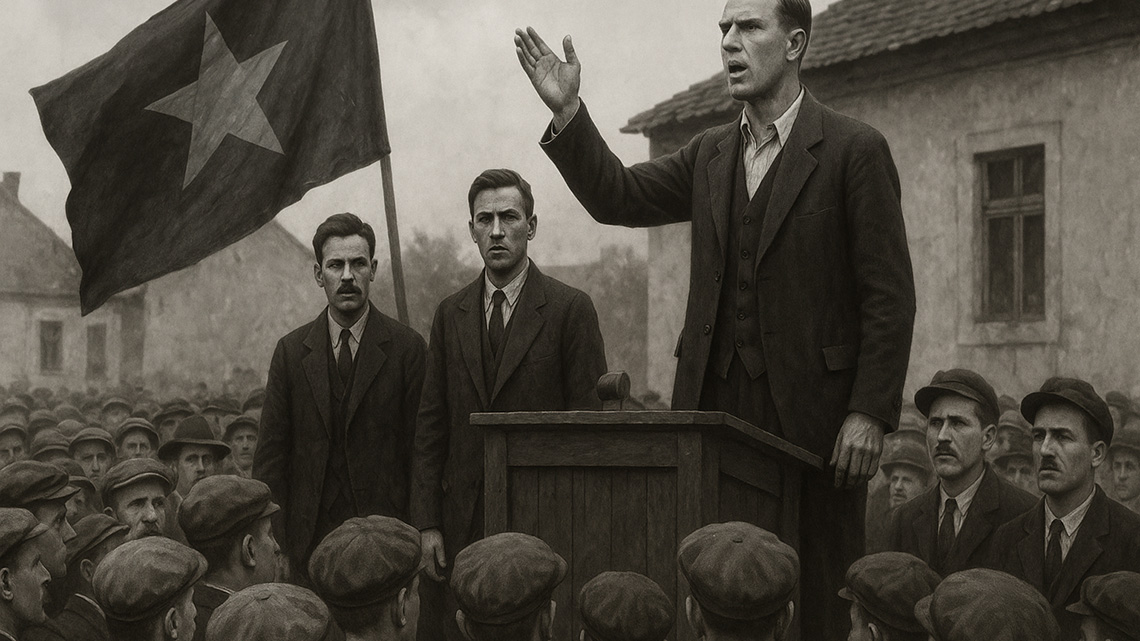
Despite government repression, a large campaign rally was held in Kumane, where parliamentary candidates from the KPJ list, Vlada Marković and Nikola Kovačević, delivered speeches. Their substitute candidate on the list was Ljubomir Čolić.
In the electoral district of Veliki Bečkerek – Velika Kikinda, which included Kumane, six candidate lists were submitted by: the Radicals, Democrats, Non-Partisan Bloc, Communists, Social Democrats, and Agrarians.
The results of the election in Kumane demonstrate the extent of the communists’ engagement. Out of 1,440 registered voters, 1,085 cast their ballots, a turnout of 73.90%. Of these, 107 voted for the Radicals, 55 for the Democrats, 12 for the Non-Partisan Bloc, 21 for the Agrarian Party, while the Communists received 876 votes — over 80%. The elected deputies were communists: Vlada Marković, a journalist, and Nikola Kovačević, a saddler, both from Novi Sad. Following the communist victory in the elections, in which they won six seats in Vojvodina, Radnički list published an article titled “Red Strongholds in Vojvodina,” listing Kumane among them.
A report from the head of the Secret Police for Torontal County on the elections concluded that communism had taken hold in some parts of Banat, particularly in purely Serbian villages. “The reasons for this are that in these villages the municipal chief employs certain constables who perform night patrol duties and guard the village, but these same constables are true communists. Together with local peasants, acquaintances, and friends, they spread communism until the masses openly embraced it through public support for communist agitators. These villages also harbor a considerable number of army deserters (‘Green Cadre’), whom the constables and watchmen protect. For example, if a deserter is sought, the gendarmerie cannot capture them, as the watchmen always warn them in advance to hide.”
After the communist victory in the elections, and following the instructions of the Ministry of the Interior, the District Office in Novi Bečej established a “blacklist” of communists and their sympathizers. These individuals were denied work permits and labor booklets by the district chief.
Comments