



The Establishment of Political Parties After World War I
The main political party supported by the Greater Serbian bourgeoisie was the Radical Party, founded in Kumane in 1919 at the initiative of Dr. Boža Ankić, a lawyer from Zrenjanin. Among the locals, the founders included Milutin Birovljev, the party president, Čeda Radišić-Bukvić, Živa Čobanov, Marko Nosonjin, and Jefta Nosonjin, all wealthy farmers.
In 1918, the organization of the Social Democratic Party of Hungary and the Agricultural Workers' Union was revived in Kumane. (According to the party’s organizational principles, every unionized worker was considered a party member.) Exact data on the number of members in the village are not available.
Many individuals were politically educated within its ranks. Fighting for civil and political freedom, universal suffrage, freedom of the press, assembly, and association, they advocated for greater participation of the disenfranchised rural poor in political life. Thus, the Social Democratic Party played a progressive role. Later, under new circumstances, some members from its left wing joined the Communist Party of Yugoslavia (CPY) in Kumane.
The following individuals are known to have been organized members of the Social Democratic Party: Boža Lirić, Lazar Stojić, Boža Radišić, Čeda Stančić-Sergije, Žarko Strajnić-Bađa, Lazar Trifunjagić, Šandor Popović, Šandor Vioglavin, Đurica Jeremić, Emil Zokić, Milivoj Čolić, Milutin Trifunjagić, Boško Mečkić, Milutin Čolić, and Luka Jelić. Until the Unification Congress, no strong party leadership existed in Kumane.
As former Austro-Hungarian soldiers, many residents of Kumane ended up in Russian captivity in various ways, mainly because they refused to fight for Austria-Hungary. They were all placed in prisoner-of-war camps and assigned to various work units throughout Russia.
When the October Revolution broke out in the former Russian Empire, many residents of Kumane joined the revolutionaries. Some participated as fighters in the Yugoslav Volunteer Corps in battles on the Dobrudja front. After the February Revolution of 1917, the Corps experienced significant unrest and political conflicts, with the rise of a dissident movement. Following the October Revolution, an increasing number of Corps fighters, including many from Kumane, joined the Red Army.
Reports from the Military Commission of the Federation of Foreign Groups on the formation of international units of the Red Army include the names of Kumane residents who fought in various regions of Russia, such as Ukraine, Crimea, the Caucasus, Siberia, and Turkestan. United with the Russians, they resisted all enemy assaults to secure the revolution's victory.
In this glorious struggle, many became members of the Yugoslav Group of Communists under the Russian Communist Party (Bolsheviks) [RKP(b)] and distinguished themselves as military and political leaders in international brigades. Their efforts attest to their consciousness and selfless contributions to the triumph of socialism in Russia. Some gave their lives in the extraordinarily harsh conditions of the revolutionary struggle.
It is known that Joca Jelić, Bogoljub Bulov, Eremić, and about a dozen others from Kumane perished fighting alongside the legendary Aleksej Dundić. On the Ural front, "Živa from Kumane" was also killed.
After revolutions broke out in Germany and Hungary, Soviet authorities permitted prisoners of war to return to their home countries. Similarly, the Red Army’s Supreme Command demobilized international fighters.
In November 1918, several groups of communists and sympathizers returned home with other prisoners. Among them was Ljubomir Čolić from Kumane, a member of the Yugoslav Group of Communists under RKP(b), who worked in the Samara Committee. Čolić participated in the formation of the Samara International Infantry Regiment and the International Cavalry Division, which included Yugoslav fighters under the command of the famous Chapayev.
In 1918 and 1919, a larger number of returnees from Russia arrived in the village: Racko Čolić, Nova Stančić, Blagoje Stančić, Maksa Mirilov, Joca Tatić, Živa Lazić, Svetozar Stanisavljev-Zaka, and others. Having participated in the Russian Revolution, they significantly contributed to spreading communist and revolutionary ideas in their hometown. Previously quiet and reserved farmers became eloquent and bold agitators whose strong influence resonated among the masses.
Everything that occurred in Kumane's workers' movement stemmed from the influence of residents who participated in the October Socialist Revolution. The successes of that revolution had tremendous significance for the development of the progressive movement in the village. The revolutionary ideas brought and spread by the returnees from Russia—about a hundred of them—provided an impetus and encouragement to the already revolutionary rural proletariat in Kumane.
One of the most prominent political activists was Lazar Blažić, whose activities can be traced to February 4, 1920, when, as a Red Army soldier, he was in Krasnoyarsk. At the time, he was 34 years old and a member of RKP(b). In January 1921, he was sent from the 1st Yenisei Engineering Labor-Military Brigade in Krasnoyarsk to attend a party course for Red commanders in Moscow. His name appears on a list of 17 Yugoslav trainees whom the Central Bureau of the Yugoslav Group of RKP(b) dispatched to Yugoslavia on June 11, 1921, to organize and strengthen the Communist Party in their homeland.
To suppress the influence and propaganda of "Bolshevik ideas" among workers and peasants, the authorities prevented their entry into the country and closely monitored their movements and activities.
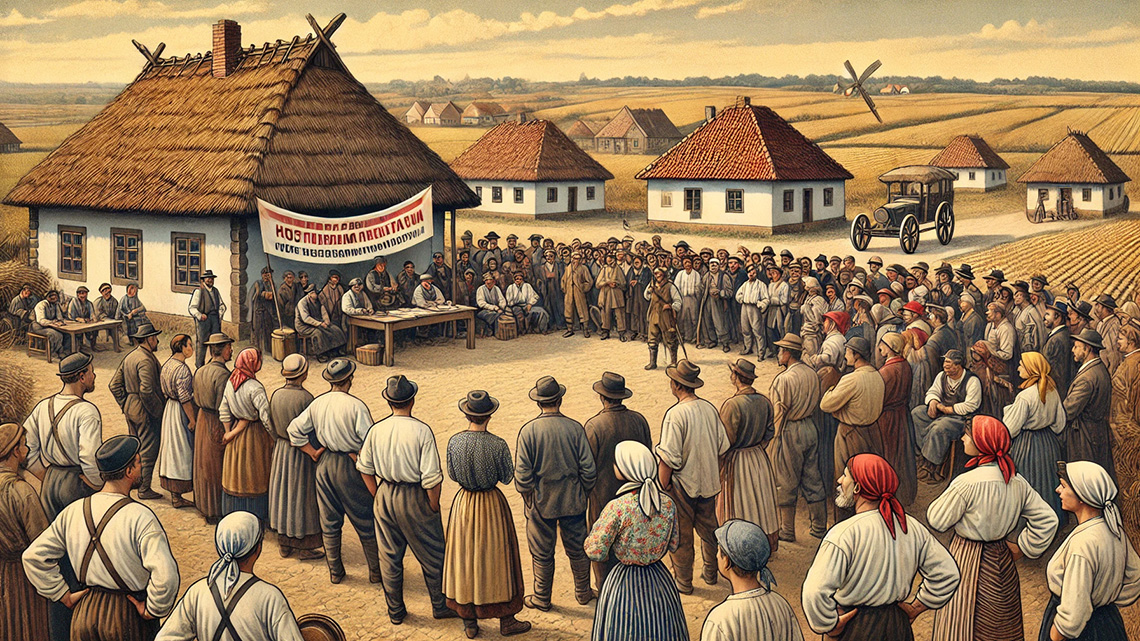
The difficult internal situation, the revolutionary state of the working masses, and the divisions within the Social Democratic Party created favorable conditions for the rapid penetration of communist ideas. Shortly after the Unification Congress, the first local organization of the Socialist Workers' Party of Yugoslavia (Communists) was formed in May in Kumane.
It was established in the house of Laza Jančić-Krmećak and had about 500 members and many sympathizers. The leadership included Čeda Stančić-Sergije (president), Ljubomir Čolić (secretary), and members Milutin Čolić, Racko Čolić, Boško Strajnić, Žarko Strajnić-Bađa, and Nova Staičić as a supervisory member.
Other members of this organization were Steva Radišić, Boža Radišić, Milutin Trifunjagić, Đurica Jeremić, Boža Lirić, Ljuba Mečkić, Pera Lirić, Joca Tatić, Maksa Mirilov, Boža Đurin, Milutin Miškov, Milan Čobanov, Đura Aćimac, Šandor Vioglavin, Kariton Mučalov, Spasoje Živanov, Živa Lazić, Milutin Brusin, Milutin Jelić, Blagoje Stančić, Lazar Brančić, Cvetko Lucić, and Branko Tatić.


Comments