



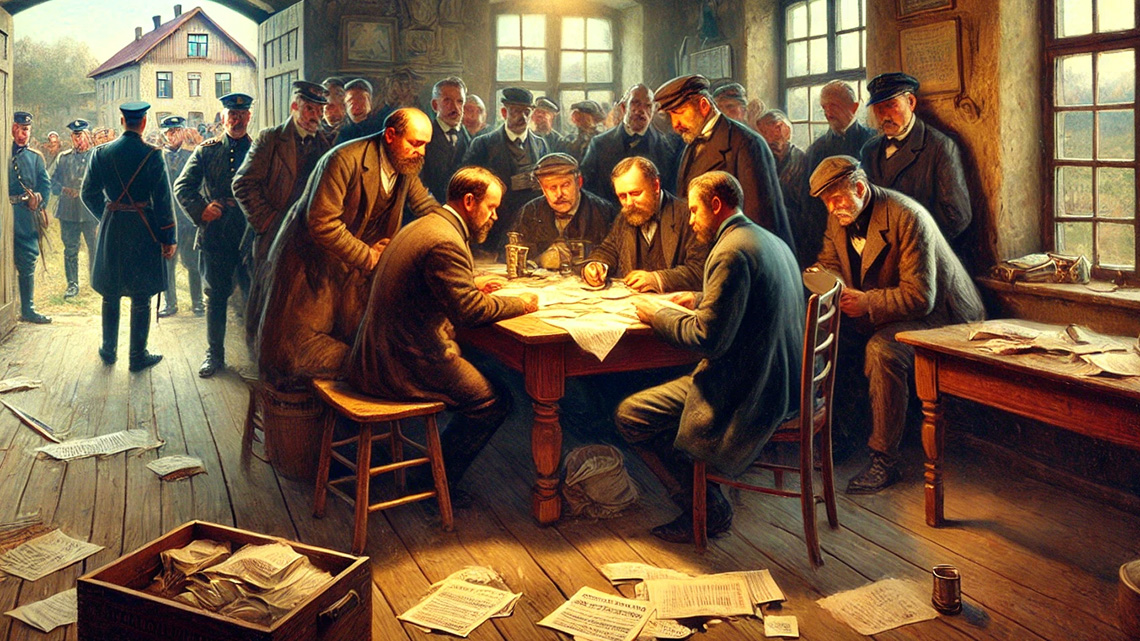
In the 1890s, Socialists were already participating in local elections. In some places, they took power. In Kuman, they achieved their greatest success in the municipal administration elections of 1898, when members of the Social Democratic Party were elected to the Municipal Board: Toša Stančić, the municipal prince, Boža Radišić-Bratko, the secretary, Živa Sekulić, and Laza Tubić, councilors.
Evidence for this is found in the contemporary civil press (»Torontal«), which reported that the Socialists of the Kuman municipality held a meeting attended by around 150 people. They had long planned this meeting, but the district head did not allow it to be held. As a result, they met illegally. The Melenačka gendarmerie station, which discovered this meeting, determined that the Socialists had elected leadership: Toša Stančić as president, who was also the municipal prince, Boža Radišić as secretary of the municipality, Jevrem Stančić as treasurer, Đuro Cicvarin as controller, and Živa Sekulić and Laza Tubić as members of the administration, who were also members of the municipal administration. When the leadership immediately started collecting membership fees and donations, the gendarmerie confiscated the money and a list with 482 names. Due to the meeting held without permission, the gendarmerie reported 61 members to the district head. Based on this report, they were arrested, and Toša Stančić and Boža Radišić were sentenced to prison.
The results of the agricultural workers' strikes, as well as the elections of Social Democrats to rural municipal administrations, led the authorities to take measures to protect landowners and large landholders. In this regard, the Hungarian government passed legal regulations in 1898 with the well-known Second Legal Clause, which was meant to regulate the relations between agricultural workers and employers. These regulations were aimed at preventing the organization of agricultural workers and strikes, i.e., against their organized struggle. Although the Second Legal Clause began to eliminate the remnants of feudalism, it was harsh and cruel to agricultural workers, which is why it became known as the »slave law«.



Comments