



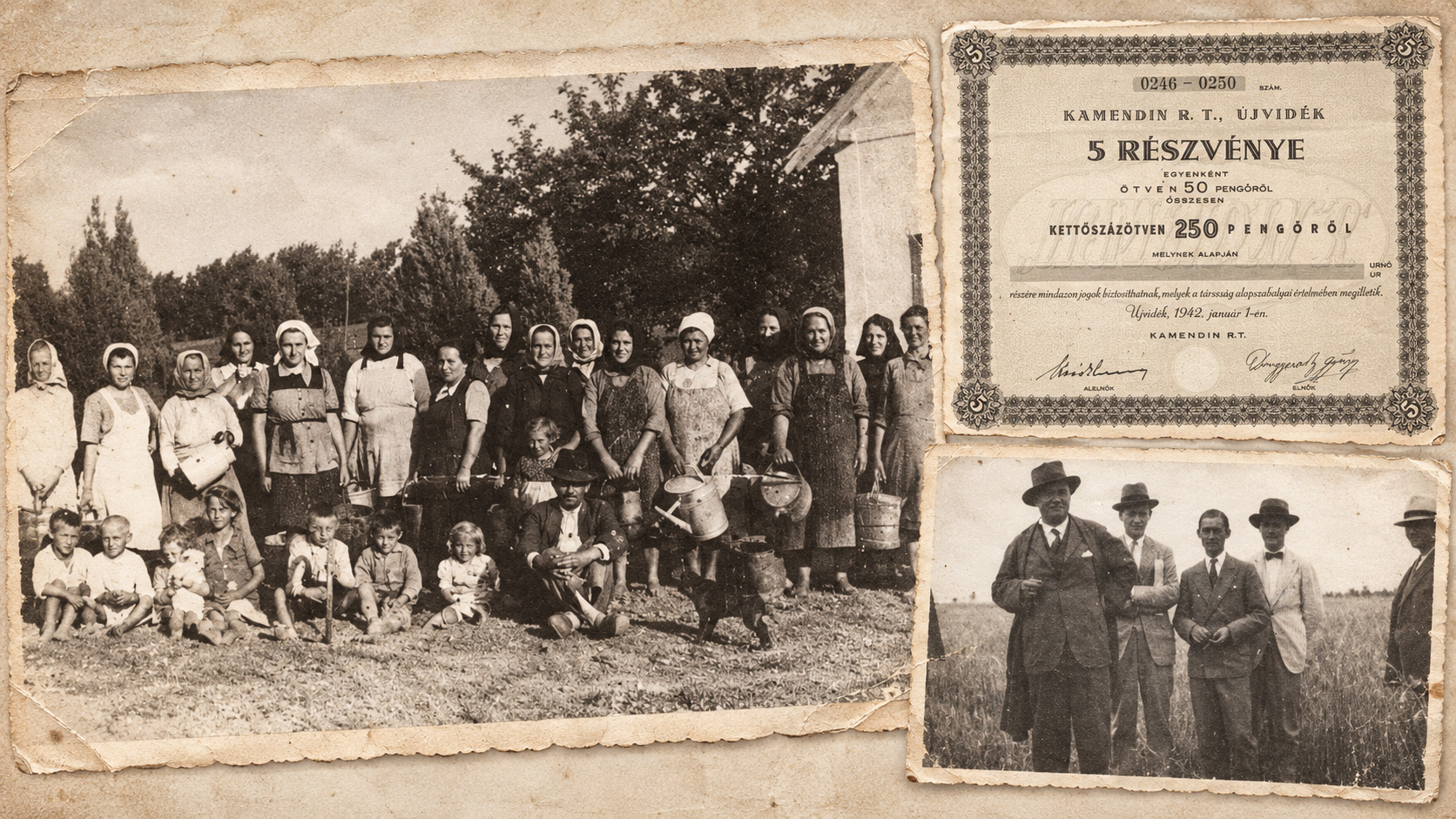
The detailed handover report for the estate in Sirig, presented in the previous instalment, reveals the condition of its buildings. Similar circumstances prevailed at Kamendin during the first year of the planned economy. The deterioration of residential and agricultural buildings made substantial investment necessary in the years that followed.
At the end of 1947, the condition of residential buildings and offices at Kamendin was recorded as follows:
| Building type | Year built | Condition | Number of rooms | Area |
|---|---|---|---|---|
| Residential accommodation | 1848 | Poor | 6 | 90 m² |
| Administrative staff accommodation | 1808 | Poor | 8 | 110 m² |
| Permanent workers’ accommodation | 1890 | Good | 12 | 240 m² |
| Permanent workers’ accommodation | 1808 | Poor | 12 | 192 m² |
| Permanent workers’ accommodation | 1808 | Poor | 4 | 80 m² |
| Permanent workers’ accommodation | 1808 | Poor | 6 | 120 m² |
| Permanent workers’ accommodation | 1808 | Poor | 3 | 60 m² |
| Permanent workers’ accommodation | 1890 | Poor | 18 | 360 m² |
| Permanent workers’ accommodation | 1850 | Poor | 4 | 64 m² |
| Permanent workers’ accommodation | 1860 | Poor | 6 | 96 m² |
| Offices | 1946 | Good | 4 | 80 m² |
| Office | 1890 | Poor | 1 | 25 m² |
The inventory of agricultural and service buildings included:
| Building type | Year built | Materials and roofing as recorded | Area |
|---|---|---|---|
| Tool and machinery shed | 1890 | Brick, roof tiles | 480 m² |
| Tool and machinery shed | 1885 | Brick, roof tiles | 60 m² |
| Tool and machinery shed | 1885 | Brick, roof tiles | 120 m² |
| Tool and machinery shed | 1887 | Brick, roof tiles | 160 m² |
| Maize crib | 1880 | Brick, roof tiles | 100 m² |
| Maize crib | 1870 | Wood, brick, roof tiles | 180 m² |
| Maize crib | 1880 | Brick, roof tiles | 30 m² |
| Maize crib | 1880 | Brick, roof tiles | 20 m² |
| Maize crib | 1890 | Brick, roof tiles | 200 m² |
| Small-grain storehouse | 1860 | Brick, roof tiles | 108 m² |
| Horse stable | 1860 | Brick, roof tiles | 216 m² |
| Horse stable | 1886 | Brick, roof tiles | 288 m² |
| Horse stable | 1890 | Brick, roof tiles | 324 m² |
| Horse stable | 1895 | Brick, roof tiles | 42 m² |
| Horse stable | 1896 | Brick, roof tiles | 120 m² |
| Cattle barn | 1860 | Brick, roof tiles | 240 m² |
| Cattle barn | 1890 | Brick, roof tiles | 800 m² |
| Cattle barn | 1890 | Brick, roof tiles | 180 m² |
| Cattle barn | 1860 | Brick, roof tiles | 500 m² |
| Pig house | 1890 | Brick, roof tiles | 1,000 m² |
| Pig house | 1890 | Brick, roof tiles | 500 m² |
| Pig house | 1890 | Brick, roof tiles | 500 m² |
| Pig house | 1840 | Brick, roof tiles | 800 m² |
| Pig house | 1840 | Brick, roof tiles | 500 m² |
| Fattening house | 1840 | Brick, reed thatch | 180 m² |
| Fattening house | 1840 | Brick, roof tiles | 420 m² |
| Dairy | 1880 | Brick, roof tiles | 30 m² |
| Workshop | 1890 | Brick, roof tiles | 30 m² |
| Workshop | 1890 | Brick, roof tiles | 40 m² |
| Workshop | 1946 | Brick, roof tiles | 64 m² |
| Workshop | 1890 | Brick, roof tiles | 25 m² |
| Garage | 1946 | Brick, roof tiles | 64 m² |
The estate also had 18 brick-lined wells.
These records show that a substantial proportion of the buildings dated from the late 19th century, when Laza Dunđerski was at the height of his economic power. Some were older still, originating from the period when Kamendin belonged to the Gorjup family.
Despite the deterioration of the buildings, enthusiasm for work and reconstruction spread among Kamendin’s workers from the time of liberation, particularly during the first year of the Five-Year Plan.
Kamendin among the Leading State Farms
In the November work competition of 1946, Kamendin ranked third among Yugoslavia’s state farms.
Following the May Day competition, the Competition Commission of the Central Administration of the Union of Agricultural Workers of Yugoslavia declared Kamendin the best agricultural estate in the country on 1 June 1947.
Kamendin’s workers and staff undertook individual and collective commitments and challenged other agricultural estates to compete. Particularly strong results came from introducing a system in which work was divided between brigades and smaller teams of ten.
The machinery section exceeded its spring ploughing quota by more than 50 per cent. Workers also volunteered to help agrarian reform beneficiaries in Sirig who lacked draught animals.
Using three tractors and 40 animal teams, Kamendin’s workers ploughed more than 100 cadastral jutra during April, helping the people of Sirig complete their sowing plans on time. Šandor Kalapoš was particularly noted for his contribution.
During the May Day competition, 1,837 saplings were planted, considerably improving the appearance of the estate grounds. Records show 20,184 hours of voluntary work in production and a further 1,215 hours devoted to the country’s reconstruction.
The introduction of production meetings was especially significant. Workers and management jointly prepared work plans, a practice regarded as an early precursor of workers’ self-management.
Kamendin in Jelena Petrović’s Report
Jelena Petrović wrote about Kamendin and the changes in its workers’ lives in the May Day issue of Slobodna Vojvodina in 1947. Her report reflects the pronounced ideological and journalistic tone of its time, while also preserving workers’ names, details of work organisation and descriptions of everyday life.
The following passage is translated from the supplied text, with spelling and punctuation edited for clarity:
“In the past, travellers passing near Sirig in Bačka would often turn towards the large farmstead hidden among the greenery to see what a wealthy man’s estate looked like. But the dense vegetation concealed the farmstead, while the sweaty, sunburnt and stooping people who worked all day in the seemingly endless fields around it were gloomy and silent.
They did not speak much about their lives, because from childhood the landowners had taught them to fear for their hard-earned piece of bread, to endure and remain silent. They never went anywhere beyond the farmstead, and the stories told by neighbouring farm workers were no happier than those they could have told about their own lives. Life was the same everywhere. Some suffered so that others could live comfortably and well.
These people, crushed by poverty, continued to serve Dunđerski, watering his fields with their sweat and reflecting at night, in their damp, low-ceilinged rooms, on how hard it was to be powerless and forever carry unspoken bitterness.
When the whirlwind of war swept across the fields of Bačka, yesterday’s servants and farm labourers sensed that something momentous had happened, something difficult to understand immediately. The neglected large farmstead, which its owner rarely visited because he had finer ones, became a state estate. Those who had been servants without rights became people who found joy in life through work, learned about a better life and developed into creators.
The agricultural specialists and workers of the Kamendin state estate faced a major task. A struggle began against everything that had, until recently, made work a burden and workers’ lives unhappy stories about the existence of ‘ordinary people’.
When the Kamendin state estate began operating, the farmstead was neglected and the land cultivated without a plan. All the tasks facing management and workers seemed equally important and urgent. Yet everything could not be achieved at once.
The only solution was to draw up a plan and then work persistently and selflessly to carry out everything it required. That is what management and workers did, and they can now speak about their achievements and their new intentions.
All work on the estate is now organised through the brigade system. Every team knows its task, every worker their duty. Work is no longer carried out without order or planning, as it once was, when each worker knew that thousands of others were selling their strength for a piece of bread and that the owner would not hesitate much when deciding to dismiss someone.
Work has become a matter of individual honour and collective pride. With the help of the estate’s agricultural specialists, the workers established quotas so that each person could receive the recognition deserved by their work.
Every day, an agricultural specialist went into the fields and recorded how much each worker could accomplish. They competed and worked diligently so that, during their breaks, leaning over the specialist’s notebook, they could help establish the quota. They made suggestions and consulted one another…
Then, one day, when quotas had been set for every type of work and the veteran worker Franja Horvat was told that he had become a brigade leader and informed of his new duties, he looked on in astonishment. How could he, whom nobody had ever consulted about anything, assess other people’s work? How would he manage the thick, colourful books he had been given?
But the manager’s friendly handshake helped him understand that people were counting on him and expected much from him. Only then did he notice how much the old farmstead, where he had worked for some ten years, had changed. The workers’ homes were whitewashed and clean. Instead of the muddy, rutted yard, a park now stood in front of them, decorated with flowerbeds shaped like five-pointed stars, while the workers’ children sang about Tito…
Only a few jutra remained to be sown with maize that had long been studied in the laboratories of the Experimental Station in Novi Sad. Crossing Flajšman and Bankut was intended to produce a new type of maize with characteristics best suited to the local climate.
This heterotic seed is now being multiplied for the first time on the Kamendin state estate, under the supervision of an agricultural engineer, and sown by the estate’s workers.
At one of the seed drills is Anuška Klipec, a blonde Slovak woman who has worked on the estate for years but has never distinguished herself in her work as she does now. Anuška is one of the estate’s most diligent workers, and the brigade leader has much praise for her. The others do not want to fall behind Anuška either. Everyone tries to do as much as possible…
The hardworking Mara Kavgić also works on the estate, where she has lived since she was twelve. She, too, now has reasons for happiness. As a child, she looked after the owner’s pigs; later, she led the horses. Now she has been assigned work of which she is particularly proud. She operates a seed drill and competes with her fellow workers.
She sees that life on the former owner’s farmstead is different now, that people are happier, more approachable and livelier. For Mara, the fields where she works and Kamendin, where she grew up, still make up her entire world.
Yet she now eagerly awaits the May Day celebration, because she will visit the city for the first time, see large buildings and new people, and share with them a great joy she has never known or experienced.
The banners that Kamendin’s workers will carry to the May Day celebration also reflect Mara’s labour and happiness. She, too, will proudly walk beneath the large banners on which the workers have recorded their achievements.
They exceeded the ploughing quota by 20 per cent and finished five days ahead of schedule. They exceeded the sowing plan by ten per cent and completed it four days early.
The names of Kamendin’s most diligent workers will not remain forgotten in Franja Horvat’s brigade book: Anuška Klipec, Ištvan Mađar, Đerđ Klipec, Lajoš Burnus, Jožef Madi, Eržebet Dobrotko, and Ferenc and Eržebet Horvat will proudly walk beside their machines. They will learn how valued and appreciated their rough, calloused hands are—hands that transformed a neglected farmstead into a respected estate and weed-covered fields into land bearing lush green wheat.
The state emblem that Kamendin’s workers are making from various seeds does not record the sad histories of people deprived of their rights. Instead, it expresses the great new joy of people who have discovered their creative strength through work and who, with their calloused hands, are opening paths towards a better future.”
Literacy Classes and the Opening of a School
In mid-1947, a literacy course was organised at Kamendin for all 34 residents of the estate who could not read or write.
The opening of a four-grade primary school was particularly important. Sava Soldatović described it in Slobodna Vojvodina on 28 December 1947:
“One of the flats is home to the family of brigade leader Jožef Molnar, who has been entrusted with pig breeding. It is a large family with many children, as is the case with most of the others. Alongside their father, three of the older children also work on the estate. The small, fair-haired Đerđ, or Đurika as everyone calls him, is in the second grade.
‘We did not have a school before,’ the boy replies confidently, looking brightly with his large blue eyes.
‘Nobody used to care about us,’ his father continues. ‘Now all our children attend school, here on the estate.’
In the past, few children of agricultural workers ever reached school. Their path through life was the same as their fathers’: childhood on an isolated farmstead and exhausting work from an early age, before eventually becoming and remaining hired farmhands. Today, however, Jova Sforcan and Jožef Alađi have been sent to agricultural school.
The estate’s best workers will attend courses for brigade leaders and team leaders. Little Đerđ’s father intends to keep him in education. ‘Let him learn more than I was able to,’ he says, and many other parents feel the same.
When it was proposed that their children attend school in Sirig, they disagreed. Why should they not have a school on their own estate?
In agreement with management, a small room between the storehouse and the workshop was quickly converted into a classroom. The school thus opened in the centre of the estate and, in the absence of a cultural centre, soon became the educational and cultural centre of the entire workforce.
Around 25 pupils from the first to the fourth grade attend this classroom every day. Fair-haired, brown-haired and dark-haired children listen attentively to their teacher, Ilonka Špic.
Alongside other subjects, the classroom features songs and recitations about Tito and readings from the Pioneer press. The children’s drawing books are filled with pictures of the great achievement of the People’s Youth—the Šamac–Sarajevo Youth Railway.
Katica Grizer, Đerđ Molnar and Jožef Turi are the best pupils, as shown by the competition board displaying the names of all the children.”
Electric Lighting, Radio and the First Film Screenings
The introduction of electric lighting on the estate and in workers’ homes significantly changed everyday life. Kamendin had 16 radio sets, and film screenings began on May Day 1947.
Giving his first newspaper interview, worker Mihalj Kelemen enthusiastically declared:
“We now have electric lighting in our homes, and for the May Day celebration they will bring a cinema from Novi Sad. We are all so eager to see what it is like.”
Until late 1947, performances on the estate were held outdoors. During the November competition, young people used voluntary labour to convert part of the former English Thoroughbred stable into a hall with a stage.
Sava Soldatović recorded:
“Every evening after work, the young people rehearse there for performances to be held in the coming days. They are not troubled by the bare stage, the lack of curtains or the fact that a few blankets serve as scenery. They will obtain those things too; the main concern is to prepare the programme as well as possible.
Ištvan Turai, Ištvan Horvat, Mihalj Hancko and others are particularly committed to this, as are the members of the tamburica orchestra, who take part in every performance.”
The “Red Corner” and Cultural and Educational Work
Considerable attention was devoted to ideological and educational activities at Kamendin. The trade union branch equipped a special room known as the “red corner”.
Newspapers were read there, and the texts of various regulations were discussed collectively. The room also housed approximately a hundred books in Serbo-Croatian, Hungarian, Slovak and other languages.
The school, trade union reading room, film screenings and youth performances became important parts of the estate’s social life.
Work Organisation and Livestock Development
In the same December 1947 article, Soldatović described Kamendin’s production, work organisation and appearance:
“The principal task of the Kamendin Livestock Institute is livestock farming. Although not all the conditions for more intensive work have yet been established, good professional leadership and the efforts of the entire workforce already allow Kamendin to serve as a model.
For the time being, the estate also engages in crop production and has produced substantial quantities of seed of various crop varieties. In livestock farming, breeding animals are obtained through the continuous selection of available stock with the best characteristics. In the near future, the institute is expected to receive 200 pedigree cows to support further work in this direction.
The animals bred so far will then be transferred to other state estates where livestock farming is not the principal task.
What particularly distinguishes this estate from many others is its small administrative staff, good work organisation and close cooperation among all members of the workforce in every task. Although it has only three or four administrative employees, its administration and bookkeeping are up to date. All other work, divided between brigades of permanent and seasonal workers, proceeds equally well.
Whitewashed livestock pens, spacious sheds for machinery and tools, storehouses, stables for working horses and cattle, workshops, workers’ homes and offices—all arranged in two elongated rectangles—form the centre where one of our country’s best agricultural workforces lives and works: the workforce of the Kamendin Livestock Institute.
It is among the best not only for its production achievements but also for the new way of working and living that is emerging.
The estate has seven work brigades. Four are permanent and three seasonal. The seasonal brigades consist of agricultural workers from nearby settlements with whom the estate has already concluded contracts. In this way, labour has been secured for agricultural work on approximately four thousand jutra of land.
Anyone interested in the estate’s present or future need not ask a manager: neither Uncle Marko Paunović, the director who, despite his years, is already at work at first light, nor his assistant Milan Vukelić, the veterinarian or the estate operations manager.
Simply walk through the estate and you will encounter the union branch secretary Mihalj Bene or its chairman Mihalj Tot, the teacher or one of the brigade leaders. Each knows what life was like here before, sees how it is now and believes that they will succeed in achieving what is still only planned. Everyone knows what they want to accomplish because they all belong to a united workforce…
Alongside improvements in product quality, substantial savings have been achieved in seed used for sowing and feed used for livestock.”
Building Repairs and Construction of the Access Road
Soldatović’s account also describes reconstruction work on the estate:
“Old, unsuitable agricultural buildings are disappearing, and new ones are being erected. A modern farrowing house and a separate enclosure with pens for breeding animals have been prepared. The barns have been repaired, and equipment has been installed to water cows inside the building.
Sheds for machinery and tools have been remodelled and expanded, and storehouses, workers’ homes and other buildings have been constructed. Finally, the pride of the entire workforce—a brick-paved road 1,800 metres long, completed through voluntary labour—connects the estate with the state road to Sirig and the international highway.
‘We are now connected to the whole country,’ one worker says proudly. Others speak with visible satisfaction about how a red five-pointed star will soon shine from the estate’s tallest building and how the enterprise’s name will be visible from afar.
Most new construction and the adaptation of older buildings to current farming requirements have been carried out by the estate itself, through the voluntary labour of the entire workforce.
Kamendin provides an excellent example of the importance of resourcefulness. Its workforce has so far succeeded in carrying out every idea despite the difficulties encountered.
Workers brought old materials—bricks, roof tiles and timber—from half-ruined farmsteads to the estate and used them effectively to extend, rebuild and repair existing buildings.
It is worth seeing how goodwill and resourcefulness can turn a shed into a storehouse and workshop, or a tiny room into a classroom.
‘The shortage of materials holds us back most. Otherwise, we would already have a cultural centre and new barns. As it is, we manage as best we can—we build new structures from old materials…’”
Housing, Wages and Workers’ Supplies
The report also described the living conditions of permanent workers’ families:
“The families of permanent workers live in flats arranged side by side in two long buildings. Once seemingly embedded in mud because nobody looked after them, they are now clean and whitewashed, with electric lighting in the rooms and kitchens and paved paths connecting them to all other parts of the estate.
This is still far from everything that is planned. Once the new barns under construction are completed, work will begin on new workers’ homes.
Most flats consist of a room, a kitchen and a pantry. The furnishings are simple everywhere: a table, chairs, a wardrobe and high beds with plump white feather duvets and pillows. Everything is clean, orderly and entirely simple. Some windows have a flowerpot.
The circumstances in which the estate’s permanent workers now live are unlike those of the past… Living conditions are different today: legally regulated working hours and remuneration, social insurance, rest and attention to every need—in short, the living conditions to which working people are entitled.
Monthly wages for permanent workers at Kamendin range from 1,600 to 2,000 dinars. In addition, they receive one jutro of land for growing maize and 200 square fathoms for planting potatoes. The estate provides draught power to cultivate this land.
Throughout the year, they are regularly supplied with specified quantities of meat and bread at uniform prices, as well as other estate products. They can all fatten pigs and keep substantial numbers of poultry, while some families also have sheep.”
The November Competition of 1947
The November competition of 1947 gave further encouragement to enthusiasm for work and competition, with Kamendin declared the best estate in Vojvodina.
A ceremonial meeting was held to mark the occasion. Slobodna Vojvodina reported that the workforce followed the proceedings attentively, from the anthem sung by primary-school pupils and a recitation by pupil Mihalj Horvat to the closing address by trade union branch chairman Mihalj Tot.
Guests included Mita Popović, director of the Administration of Provincial Agricultural Estates; Rada Prodanović, president of the Union of Agricultural Workers of Yugoslavia; and Jagoš Pušara, secretary of the Local People’s Committee in Sirig.
According to the newspaper report, Kamendin’s workforce exceeded its production target by 20 per cent, while production quality improved by the same percentage. These achievements were attributed to the application of agricultural techniques and the organisation of work into brigades and teams of ten.
Work meetings with brigade and team leaders took place every evening. With good organisation and assistance from professional management, some workers exceeded their quotas by 30 per cent.
Savings were achieved through the proper allocation of seed during sowing, regular livestock care and the appropriate composition of feed rations. Livestock feed consumption was reduced by 20 per cent compared with the planned quantity. Total financial savings amounted to 874,000 dinars.
During the competition, 23,185 hours of voluntary work were recorded. Tasks included harvesting maize, cutting maize stalks, repairing and maintaining residential buildings, constructing roads, dispatching and loading seed, and other activities.
Shock Workers and Awards for Achievement
On the competition commission’s recommendation, management named ten workers as udarnici, or shock workers, and awarded them cash prizes. A further 16 members of the workforce received commendations and prizes ranging from 1,000 to 2,800 dinars for exceptional effort and strong work discipline.
The following workers received the shock-worker title:
| Name | Amount by which quota was exceeded |
|---|---|
| Stanko Dragin | 30% |
| Šandor Kalapoš | 30% |
| Đura Legenj | 30% |
| Jožef Molnar | 30% |
| Ferdo Deak | 30% |
| Petar Kurbiš | 30% |
| Franja Turan | 25% |
| Mihalj Hancko | 20% |
| Jožef Alađi | 20% |
| Pal Martinak | 20% |
Mihalj Hancko expressed thanks on behalf of the award recipients. The president of the Union of Agricultural Workers of Yugoslavia then announced that Kamendin ranked first in Vojvodina and presented the workforce with books, two chess sets and a football.
For his dedicated trade union work, the Union awarded branch secretary Mihalj Bene 3,000 dinars.
Director Mita Popović thanked the workforce on behalf of the operational management authority. He emphasised that the achievement resulted from close cooperation between managers and workers in fulfilling production tasks.
For successful management, the Administration of Provincial Agricultural Estates of Vojvodina awarded Marko Paunović, director of the Kamendin Livestock Institute, 6,000 dinars, and his assistant Milan Vukelić 3,000 dinars.
The Slobodna Vojvodina reporter concluded the account by emphasising the workforce’s determination to continue implementing the Five-Year Plan, which it regarded as a guarantee of a better future.
Recognition from the FPRY Government in 1949
In early 1949, Kamendin received another important honour. For exceptional achievement in fulfilling planned tasks during 1948, it was named the best workforce among state agricultural estates.
At a ceremony held on 4 January 1949, it received a diploma and the challenge flag of the Government of the Federal People’s Republic of Yugoslavia.
The federal government awarded the estate 50,000 dinars, while the federal Ministry of Agriculture allocated 25,000 dinars to its five best workers.
The Agricultural Commission of the Main Executive Committee awarded Kamendin a further 50,000 dinars, and the Main Directorate of Provincial Agricultural Estates of Vojvodina awarded it 120,000 dinars.
On this occasion, the following workers received the shock-worker title:
- Jožef Molnar;
- Lajoš Boroš;
- Janoš Šulc;
- Stanko Dragin;
- Đura Legenj;
- Franja Horvat;
- Franja Grizer.
The Beginning of Substantial Investment
Investment at Kamendin began in 1947 to support the Five-Year Plan and intensify agricultural production.
Funds were directed towards constructing barns, livestock pens and workshops, improving living and working conditions for permanent and seasonal workers, and purchasing quality livestock and agricultural equipment.
In the first quarter of 1947, the institute submitted a request to the Planning Commission of the People’s Republic of Serbia for 88,000 dinars. This was intended for investment works, purchases and repairs outstanding from the previous year.
During the same year, a request was submitted to the Main Directorate of Provincial Agricultural Estates for the construction of a barn for 100 dairy cows, repairs to the narrow-gauge railway and other purchases, particularly quality livestock.
An October 1947 report on the progress of investment works stated that construction of the cattle barn had begun, but only the upright walls had been built. A further one million dinars was needed to complete the work.
The report was prepared on Kamendin’s behalf by deputy director Branislav Petrović and bookkeeper Danilo Nikolić, and on behalf of the Main Executive Committee of the People’s Assembly of the Autonomous Province of Vojvodina by Žarko Jakovljević and Veliša Raičević.
The same document recorded the purchase of 17 heifers, with a stated value of 9,500 dinars, and two seed drills valued at 64,000 dinars.
Comments