



Among the many tragic memories from the time of the Jewish deportations in Novi Bečej, one account stands out. Senji Maćaš recalled how Gabriela, the wife of merchant Adolf Berger, carrying her infant son Ladislav—born on January 19, 1941—managed to bribe a guard and escape through a prepared route into Bačka.
However, she was later arrested and vanished into one of the camps. Nothing more was ever learned of her fate. It is only certain that the entire Berger family perished.
Another particularly tragic story is that of Imre Deri, former director of the "Senćanska Steam Sawmill and Mill," who owned an estate near the Matejski crossing. He was approached by Franz Rajta, then head of the Banat District Economic Department, and persuaded to transfer ownership of his property under the guise of a fictitious sale. In return, Rajta promised to secure Deri’s passage to Hungary. It was, of course, a ruse. The only benefit Deri received was that he spent part of his captivity in his own apartment instead of a camp.
When the time came for deportation, Imre Deri was summoned as well. According to one version of events, he hanged himself in his apartment; another account claims he threw himself into the river from the transport barge and drowned. These reports came from Lazar Mečkić and Senji Maćaš, who remembered the event. Dr. Viktor Jordanić also learned from friends that Deri had jumped into the river, while Dr. Konstantin Vukov was told that Deri committed suicide upon learning he had to report back to the camp administration for transport.
The deportation date is most reliably established as September 20, 1941. Although some sources mention August 20—when deportations from Veliki Bečkerek and Pančevo took place—multiple records confirm the September date. This includes the death registry in the Novi Bečej municipal records, where the last entry is dated September 19, 1941, and a report by B. Ivković referencing the situation in the Novi Bečej camp.
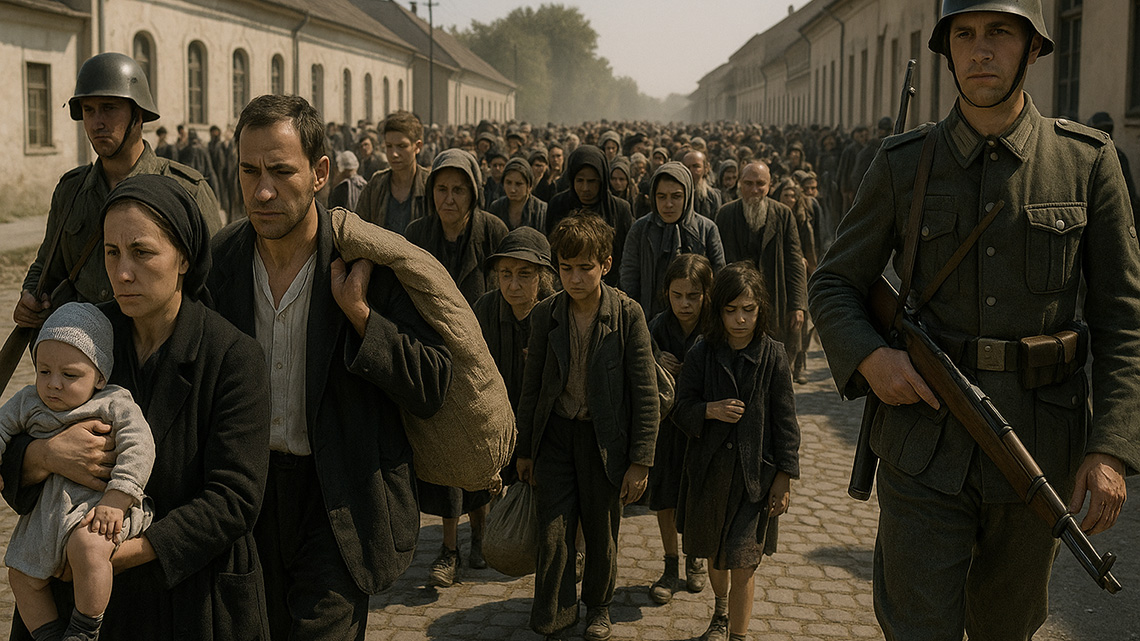
On the morning of that tragic day, the main street of Novi Bečej witnessed a heartbreaking sight. A long column of people—men, women, children, and the elderly—marched along the dusty road. With exhausted and terrified faces, the procession moved slowly under the watch of armed guards. The day was hot, and the people were hungry, weak, and ill. They dragged their meager belongings, while women led and carried small children who stumbled and fell.
Eyewitnesses described this as a “column of despair and death.” Among those who witnessed it were Svetolik Mečkić, who remembered that one prisoner managed to beg a guard for permission to go into his shop and ask for money. Others, including Nađ Šandor and Čeda Tašin, described the unbearable heat and the struggle of prisoners as they waited to board the barges. People formed protective groups to shield the sick and the young from the sun and created makeshift barriers to preserve a semblance of privacy for bodily needs.
The column turned left near the Catholic church, then right at the Orthodox church, moving toward the Tisa River port. There, between the river and the embankment, under the scorching sun and without food or shelter, they waited for hours. When the barge finally arrived, it was too small to hold everyone. Guards tried to force more people aboard, cramming them into the stifling, dark hold of the vessel. Many were left behind as night fell and no additional barges arrived.
To prevent escapes, the remaining deportees were herded into a nearby corn storage shed belonging to shoemaker Miša Lalić, near the Queen Mary Street. That night, without food or water, the exhausted and ill ten-year-old Katica Naftali—affectionately called “Kitika” by her classmates—passed away. Her schoolmate Mirjana Velisavljev, born Dragić, later shared this story and contributed a class photo showing little Kitika. Her seat in the fourth-grade classroom would remain empty forever. This death, like many others, was never officially recorded in the municipal registry.
The next day, Katica’s parents were transported with the others on a second barge. B. Ivković wrote that while Jews from southern Banat were sent to Belgrade in mid-August 1941, those from the northern parts—including Novi Bečej—were transported around September 20 in small groups on a barge that arrived after curfew. The barge, carrying about 170 Jews, was overcrowded and completely enclosed. The passengers endured darkness, lack of air, and extreme discomfort until dawn.
All the men were taken to the infamous Topovske Šupe camp, while women and children were temporarily accommodated in Belgrade under restricted conditions. According to a different account by Roža Niedermann, daughter of Bernat Naj from Novi Bečej, her family stayed with relatives in Belgrade. Some men were reportedly living semi-freely in the city before being taken to the Banjica camp in early December, from where they were led to executions.
Comments