



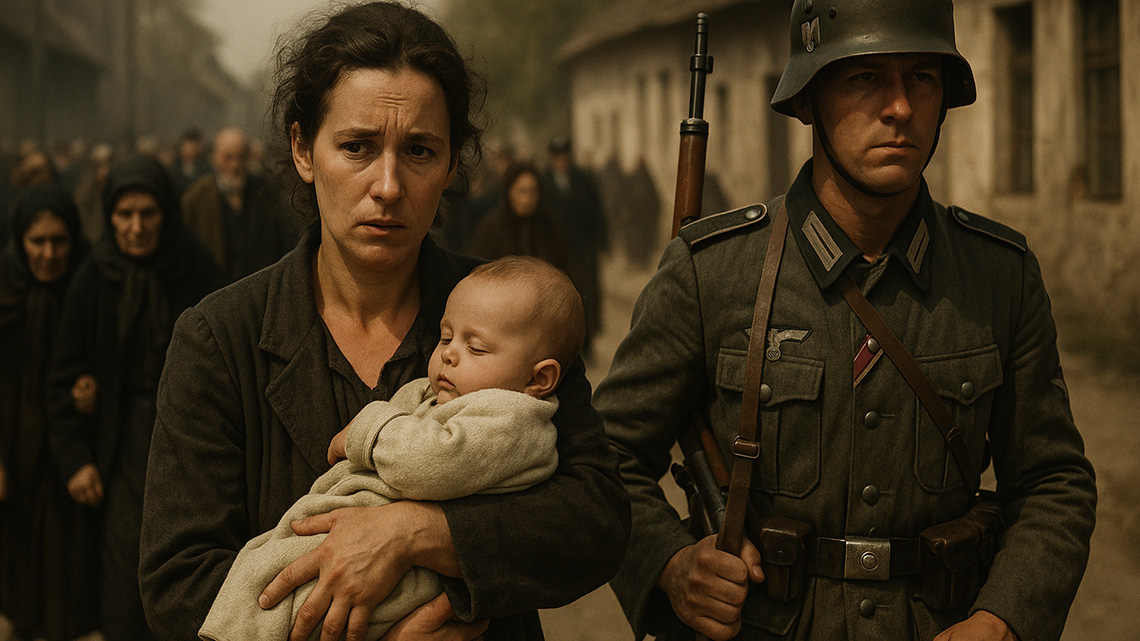
One account states that, during a brief period of partial freedom, some wealthier Jews from Novi Bečej managed to escape by bribing German soldiers—often drivers—and fleeing beyond the borders of Serbia. There is also a theory, based on unconfirmed information, that Verona, the daughter of Danijel Cigler, a timber merchant from Novi Bečej, managed to reach Romania thanks to her relationship with a German officer, and later emigrated to Israel after the war. However, this information was never officially confirmed.
In a series of articles by Jaša Almuli, published in Politika during April and May of 1989, we learn more about the tragic fate of the Jews from Novi Bečej.
The arrival of the Jews from Novi Bečej at the camp near Topovske Šupe coincided with the intensification of the national uprising in Serbia. As a result, the camp quickly became a reservoir for hostages to be executed in reprisal actions. On October 10, 1941, General Franz Böhme, commander of German forces in Serbia, issued a monstrous order: “One hundred hostages for every German soldier killed, fifty for every wounded.”
The camp rapidly emptied. Between early October and November, most of the detainees were taken for execution. Only 330 prisoners remained, who were used in November to prepare the camp at Sajmište for the arrival of Jewish women and children.
Jaša Almuli described these executions in his articles. As an illustration, he cited a report by Lieutenant Lipe about the first execution on October 9, 1941:
“The prisoners, carrying their belongings, were taken from the camp at 5:30 a.m. They were given tools to deceive them into thinking they were going to work. Their mood was good. The execution was carried out from 12 meters, with five riflemen per prisoner, and two soldiers finished off survivors with a bullet to the back of the head. Their belongings were handed over to the Security Police. The execution ended at 6:30 p.m. A total of 180 people were shot. Nothing unusual happened. The units returned satisfied.”
Executions continued until the camp was nearly emptied by early November. No further testimony or records about life in the camp have been found. What remains is the painful truth: nearly all the Jewish men from Novi Bečej were killed solely because they were Jews.
The Fate of Jewish Women and Children
The fate of the women and children was even more tragic. Upon their arrival in Belgrade, the Jewish community took them in, placing them with relatives, friends, and in the facilities of religious organizations. This difficult but seemingly free life lasted until early December, when an order was issued for their arrest.
All the women and children were gathered in front of the Special Police for Jews, located at 23 George Washington Street, and from there were escorted under guard to Sajmište, to Pavilion No. 3.
Survivors left horrifying testimonies about the living conditions:
“Each person had only half a meter of space to lie down. Women often fell down the stairs and died. The walls were freezing, windows shattered, floors soaked with water and urine. We slept on damp straw, often without anything to cover us. The food was awful: a cup of hot water in the morning, slop for lunch and dinner, and 150 grams of bread per day.”
Children suffered terribly—many died from hunger, cold, and frostbite. Their nails and skin fell off, and most of the sick had no access to the camp’s only infirmary.
The Pogrom – March 1942
In early March 1942, the systematic extermination began. A special Saurer truck, known as the gas van or dušegupka (soul-killer), arrived from Germany. Its task was to suffocate detainees with exhaust fumes during the ride to Jajinci.
“The victims were told they were being relocated to another camp. They packed their belongings into a separate truck while they boarded the gas van. After crossing the bridge, a pipe was connected from the exhaust into the sealed cabin. Thus, every day except Sundays, women and children from Sajmište died in the gas van and were buried in mass graves.”
The final transport occurred on May 10, 1942, when even the members of the Jewish camp administration, doctors, and the sick were killed. The Serbian prisoners who unloaded the bodies were then executed to eliminate witnesses.
The gas van was returned to Berlin, and the perpetrators were rewarded with leave.
Closing a Chapter
This is how the last women and children of Novi Bečej’s once-thriving Jewish community perished. This community, which had contributed to the development of Novi Bečej for decades, was annihilated without guilt—wiped out in the whirlwind of one of the most horrific crimes of World War II.
Today, Novi Bečej hardly remembers its Jews. It is our responsibility to preserve the memory of their lives, their contributions, and their tragic fate through this text.
Comments