



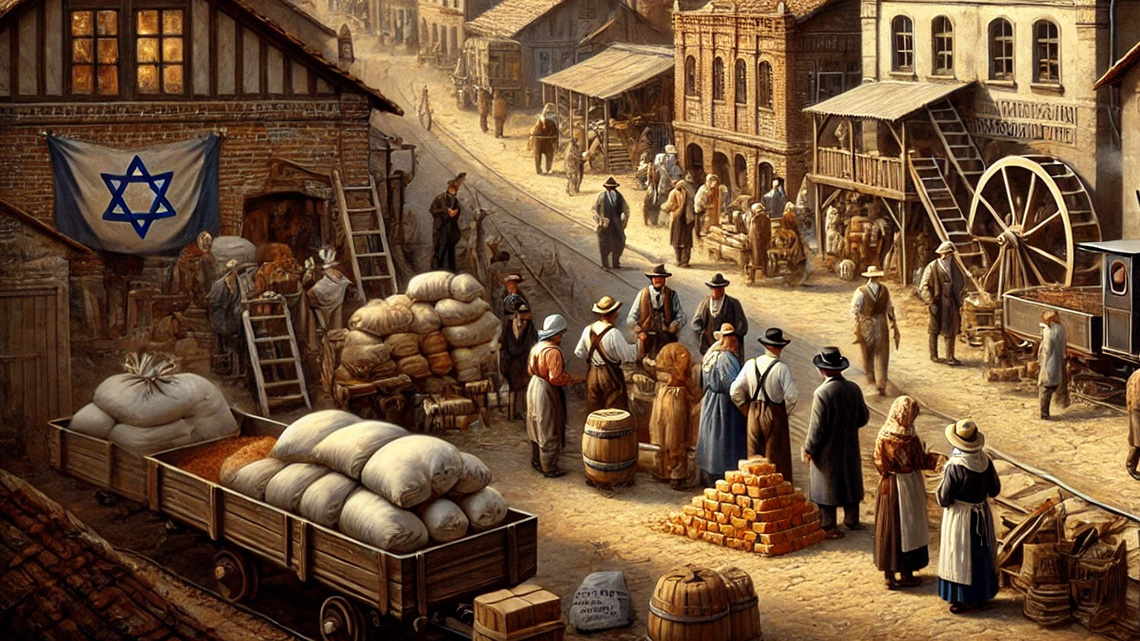
The general characteristic of this era was the strong development of industrialization, modernization of transportation, with a marked preference for railroads. Novi Bečej, in such conditions, had nothing to offer. In fact, it lost its previous advantage, and this was the cause of its increasing lag behind Veliki Bečkerek and Velika Kikinda, which gained new momentum.
This particularly applies to Veliki Bečkerek, which, as a new center of Banat, became an industrial city on the rise. Located at a very good transportation position—at the crossroads of land routes—this city became a true Mecca for fresh capital, which began to flow in from all directions, attracting mutual investment. There was some progress in Velika Kikinda as well, while Novi Bečej was entirely left out of this great race. There was no larger capital, so investments were relatively small, and the neighboring municipality of Vranjevo, rich in good land and agricultural products, was not interested in investing in modern industrial branches. Apart from existing mills and a steam sawmill, there was a brick factory, or tile factory, in Vranjevo, and since 1910, a small brewery was operating. These were the only capacities that somewhat resembled industry (L. Mečkić - NOVI BEČEJ AND VRANJEVO THROUGH HISTORY – Industry). Therefore, the development of Novi Bečej’s economy began to slow down. This trend discouraged entrepreneurs, and all those who wished to act in prosperous environments left Novi Bečej and moved to the cities. This surely also affected the Jewish population, as younger and more ambitious individuals moved to Veliki Bečkerek, Velika Kikinda, Senta, Stari Bečej, and other cities. The older generation stayed behind. This was likely one of the reasons for the declining birth rate in the Jewish community, which would be strongly felt during this period.
This population shift is evident from the data we could access from school registers. In these records, there are over seventy various family names that appeared among student parents, and we know that the number of families in each school year was considerably smaller. More than a quarter of these names represent parents who moved away at that time. There were many cases where families lived in Novi Bečej for only two or three years. However, amidst these movements, about forty families had already settled and could be considered indigenous. Such assumptions are supported by the data already highlighted on page 20, where it is evident that during the first two decades of the 20th century, the average annual number of newborns dropped from 7.4 in the 19th century to 4.0; the number of marriages from 2.7 to 1.6, and the number of students in school from 40 to 17.5. However, since the death rate decreased from 4.0 to 3.5, it is reasonable to assume that the number of young families, i.e., those having children, decreased, while the number of older members also diminished but to a lesser extent, because it is logical to assume that death data mainly refer to the elderly, and mortality slightly changed.
Nevertheless, despite the decrease in the number of young Jews in Novi Bečej, those who stayed put down roots, stabilized, found good paths to prosperity, and began to develop the life of a new Jewish community that was more focused on public life and fellow citizens of other nationalities. This change is also visible in the occupation structure of Jewish families, as the number of wholesale firms and grain traders in commerce increased, as well as the number of Jews in public services and the civil service in general. Part of this same process was the rise in the educational level of young Jews, who were sent to higher education institutions, which led to a change in the educational structure in favor of a larger number of educated members of the community (CONTRIBUTIONS: List of Prominent Individuals).
The consequence of all these changes was the greater involvement of young Jews in the public life of the town, particularly in football, which had just begun to develop. A significant fact was that young Jews appeared as active players, while older ones were interested in managerial positions (L. Mečkić: Ninety Years of Football in Novi Bečej). We do not know the exact involvement of Jews in other social activities, as we have no data on this, but it can be assumed that during this time their religious and cultural society "HEVRA KADISHA" might have been established, which we know operated positively between 1920 and 1941 (In the Land Registry Directory of the Novi Bečej Municipality for 1937, it is recorded as "Novi Bečej-Vranjevo HEVRA KADISHA").
The rise in the general educational level of Jewish youth is evident in their relationship with the Civic School in Novi Bečej, which was established in 1908. Throughout the time this school operated, there were always Jewish students, and their percentage in relation to other students was significantly higher than in the elementary school, showing their desire for youth education (CONTRIBUTIONS: List of Jewish Students in the Civic School 1908-1920). This trend was also felt in the fact that Jewish girls enrolled in women's practical knowledge courses that were held at the Civic School in Novi Bečej from 1912 to 1918. For example, the daughter of lawyer Dr. Samek attended these courses for three years.
When World War I began, Jews, like everyone else, participated. We have no data on the number of war participants, but we know that at least three Jews were killed. We say "at least" because not all of the data were entered in the death register. In the death register of the Novi Bečej municipality, under number 32ž917, we find that Gotlib Samuel, born in 1886, a commercial assistant and Austro-Hungarian officer, was killed in battles near Šabac in 1914. Under number 20ž918, we find a record of the death of Kon Šandor, born in 1895, a commercial assistant who died in an unknown place in 1916.
There is no record of the death of Šafer Samuel, a merchant born in 1890, in the death register, but his death was a well-known fact to all townspeople, including the author of this text, as the family of the deceased lived in his immediate neighborhood.
During the unrest at the beginning of November 1918, after the departure of the Austro-Hungarian army and before the arrival of the Serbian army, a rebellion broke out among the poor of Novi Bečej, who looted and set fire to a number of the wealthiest stores. The ironmongery and house of Jewish merchant Hugo Richter on the main street suffered the most (B. Čiplić - "The Day of Judgment Arrived in Bečej" - Farewell to Rahava). It is very likely that other Jewish shops were also affected, but this stopped after a few days, and the new authorities began to restore order and return everything to normal.
Thus ended the last period of Austro-Hungarian rule in Vojvodina, which brought equality and affirmation for the most capable Jews of Novi Bečej, many of whom achieved personal wealth and great business success. From that time, many beautiful houses and well-developed businesses remain, which would continue their development even after the change of government. But that will be the subject of the next chapter.
Comments