



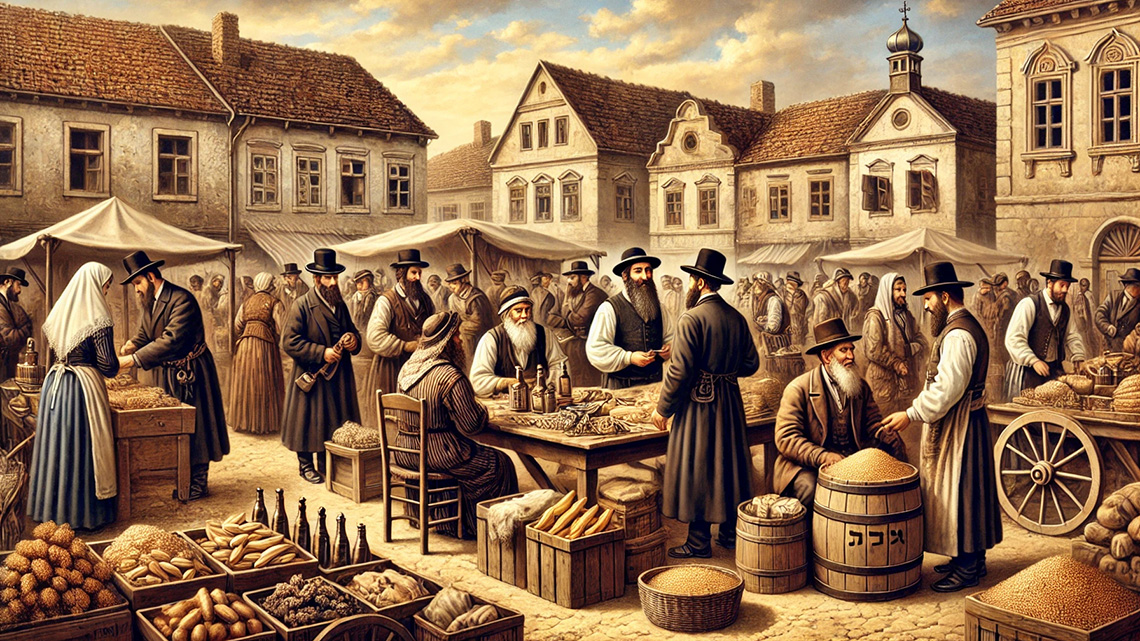
Novi Bečej, along with Vranjevo, was a prominent trading center during the era of the Great Kikinda District, particularly known for its grain export trade in the late 18th and early 19th centuries.
Due to its exceptional geographic location—situated in the heart of a vast agricultural region and strongly connected to the Tisza River, one of the most significant transport routes in Southern Hungary—it provided a large market for grain. This market was linked to Croatia, the Adriatic ports, and, via the Danube, to Austria and Germany.
At the height of the grain trade boom, Jews were still unable to participate due to various legal restrictions. However, with the gradual liberalization of laws allowing them to engage in different professions, they slowly but surely moved into commercial activities.
As the general economic development of Banat increased the demand for goods, Jews took on many business activities that members of other ethnic groups were reluctant to enter. These included small-scale retail trade, purchasing and reselling hides, bones, feathers, scrap metal, and other raw materials for crafts and industry. They were also engaged in brokerage and trade agency services. Initially, they opened small shops in hamlets and villages, later expanding to larger centers and specializing in particular types of goods. There are few records of these early beginnings, apart from those noted by Vasa Stajić in The Great Kikinda District 1776–1876, where he mentions cases of Jewish leaseholders of royal rights for alcohol sales and fishing in the district’s settlements (V. Stajić – The Great Kikinda District: Jews and Royal Rights).
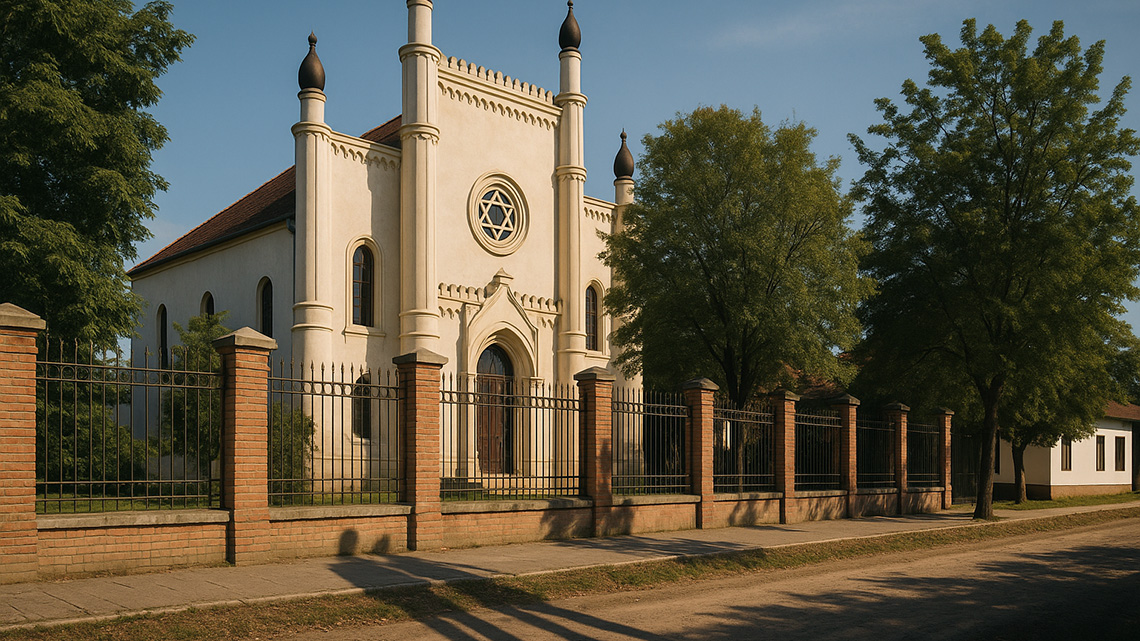
Following the adoption of the 29th Act by the State Assembly in Pressburg in 1840, Jews were granted equal rights to engage in all types of businesses across Hungary, Croatia, and Slavonia, provided they were born in these regions and were otherwise law-abiding citizens. This marked the beginning of more intensive Jewish economic involvement in Banat. By that time, the Jewish religious community in Vranjevo and Novi Bečej had already formed, as evidenced by the Jewish cemetery established in 1825. There is also speculation that a temporary synagogue existed in Vranjevo before the Novi Bečej synagogue was built in 1865, 42 years after the cemetery was founded. Unfortunately, no concrete evidence confirms this, apart from testimonies from two elderly residents of Vranjevo (Contributions: Memories of István Szekeres and Slavko Mojicki).
According to the Austro-Hungarian census of 1857, there were 237 Jews in the Novi Bečej district, meaning that around 200 Jews lived in Novi Bečej and Vranjevo. The 1870 census recorded 190 Jews in Novi Bečej alone, indicating a strong and growing community. The rapid increase in population suggests that the economic and social environment was favorable for their development. This trend is further confirmed by the first official records on occupational structures from 1876, presented by D. Čolić based on archival sources (D. Čolić: Jewish Participation in the Economic Development of Banat).
For the year 1876, the following Jewish-owned businesses were registered in Novi Bečej:
- Julo Hirschl, owner of a general store (1876–1902)
- Bodog Berenji, owner of a hardware store (1876–1883)
- David Adolf, owner of a general store (1876–1891)
- Georg Lukseder, grain trader (1876–1902)
- Pinkus Klein, owner of a general store (1876–1902)
- Breitner & Son, owners of a general store (1876–1884)
The following year, 1877, saw the establishment of a credit bank by Rosenberg, Berenji, and Breitner, as well as the opening of textile shops owned by Adam Simon, Ignác Reiter, Ludwig Kraus, and Jakob Spitzer. Grocery stores were also opened by Edo Hakner, Stefania Kaiser, and Eliza Hyman. In 1882, the Vranjevo-Turkish Bečej Savings Association was founded by Bodog Berenji, meaning that within five years, two financial institutions had been created—an indication of the era’s needs, with Jews playing a key role.
In the following years, specialized businesses emerged. In 1885, Ignác Reiter opened a shop for handicrafts and fashion goods; in 1888, Adolf Wiks established a vinegar production workshop; and Adolf Lorsi opened a wine trade business. In 1895, Daniel Rosenberg started a soap manufacturing business, and Anna Grossman opened a second hardware store. From 1878, Leopold and Izidor Reiser were engaged in the purchase and sale of raw hides. Towards the end of the century, Jews began entering the grain trade, with Kon Gutman and Frankl Sándor active from 1881 to 1900. József Hartl ran a lumber business from 1878. However, there is little documentation on traveling peddlers, feather collectors, and scrap metal dealers.
One particularly noteworthy event was the establishment of the first industrial enterprise in Novi Bečej in 1867—a steam sawmill and mill—founded by a Jew from Senta, Vilmos Milko. This enterprise would remain one of Novi Bečej’s most significant economic entities for many years.
By the final decade of the 19th century, around 40 Jewish-owned businesses operated in Novi Bečej and Vranjevo. Registry books and municipal school records reveal the diverse range of Jewish professions at the time. Between 1890 and 1900, the occupational distribution was as follows:
- Merchants, traveling salesmen, and bankers: 44 families
- Innkeepers: 4 families
- Craftsmen and manufacturers: 8 families
- Clerks and bookkeepers: 7 families
- Cart rental services: 3 families
- Rentiers: 4 families
- Work supervisors (ispáns): 4 families
- Managers and specialists in the steam sawmill: 3 families
- Intellectuals, apart from clerks, included a teacher, a doctor, a lawyer, a rabbi, a cantor, and a shochet (ritual slaughterer).
This occupational structure highlights the significant economic role of Jews in Novi Bečej. Additionally, they entered public service, with two Jews employed in government institutions, one in the postal service, and one in the railway. At the time, such public roles carried considerable influence. Notably, Novi Bečej was home to lawyer Nándor Mitelman, who moved from Kovin, and Dr. Salamon Stern, a native of Novi Bečej who left the town in 1898.
It is important to remember that during this period, Jewish and non-Jewish citizens increasingly integrated, with national distinctions gradually fading. Through their skill, humility, and hard work, Jews achieved equal status in society. However, as they emerged from isolation, they increasingly identified with Hungarian, and to a lesser extent German, national sentiments. By the 20th century, some Jewish families had fully assimilated.

Comments