



We have no data on how the social life of Jews in Novi Bečej and Vranjevo was organized. However, there remains a general impression among those who remembered that time that the main strength that united them was their religious community, which followed the development of the community and sought to organize assistance whenever a family faced difficulties.
These memories indicate that each Jewish family or individual had the right to expect help from their religious community up to three times, and if they failed after that, they were expected to be left to decline. This is likely true, as the development of the community shows that it achieved significant material success. A large number of community members knew how to persistently fight for success, change jobs, and undertake new, previously unknown types of economic activities. There were traders who changed the type of goods they dealt with, and they were often the first in new economic ventures. One example is the venture of founding a steam sawmill by Milko Vilmoš, who came from Senta and created a powerful business with a rather complex operation. First, timber had to be procured and brought by rafts from Erdely, downstream on the Tisa, then mechanically pulled out of the river and stored to dry. After that, the wood had to be sorted, and beams, planks, and other small pieces for further craftsmanship were made according to the quality of the wood. All this required large storage space, large wooden sheds for powerful saws, and space for storing sorted wood that was sold. The sawmill also had its own transportation if needed for delivery. All of this required considerable expertise, organizational ability, and diligent care to ensure everything ran smoothly, as significant damage would occur otherwise. For security reasons, the company always brought in its experts from Senta, who were usually Jews and sometimes even relatives. Since the sawmill also had a mill, the company’s operations were quite extensive, but the leadership was carefully selected, and nearly always predominantly Jewish. This continued for many years. The director was always Jewish, followed by section leaders, machinists, millers, accountants, and clerks. These were always capable and productive expert teams, so the company operated successfully until the economic crisis, when the steam sawmill had to cease operations. The mill, however, was reconstructed and its capacity increased, operating until 1944 when the Germans burned it before retreating. We highlight this business not only because it was a special type of enterprise but also to understand the organizational ability of the Jews, who played a decisive role in it until the firm’s closure (CONTRIBUTIONS: Data on the parents of elementary school students 1888-1898).
A similar economic initiative was undertaken by the Jews in the founding of Novi Bečej banks, where they also played a prominent role and were often key figures on the management boards. This continued until the end of their lives, as the last president of the board of the Tursko-Bečejska savings bank in Novi Bečej was Deri Imre, who was also the last director of the mill, the remaining part of the firm: "Senćanska steam sawmill and mill."
Among the original pioneers, we should include the few Jews who, during the large earthworks on the Tisa embankments, had special carts made for transporting soil and rented them out (Ibid.). Another rare occupation at the time was organizing the collection and drying of medicinal herbs, as well as organizing the "Domestic Crafts" work for women, which the Jews in Novi Bečej were the first to organize.
We mention all these examples to highlight the persistence and inventiveness of individuals who fought to achieve material well-being through their own labor. In these efforts, they helped each other or cooperated equally, which was significant at that time (specifically the late 19th century). Jews were still in a position where they were not entirely equal, especially when starting their lives, and they could only succeed if they relied on the solidarity of their fellow countrymen. The religious community at that time oversaw these interpersonal relations, and they bore fruit.
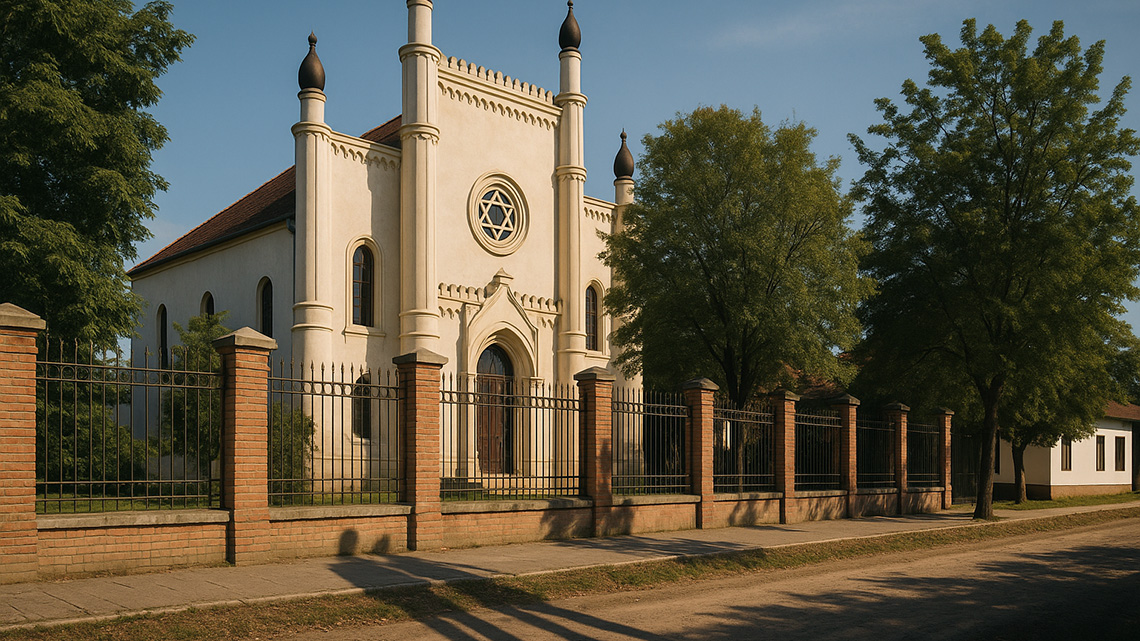
One of the most significant actions of that time, which involved all Jews, was the construction of the synagogue – their religious home, built in 1865. At this moment, we have no data on how the action was carried out, but according to the memories of the oldest residents of Novi Bečej, difficulties are mentioned that the authorities posed at the time, in an effort to marginalize the significance of this public building and reduce its visibility in the panorama of Novi Bečej. It seems this was the case, as the building was not only modest in appearance but also fairly deeply embedded in the churchyard (B. Čiplić: "Synagogue" - from the collection "Farewell to Rahav"). This building became their shared home, bringing them together and connecting them with one another.
At the end of the century, the Jewish School was founded within the framework of the religious community – a kind of supplementary practical education with an economic character, to which children were sent after completing elementary school. This institution had great significance for the community at the time, and it operated until the establishment of the Civil School in Novi Bečej, which took over this task at a more professional level. Unfortunately, we do not have detailed data on the school’s operations, but we find some information in the memories of the oldest residents of Novi Bečej, recorded by Lazar Mečkić in his book "Novi Bečej and Vranjevo Through History" (L. Mečkić: NOVI BEČEJ AND VRANJEVO THROUGH HISTORY).
From the example of the Jewish School, we can see their efforts to improve and advance the educational level of their youth. This effort is also evident from their advocacy for all children to finish elementary school, even though it must have been quite challenging, as some families were large, and school records show that there were families with three or even four students in a single school year (CONTRIBUTIONS: Data on the parents of Jewish schoolchildren 1888-98). However, the records also show that every better-off family made efforts to ensure their children completed the V and VI grades of elementary school, which was relatively rare at the time (Ibid.). All these measures contributed to the stronger integration of Jewish youth into the general public and cultural life of the place and paved the way for their equalization with other citizens.
We can only assume, as we have no data on this, that Jews gathered mostly at their religious meetings, especially during the organization of their major religious holidays, where the main focus was mutual assistance.
Thus, the Jewish community of Novi Bečej and Vranjevo entered the 20th century well consolidated, with a strong layer of materially prosperous fellow countrymen, a group of intellectuals and public workers who acted as a leading cadre for further progress in the 20th century.

Comments