



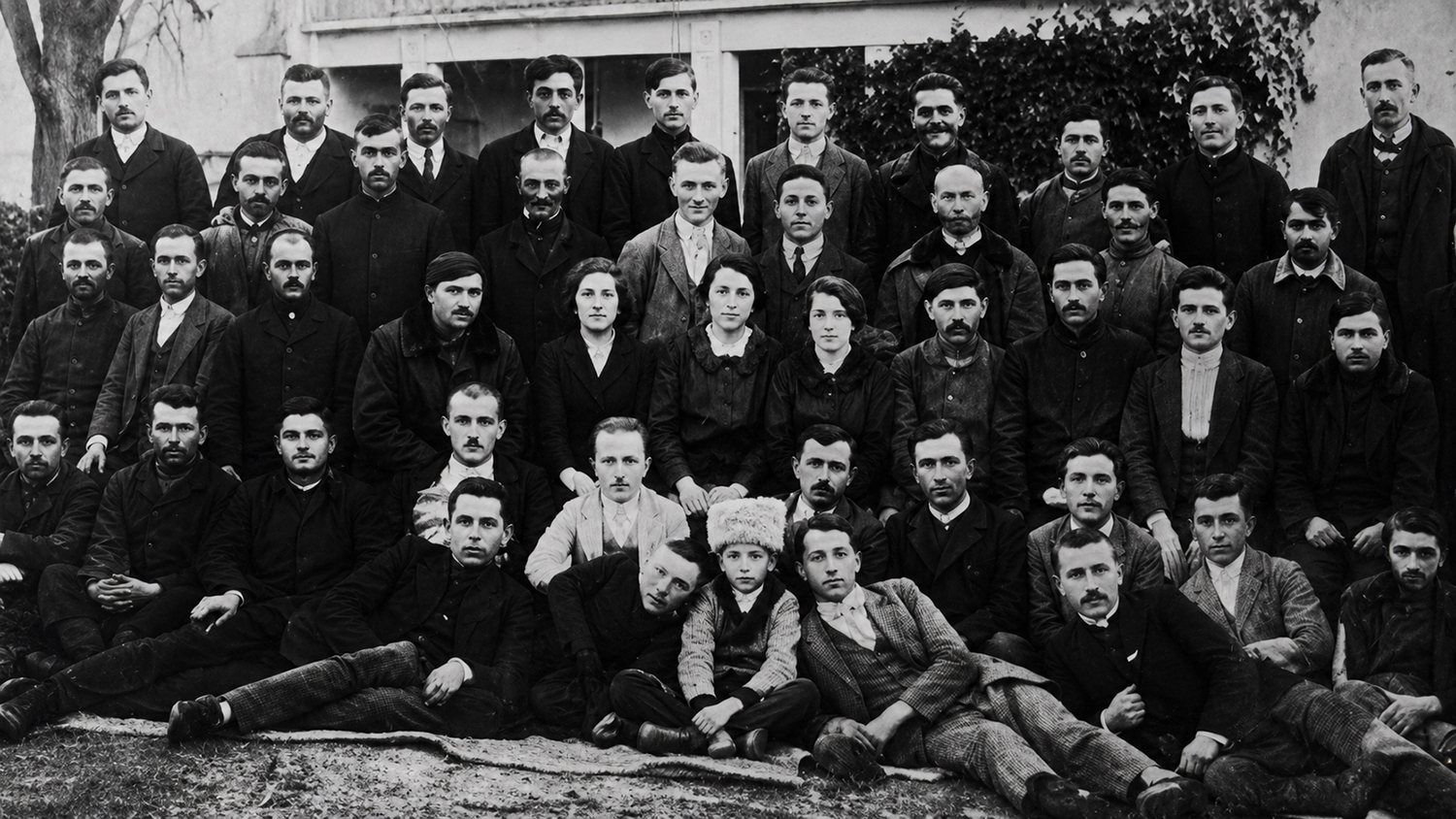
In the years leading up to World War II, the Jewish community of Novi Bečej lived much like the rest of the town’s population. They did not perceive the rise of fascist movements across Europe as an immediate threat to their survival, believing that, if war broke out, they would manage like everyone else. This belief was perhaps reinforced by the fact that there were very few ethnic Germans in Novi Bečej, and anti-Semitism was not openly felt.
Jewish intellectuals did not take any specific precautionary measures, nor did they warn their fellow citizens of the growing danger. There was some awareness among students and pupils, but their numbers were small and their influence limited. As a result, out of around fifty Jewish families living in Novi Bečej, only one managed to take timely action to escape the coming catastrophe.
That was the family of Adolf Šlezinger, a grain trader. His two daughters married men of other nationalities — one from Dalmatia, the other from Bosnia. These sons-in-law helped relocate the entire family first to Split, then to Korčula, and after the Italian capitulation, to Bari, which had already been liberated. Those who escaped were: Adolf Šlezinger, his wife Seren, son Viktor (now Dr. Viktor Jordanić), daughter Marija, and younger daughter Julija.
Besides this family, only 15 individuals survived — mostly because they were not in Novi Bečej during the tragic events.
The only known person to survive the deportations from within Novi Bečej itself was Helena Kiurski, née Beamter, who was married to a Serb, Stevan Kiurski, a local blacksmith. She survived because of her marriage to a non-Jew and her serious illness. Another key factor in her survival was the intervention of several influential individuals at the time.
There are reports of two other survivors from the warehouse camp in Novi Bečej: siblings Tibor and Olga Ungar from Novi Kneževac. Also, Zlata Raičević, now a dramatic actress from Podgorica, survived imprisonment in the Novi Bečej synagogue — she had been detained in 1941 as a Jew married to a Serb from Melenci.
An unverified account suggests that Verona Cigler, the young and beautiful daughter of Daniel Cigler, managed to escape from Belgrade to Romania with the help of a German officer, and later emigrated to Israel.
After the war, a few former members of the community returned to visit Novi Bečej, including Viktor Šlezinger, Magda Kanic, Ženi Kaštiher, Geza Šafer, and Dr. Albert Vajs. For a while, Jovan “Janči” Šlezinger and Ana Handler (married name Cvejin) also lived in Novi Bečej.
A complete list of the survivors is available among the appendices to this article.
With the exception of the few mentioned, all other Jewish families in Novi Bečej faced their fate at their own doorsteps. On September 20, 1941, Novi Bečej — like the rest of Banat — was declared “Judenfrei” (“cleansed of Jews”), as the Nazis proudly proclaimed. The entire community was wiped out through harsh and systematic measures imposed by the German occupying forces.
The Persecution Begins
Persecution of the Jews began immediately after the Yugoslav army's withdrawal and the collapse of the old government. The new local authorities were formed by the Volksdeutsche (ethnic Germans). While their numbers in Novi Bečej and Vranjevo were small, they were reinforced by ethnic Germans from surrounding areas and joined by fascist-leaning locals.
Some individuals saw the collapse of the state as a chance for personal gain and quickly began to harass and intimidate Jewish families, aiming to confiscate valuables under the guise of helping or protecting them — promises that were never fulfilled.
By April 12, 1941, the German military administration had begun registering all Jewish families and businesses. Shops were closed and marked with signs reading "JUDE", which meant that Jews could no longer trade with non-Jews.
Immediate restrictions followed:
- Limited freedom of movement
- Curfews specifically for Jews
- Bans from public places like cinemas and restaurants
- Forced eviction from their homes, which were taken over by new authorities, while the Jewish owners were moved into utility buildings like laundries and sheds
Soon, commissioners were appointed to oversee Jewish businesses. Eventually, all businesses were shut down and confiscated.
Although Jews had already been robbed of much, the authorities suspected they still held valuables. A special decree issued on April 24, 1941, demanded that all non-Jewish citizens return any Jewish property they were safeguarding. The order included severe warnings against anyone hiding such belongings or even failing to report those who did.
By the end of April, 44 Jews from Novi Bečej and Vranjevo had been arrested (Source: Božidar Ivković, The Destruction of the Jews and the Plunder of Their Property in Banat 1941–1944, Tokovi revolucije, Belgrade, 1967).
Comments