



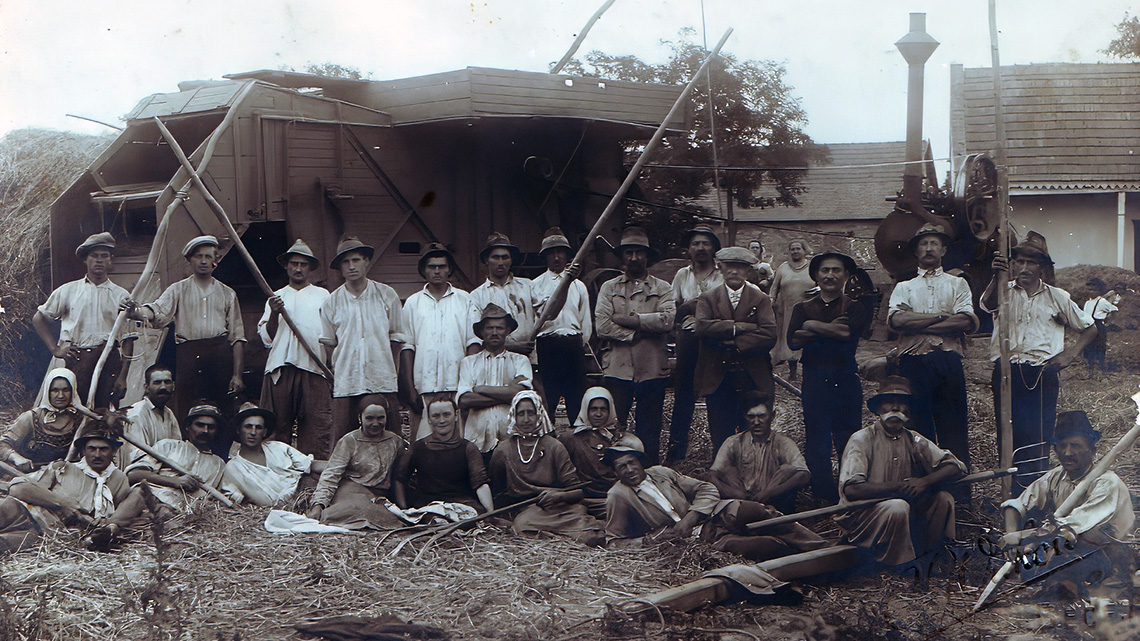
In my book “The Charm of Past Days”, I presented the state of agriculture, the methods of sowing, harvesting, and threshing from 1929 to 1940. I emphasized that, despite the hardship of this work, harmony, peace, and satisfaction reigned in almost all families. However, I did not delve into presenting the results (material effects) of this work. Here, I think I should dwell a little more on this, as I wish to leave these records for the history of our two towns—I mean Novi Bečej and Vranjevo.
Despite the fact that farmers worked from March until the end of November, from dawn until dusk, the results of such work were often very modest. In the days of spring and summer—starting from May with the hoeing and hilling of corn, sugar beets, and sunflowers in the blazing heat of over 35 degrees Celsius—and when the grain harvest began: mowing, hauling, and threshing under the scorching sun, often exceeding 40 degrees. The workday, under these harsh weather conditions and involving the hardest physical labor, lasted from 4 a.m. until sunset (around 8 p.m.), and during threshing, until 10 p.m. When autumn came and the harvest of sunflowers, corn, and the digging of sugar beets began, autumn rains usually started, and again, without adequate protection, workers spent 12 hours in the rain, trudging through the mud, but the work had to be done. Not a single furrow of corn or sugar beets could remain unharvested or undug. It would have been considered the greatest sin for the yield to be left in the field despite such effort, and a farmer who let that happen would have been condemned as the greatest idler.
I will not delve into the details of the work of individual households and their results, as they varied not only depending on the diligence of the farmer and the time spent working but also significantly on the quality of the land, how well the optimal moment for sowing was utilized, the depth of plowing, the quality of the seed, the use of manure (back then, no one used artificial fertilizers—they didn’t exist), and other factors. Instead, based on my knowledge of the general situation, I will give an overall assessment of the results.
The general observation would be that only a small number of farming families were able to increase their land holdings, and when this did happen, it was through modest purchases of 1–3 acres in a year, even though it was a period when large estates of over 50 acres with farms were being sold due to the difficulties caused by the Great Agricultural Crisis. Those who gradually increased their landholdings year after year had to have a solid material base—at least thirty acres of good land, plenty of livestock for cultivation and manure production, and above all, all household members had to be hardworking and engaged in the work. Even that was not enough; another very important component of success was the practice of general thrift. Everything was saved, even food. Although every wealthier household slaughtered four pigs in December, the meat—especially the fat and bacon—had to last until the next slaughter, until the next December.
There were not a few households that worked and saved, but still, not all of them were able to buy land. Only about one in every four or five such households succeeded in doing so, while the others lived on their inherited property without any changes. Success was measured by avoiding the need to sell or diminish inherited assets.
If during the Great Crisis of 1929–1935, many people sold their land, or it was sold on their behalf by judicial auction authorities, the question arises: who were the buyers of these estates, and where did they come from? The answer is that they were from the local area, but not from the ranks of farmers—rather, they were merchants, craftsmen, directors, doctors, and pharmacists.
I will list numerous examples of the purchase of these larger estates by merchants, craftsmen, and others from Novi Bečej and Vranjevo. Geza Šelzinger, a grain merchant, owned about seventy acres with a farm of the highest-quality land in Berek; Adolf Šlezinger, another grain merchant, owned about fifty acres in Bačko Petrovo Selo; Maksa Tolmačev, a grain merchant, owned around thirty acres; Đura Krstić, a grocer, owned a farm with about sixty acres in the Vranjevo marsh; Dušan Turinski, another grocer, owned about twenty acres with a farm; Pera Sekulić, a textile merchant, owned about seventy acres; Ištvan Balog, a fancy goods merchant, owned around thirty acres; Konstantin Vukov, a photographer, owned a farm with about twenty acres; Jene Janković, a butcher, owned around thirty acres, and his brother Kalman Janković, also a butcher, owned another thirty acres; Maćaš Pal, a construction master, owned about fifteen acres; Farkaš (I don’t know his first name) owned about ten acres, as did Maksa Lazarov, a tailor. Milorad Čolak, the owner of a thresher, owned about ten acres; Karolj Kiš, the owner of a thresher and a blacksmith, owned about twenty acres; Imre Deri, the director of the mill and sawmill, owned seventy acres in Matejski Brod; Giga Jovanović, a printer and director of the Tursko-Bečejska Savings Bank, owned about thirty acres; Gliša Veselinov, a pharmacist in Vranjevo, owned about forty acres; Dr. Živojin Ćeremov, a doctor in Vranjevo, owned around thirty acres, and so on.
As can be seen from this free enumeration based on my recollection, there were just enough of them to buy up all the land that wealthy farmers were forced to sell. These data unequivocally show how devalued agricultural labor was compared to other economic, and even non-economic, activities.
To confirm this assertion, I will present the case of a threshing machine owner and compare it with the corresponding owner of agricultural land. The threshing machine, in operation for about 25-30 days (which is the average duration of threshing), generated almost as much as a medium-income agricultural household, where all members work from March to December from dawn to dusk, and from December to March, they care for livestock and prepare for spring work. Such a comparison in words alone is unconvincing, so I will attempt to conduct a real calculation.
A used threshing machine, which were mostly around 15 years old or older in Novi Bečej and Vranjevo, was worth 30,000 to 40,000 dinars. This was a significant sum at the time, enough to buy a decent house closer to the center. There were also cheaper threshing machines, even for half the stated price, but they were also quite old, around thirty years, though their work efficiency was not to be underestimated.
I will base the calculation on a threshing machine that cost 40,000 dinars, expressed in wheat, which at that time was priced at 170 dinars per metric quintal from 1935 to 1938. By 1939-1940, the price of wheat rose to 200-250 dinars, amounting to 250 metric quintals, or for easier tracking, 2.5 wagons of wheat.
The average yield during threshing was 7% (in the first days of threshing, when it came to small - impoverished stacks, the yield was 10%, decreasing to 6% at the end). The average output of one threshing machine during a season of 25-30 days was 35-40 wagons of wheat, so if we apply a 7% yield to this amount of threshed wheat, it results in over 2.5 wagons, exactly the value of the machine. Half of this yield goes to the workers on the threshing machine (the operators), and half to the owner of the machine (such were the contractual relations), from which he pays the machinist and the stoker. Therefore, from the 125 metric quintals belonging to the owner of the machine, he pays the machinist and stoker with 25 metric quintals, which would be a high fee. Additionally, the owner had maintenance costs for the threshing machine in preparation for threshing, up to 20 metric quintals at most, leaving him with a clean 80 metric quintals, which at a price of 170 dinars per quintal amounts to 13,600 dinars. During threshing, the owner has no expenses except for lubricant, totaling about 200-300 dinars for the season, as he uses the farmer's straw for fuel where the threshing occurs.
In this case, I conducted the calculation with significant reservations to the detriment of the owner, who had no work to do regarding threshing, as this was handled by the machinist and workers on the threshing machine; he merely had to do the final accounting and divide the obtained yield, leaving him over 13,000 dinars. This is the calculation for the owner of the threshing machine, assuming he is not an expert machinist. If we take the example of Milorad Čolak or Karolj Kiš, who ensured their machines maximized threshing time, they could harvest up to 45 wagons in a season. If we apply a 7% yield to that amount, it results in over 3 wagons of wheat, of which the owner gets 1.5 wagons. He has no costs for a machinist because he performed that role himself, and his preparation costs for the machine were minimal, as he mainly handled it with an apprentice. Thus, at the end of the season, after less than two months of work, they are left with 20,000 dinars. With such a calculation, they can pay off their threshing machines within two years of operation—two threshings.
Such income can only be achieved by a household that owns more than 20 jugars of land with an appropriate livestock fund and engages in hard work for 10 months from dawn to dusk. If I had not accidentally used figures of 20 jugars, I would illustrate this with a clearer example:
The simplest calculation is to take the example of renting land on a half-share basis. The annual yield averaged 10 metric quintals of wheat per jug, meaning that it takes 20 jugars rented on a half-share to yield 100 metric quintals, or one wagon, because another 100 metric quintals go to the renter.
From this simplified calculation, dear readers, you will conclude that it is better to have 20 jugars of land and rent it out on a half-share basis, without any "headaches," than to own a threshing machine and worry about its timely preparation for threshing and its complete engagement during threshing, which the landowner renting out on a half-share does not need to worry about. You are right when you compare just the realized income, but when you consider that those 20 jugars of land cost about 200,000 dinars—since a jug of good land was sold for around 10,000 dinars—and that the threshing machine cost 40,000 dinars, the calculation yields the opposite result. The interest on the amount invested in 20 jugars of land would be five times higher than the interest one would earn from the money invested in purchasing a good used threshing machine. Above all, it should be noted that it was almost impossible for a farmer or craftsman—like a locksmith—to accumulate 200,000 dinars, which is not so inaccessible when it comes to 30-40,000 dinars.
You might wonder, dear friends, how individual holdings of wealthier landowners in Novi Bečej, especially in Vranjevo, were established. The answer might be somewhat risky regarding objectivity; these are mainly inheritances from the original division of land in 1770/80 when some households received land in parts and whole sessions, with some receiving two (a session is 37 jugars). At that time, many even avoided accepting land, opting instead for livestock farming. The government often imposed land on certain households just to collect taxes. We have a documented case in Vranjevo where Živan Krompić requested the return of a whole session on May 29, 1802, which he had gifted to Timotej Janković from Vranjevo in 1794. Those households that received land and cultivated it quickly became wealthy and were able to purchase land from those less engaged in its cultivation.
With the regulation of the Tisa River, the construction of levees, and the cutting of meanders, a considerable portion of floodplain land was freed up, which was later distributed to individuals in the form of so-called "iberland"—marshy land. In 1840, Vranjevo distributed 4,337 jugars to 758 numbered plots. Of this amount, most received 4-5 jugars, while 20 individuals, as noted by Professor Stančić from Kikinda in his letter, received 1,168 jugars, or 27% of the total iberland distributed that year. These are mainly those who already had significant areas of the so-called old land.
I won’t tire you with these calculations and data, but I wanted to leave this impression of how people lived back then, assuming that few think about it, and especially that it should be recorded and passed on to future generations as an era in which a large part of the population lived from agriculture, with much hard work and significant savings, yet still only managed to maintain households under modest living conditions.
Comments