



I never thought much about the tasks of the village herd keepers while living in Novi Bečej with my farmer parents. It was entirely normal when, in the evening, the cattle guard—whom we called the chief guardian—opened the gate and shouted from the street:
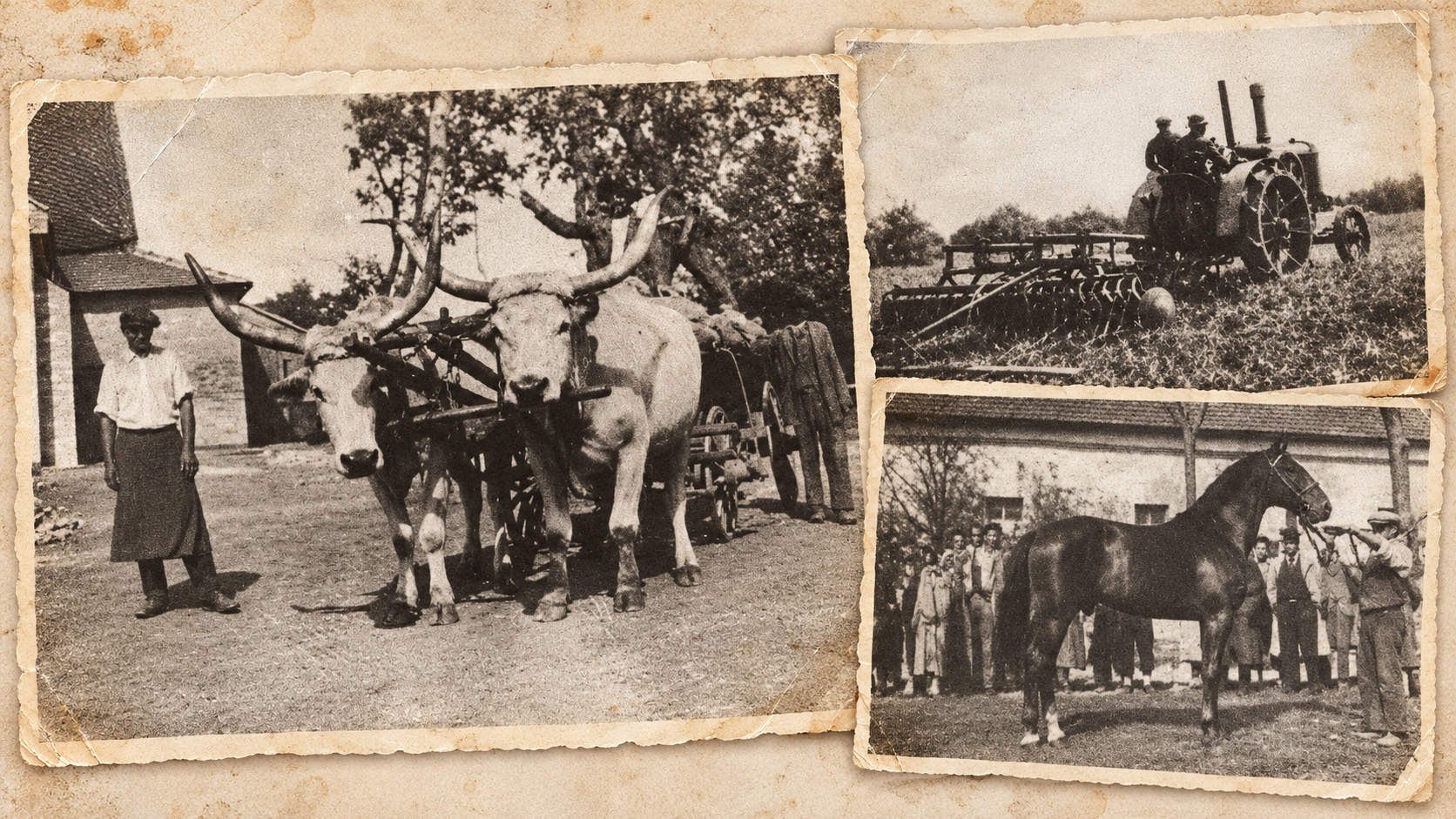
- Housewife, will the dog come out? Is anyone there? When someone answered, he would announce, "Yesterday, your cow, Ruža, was taken out." This meant that from that day on, one should calculate when it would calve. For this good news, the guardian would be rewarded with a shot of rakija and possibly a larger piece of bread and some bacon. This was similarly announced by the swineherd, the horse keeper, and every other village herd guardian about any change in the horses, oxen, sheep, or other livestock entrusted to them.
We didn't see anything special in this; it was just part of everyday events in the division of labor and mutual relationships. We didn't consider it a great service when, on market days (where all the shepherds were usually present), a horse owner with horses in the herd would say to the shepherd:
" - Hey Simo, bring back the horses Julča and Lacika tonight through the assistant." The owner had three horses in the herd, and these two were needed to go to the field on Monday. The guardian would accept this request as any other and fulfill it precisely according to the owner's wishes. The assistant would bring the horses and be rewarded with a piece of bread and some bacon. No one wondered how the shepherd knew which cow belonged to whom and its name, out of the thousand cows entrusted to him, or how the horse keeper knew not only the owners but also the name of each horse in the herd.
- What I've shared about the shepherds aims to dispel any doubts about the truth of what I will say about them and their conscientiousness. For today's generation and today's living conditions and work attitudes, it may sound somewhat unbelievable and hard to accept, but you must believe me that I am telling the truth because I have no reason to embellish or glorify the past. My desire is to leave a faithful testimony of the attitude towards work and duties at that time, which in many ways differs from today's. This difference is not only with us but to a lesser or greater extent in the whole world, and certainly in Europe.
Namely, these herds and studs consisted of the ownership of individual households, which means that out of the thousand cows in the herd, at least 700-800 belonged to individual households. The same, or at least similar, was with the horse herds. There was a difference with oxen, where their number should be divided by 4, as that is the minimum from one household, to get the number of households with their oxen in the herd. The situation was different with sheep. In a herd of 150, there could be at least 10-15 owners. You might be surprised, dear readers, why I dwell on such seemingly insignificant details, but when I say that the shepherd—the chief guardian—knew every cow, every horse, and every sheep, it will seem incomprehensible, but it was the absolute truth. If anything happened to any cow or horse, the chief guardian personally, or through his assistant, informed the owner. Similarly, the swineherd or shepherd knew whose piglet or sheep it was.
Not only did they know every cow, every horse, but also the owners of every sheep, which are so similar to each other that we ordinary people cannot distinguish them.
They cared for the entrusted herd in every way. It had to be watered and fed on time, and they often provided first aid in case of calving, farrowing, lambing, or illness. If their treatment knowledge failed, they quickly informed the owner to take the sick animal to the vet or home for treatment.
All this functioned flawlessly day after day and year after year. Guardians and assistants might change, but the care and conscientiousness towards the livestock remained high. Today, such a past might seem incomprehensible and unacceptable to younger generations, especially knowing that these tasks were often performed by completely illiterate people. But their sense of responsibility was highly pronounced, and they passed this concern on to their assistants.
Chief guardians did not allow assistants to be rough and merciless towards the livestock, to beat them, or to fail to water them on time, not even allowing there to be insufficient water in the long trough.
They were harsher towards the assistants than the livestock. The assistant would get a severe beating, with a stick, for any negligence towards the herd. They especially received harsh beatings if their negligence caused a transgression, for which the chief guardian would be accountable to the field guards.
Thinking about this relationship of the herd guardians towards their duties and their responsibility towards the entrusted work leads me to think about the relationship of farm overseers, to whom livestock and all living things on the farm were entrusted, the machinists at the threshing machines, the overseers for the workers (reapers) on the threshing machine, private artisans and guardians of order. I believe that in this lay the beauty, warmth, and above all, the peaceful life of that time.
One had to experience the pleasant commotion—the shouting that the herd guardians raised when moving from one pasture to another. The roads were narrow, flanked by tall green corn stalks or already sprouted but still green wheat, and the herd of over a thousand heads had to be driven to run through these roads without damaging the crops beside them. In this task, besides all the assistants, the guardians' wives and their relatives were engaged, ensuring the quickest passage through the fertile fields along the village roads. Any slowing down allowed some animals to stray into the cornfield or wheat, and there was accountability for that.
The chief guardian would be responsible before the municipal field guards for any damage caused to the owners of the fields near the road the herd passed. This shouldn't be taken so strictly that no cow ever quickly turned its neck and grabbed a stalk of green corn. Such cases were accounted for and justified even by the field owners, but it was important that no significant damage was caused.
I enjoyed, and even today my soul fills with joy, remembering how in mid-May the village herders would drive the herd of a thousand cows along the Kumanski road from Novi Bečej to Berek. It was almost continuous shouting—Hey, stop! There it goes into the corn!—the drivers would call out to each other, warning about a cow that had strayed from the herd. It was delightful to hear their loud commands—"siccing" the dogs on the cows to bring them back before they entered the cornfield. Even more delightful was the barking of the half-starved dogs, faithfully and obediently carrying out the orders.
This commotion didn't bother anyone; it was even charming, and we would all stop to watch the herd pass and regretfully watch their gradual disappearance from sight and the fading of the drivers' voices, while from a distance, only the barking and yapping of the shepherd dogs could be heard. Their barking was the last echo of the large village cattle herd's departure to their overnight pasture in Berek.
Comments