



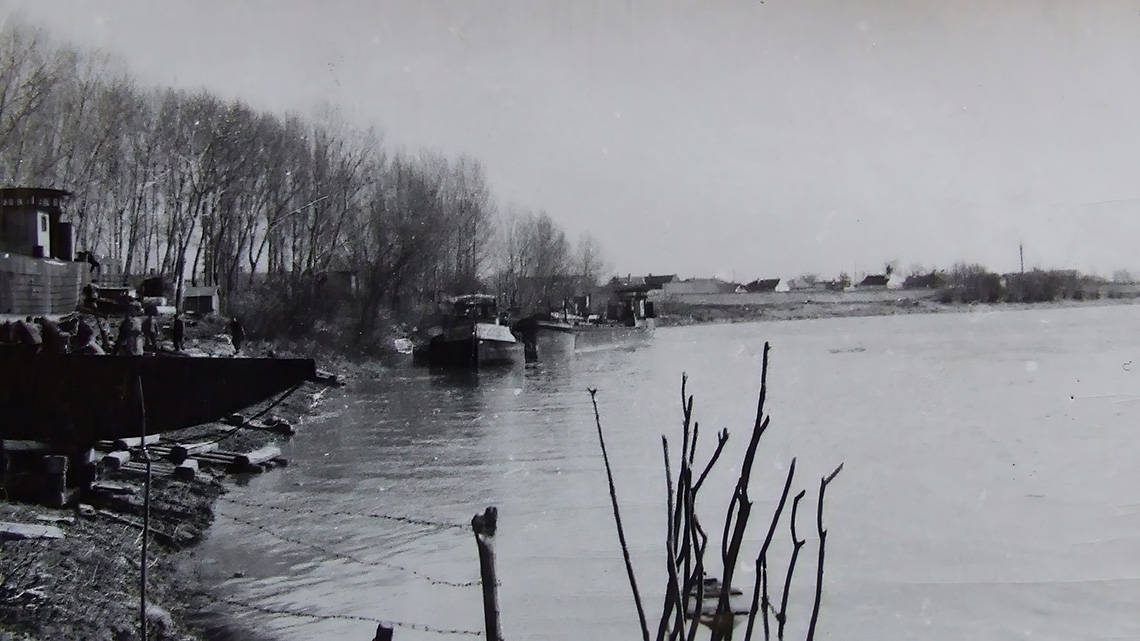
If we translate the word "photography" into Serbian, we get the word "svetlopis" (from Greek, where "photos" means "light" and "graphein" means "to write"). Writing with light, or capturing light on some medium, has been a human desire since ancient times. Through a series of inventions, people have succeeded in their efforts to "capture" light. We know that we cannot put light into a box or catch it because light is elusive. Or perhaps it's not? It seems that it isn't, because if it were, today there would be no photography, film, television, or many other modern media.
Before we start telling stories about Novi Bečej's light writers, we should briefly get acquainted with the beginning of photography and the camera itself.
The camera obscura is the first form of the camera, invented by Ibn al-Haytham in the 11th century. Translated from Latin, "camera obscura" means a dark room or chamber. It is a completely dark room with a small hole through which light passes. On the opposite white wall in such a room, an image of the outside world (like a photograph) is projected, but upside down. Throughout history, the camera obscura has been refined, so today's camera is essentially a camera obscura that has been technically perfected. The first photograph was created in 1826 by the French inventor Nicéphore Niépce using a camera obscura and photosensitive paper.
Since the day in 1888 when George Eastman's first box camera, the "Kodak Brownie," appeared on the market, photography has proven to be not only one of the most revolutionary inventions in the world but also the most popular artistic expression. It has influenced history, science, and art, and entire industries today thrive on it.
From the earliest test cameras, including a twelve-meter-long behemoth, cameras have gradually evolved into true marvels of chemical and mechanical perfection: lenses that allow observation of molecules, filters to neutralize mist and glare, apertures, and chemical reactions fast enough to "capture" a shot in mid-flight, methods for producing positives that turn mundane snapshots into good photographs.
For an individual, photography is a practice that rewards them in a unique way. For a small amount of money today, one can purchase an instrument that makes transient events permanent—preserving a daily family scene or a fleeting landscape, capturing history on film as it happens, and sometimes creating an unforgettable image.
Regardless of an individual's skill, a photographer's camera will always be a source of new excitement. Millions of people have probably felt the truth of the words of the great French photographer Jacques Henri Lartigue when, as a seven-year-old boy, he exclaimed while trying out his first camera: "Wonderful! Wonderful! Really wonderful fun!"
All the wonders of photography and photographers from our town will be presented in this book in an original and unusual way. The aim is to gather in one place all those who have engaged in photography, but analog photography, as this method is now in decline, having been replaced by the era of digitalization that elevates the world into a third or fourth dimension. With this book, we wish to evoke memories of not-so-distant but, above all, forgotten times, people, places, and events, which will undoubtedly evoke a burst of emotions in readers.
One human lifetime would not be enough to exhaust all the scientific possibilities of photography, and substantial financial resources would also be required. However, above all, specific technical knowledge is necessary, as good photographs do not come about by chance. Only with such prior knowledge, regardless of technical equipment, can a photographer achieve the perfection that is often talked about, but continuous learning and dedicated work are essential. Photography masters say that knowledge is more important than equipment. Henri Cartier-Bresson, perhaps the greatest among photo-reporters, used only one camera and two interchangeable lenses, and with just that, he astonishingly fulfilled his ambition to "capture the whole world in that little box.


Comments