



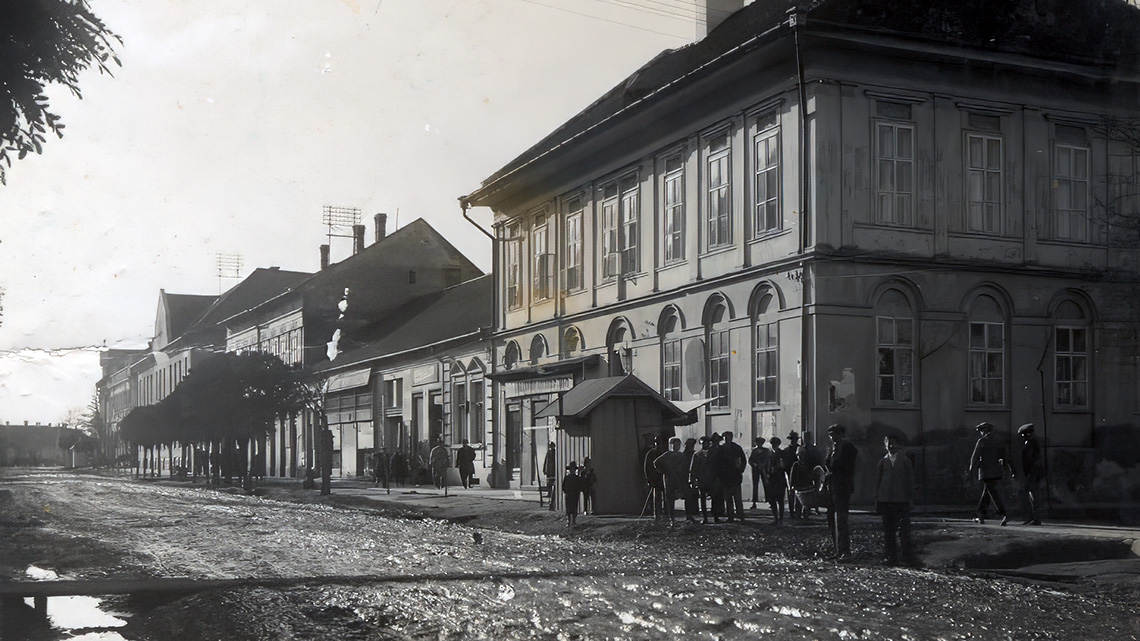
Delving into the past of one’s homeland and simultaneously being a collector of old postcards imposes the task of dedicating oneself, willingly or not, to old photographs and the photographers of that time. It would be inappropriate and irresponsible not only to omit mentioning the artistic photographers who vividly recorded events and personalities over the past 140 years, but also not to write their biographies. On those yellowed photo papers they left behind, they themselves are not documented, but their presence is felt in all the photographs.
Thanks to them, Novi Bečej remains "frozen" in photographs, and curious observers today, looking at those old black-and-white images, are transported back to the times of our grandfathers and great-grandfathers. Visualizing the past of any inhabited place, including Novi Bečej, from the mid-19th century onward, is unimaginable without the photographs1 of the then light-painters—photographers. They are responsible for capturing light traces and transferring them onto special mediums through which the moments of a long-gone era will be eternally recorded. But where and when did this marvel of technology arrive in Novi Bečej? How did the population embrace it? And, most importantly for the author of this book, who were the locals who, instead of using a painter's brush, made the most accurate images of that time using this new contraption and chemistry?
Let professional and passionate photographers not take offense if this book perhaps focuses more on the personalities and objects depicted in the photographs than on the photography technique itself. This book is not a photographic manual but a written trace of Novi Bečej's photographers throughout the history of this now well-established science. Photography tells its own story, but to help future generations better understand it, each photograph in the book will be accompanied by an appropriate text, guiding the reader's attention to some historical facts and curiosities from the history of Novi Bečej and Vranjevo, as well as stories about the people who lived in that time.
The story of the discovery of photography takes us back to the beginning of the 19th century, specifically to 1839, when Joseph Niépce and Louis Daguerre presented their invention to the French Academy. The French state purchased the invention, thereby enabling every citizen of the world to freely engage in photography. The day when the French Academy of Sciences and Arts announced the daguerreotype2 technology is considered the birth of photography.
In 1840, Englishman William Fox Talbot developed a different process, the so-called negative-positive, known to the public as the calotype3 (or talbotype). With this process, Talbot paved the way for modern photography. In the same decade, the wet glass plate (collodion) began to be used as a negative, and later, the dry glass plate (based on gelatin emulsion). These discoveries, especially the celluloid film (as an emulsion carrier), would enable the era of industrial production of photographic material.
In 1861, Scottish physicist and mathematician James Clerk Maxwell created the first color photograph, after which experiments with color began—a process that would prove to be more prolonged than that of black-and-white photography.
From France, via Vienna and Budapest, traveling photographers rapidly reached Belgrade and Vojvodina, where they also taught interested individuals about photography. In Budapest, in 1841, Jakob Marastoni opened the first photographic studio and art school. It was here that Đura Jakšić, in addition to learning the craft of painting, mastered the daguerreotype technique.
The first Serb to use the daguerreotype was Dimitrije Novaković, while the lithographer and painter Anastas Jovanović applied photography from 1841. The first photographer from Vojvodina is considered to be Georgije Knežević. The closest photographic studio to us at that time was in Veliki Bečkerek, run by painter-photographer István Oldal, one of the pioneers of Vojvodina photography.
1 The term photography (from the Greek words photos and graphein) was first used by Frenchman Hercule Florence in 1833. This term has been officially used since 1839, thanks to English astronomer John Herschel.
2 The daguerreotype technique involves exposing a silver-plated copper sheet to iodine vapor. The invisible image appears after treatment with mercury vapor and sodium sulfite solution. These photographs could only be viewed from a certain angle.
3 Calotype is based on the process of inserting prepared paper treated with silver chloride into the camera obscura. After exposure and copying, an unlimited number of positives can be produced.


Comments