



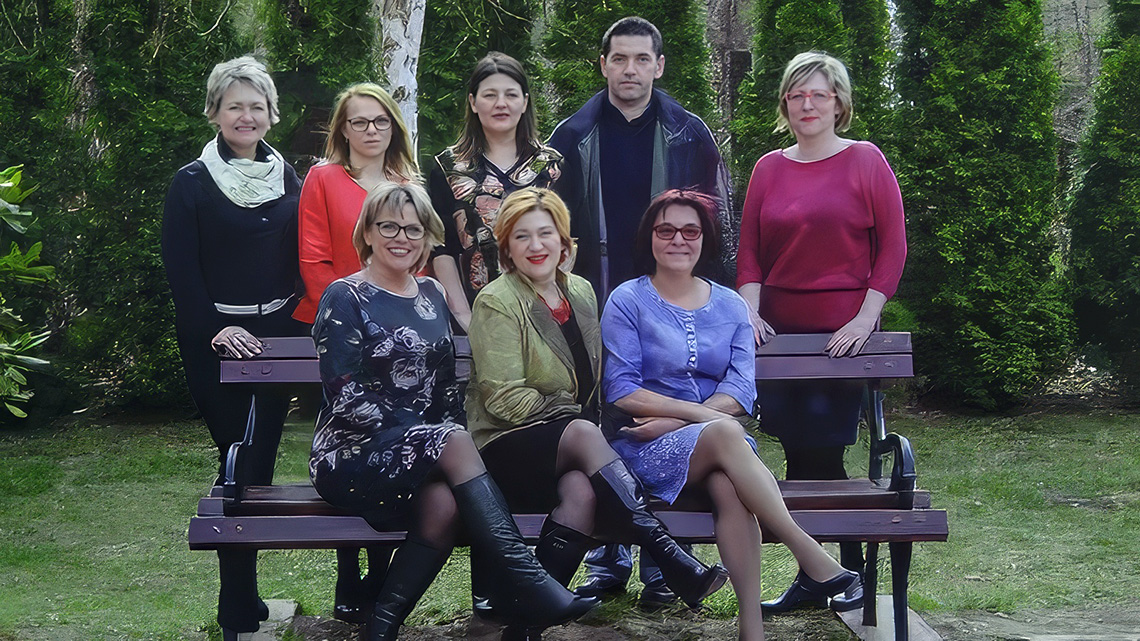
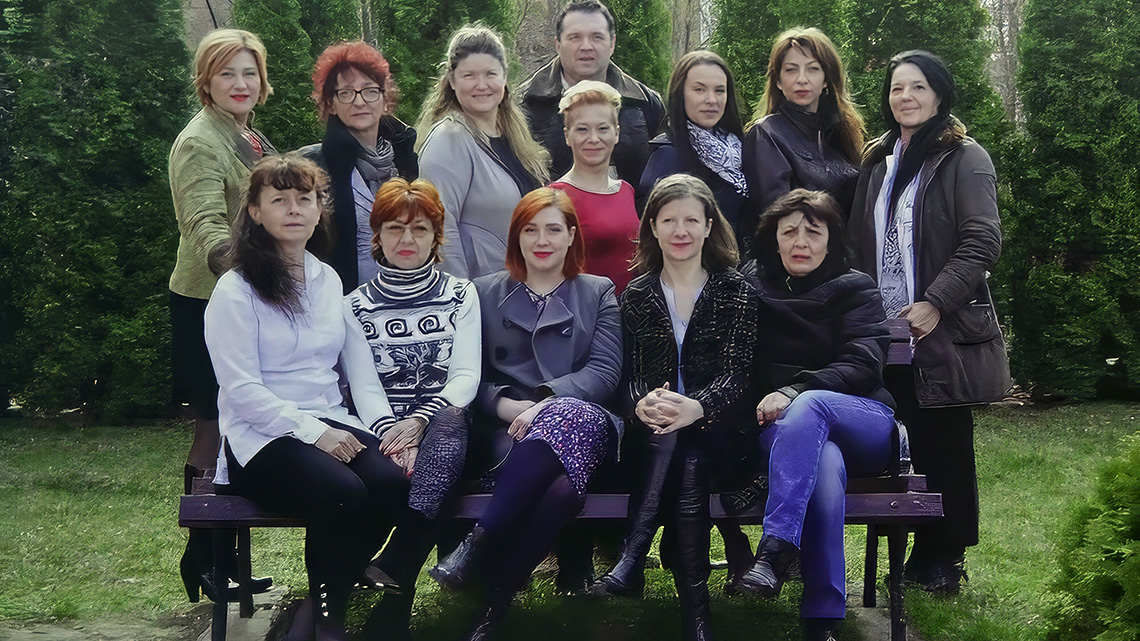
Everything that has been accomplished so far and described in this book is the result of the work, dedication, commitment, and expertise of the employed workers, without exception—from cleaning staff to the management. Their names are therefore woven throughout all chapters of this book, to a greater or lesser extent.
At the Adult and Elderly Home “Saint Vasilije Ostroški - Miracle Worker,” various profiles of employees work. These include social, health, and administrative workers, craftsmen, cooks, and auxiliary staff. However, despite their undeniable expertise in their respective fields, we must again emphasize their qualities, such as: helpfulness, empathy, communication skills, collegiality, openness, and others.
Formally, they can be classified as:
- Professional workers: social workers, doctors (general practitioners, specialist doctors - neuropsychiatrist and physiotherapist), psychologists, a lawyer, and a defectologist.
- Professional associates: physiotherapists, occupational therapists, and work instructors.
- Other associates in the job: caregivers, nurses, and geriatric housekeepers.
- Administrative: head of accounting, analytical bookkeeper, payroll worker and cashier, technical secretary, safety and health personnel, and IT programmer.
- Other workers: cooks and kitchen assistants, servers, laundresses, cleaners, hairdressers, porters, drivers, boiler operators, warehouse workers, and maintenance staff (mason/painter, plumber, and electrician).
- Among the managerial staff in the institution, the following have permanent employment: director, manager of the residential facility, head of the health service, head of accounting, head of the kitchen, chief nurse, and department nurses, maintenance service organizer, and coordinator of non-institutional care.
As of December 31, 2018, there were 144 workers employed permanently at the “Saint Vasilije Ostroški - Miracle Worker” Home, 14 on fixed-term contracts, 3 in temporary jobs, and 12 workers through targeted transfers and within the IPA project.
A part-time religious educator is also contracted to provide religious classes to users, which has generated significant interest among them. A chapel has been built on the second floor to meet their religious needs.
Since April 2011, there has been approval for the acceptance and work of volunteers in the institution, although their number has decreased over time. In this way, the missing labor norms are supplemented, training is conducted for those interested in work, and new workers are hired as needed. They are usually engaged from among the volunteers, meaning they are already educated and prepared for specific types of work.
The staff at the home that provides services have a positive attitude and are sensitive to working with users. They are available 24 hours a day to assist people residing in our institution who, for various reasons, cannot take care of themselves, are unable to move independently, or cannot feed themselves. Through their commitment and work, employees ensure that even in such difficult circumstances, all users receive adequate care, a kind word, and, above all, live a life worthy of a human being.
The good relationship of the employees towards the users, respect for their personality and dignity, maintaining a positive life attitude, and a homely atmosphere in the institution are of great importance.
For all these reasons, significant emphasis is placed on working with employees. The institution strives to raise the level of professional work among employees through various seminars, educational gatherings, and continuous training for new ways of working, all aimed at application in user interactions. Therefore, all workers are allowed to attend ongoing educational seminars in their relevant fields, at the institution’s expense.
The first cycles of educational workshops with new staff in the institution were initiated in 2005 by psychologist Dragica Fink. Newly hired staff, mostly cleaners, caregivers, and servers, were divided into groups and attended our internal training for several months. There were typically eight such workshops. The goal of this work was to familiarize the staff with the characteristics of the users of this institution and appropriate ways to respond to them, so that users would have the best possible conditions, and the workers, with new knowledge, could perform their jobs better and establish the best possible relationships with the users.
At the beginning of each year, professional development and education are planned in accordance with the needs of users and the institution’s work program. The training and development plan determines the scope, methods, and processes for the rights and obligations of employees for professional development, identifying areas where it is necessary to improve professional competencies. Continuous acquisition of knowledge and skills is pursued to raise the quality of services to a higher level, follow the development of science and the profession in social protection, and other forms of additional education, in accordance with the needs of providing services to users of residential services. Employees are obliged to continuously monitor the development of their profession and to improve their skills to maintain and enhance their professional competencies and improve the quality of professional work. Professional development and successfully completed training in an accredited program are conditions for obtaining and renewing work licenses.
Between 2014 and 2015, workers were given the opportunity to work for a certain time in various departments. This allowed them to familiarize themselves with working methods in other departments, as well as to connect, socialize, and exchange experiences with each other.
With the motto "a satisfied worker is a good worker," a trade union organization operates at the “Saint Vasilije Ostroški - Miracle Worker” Home. It was established in the 1980s within the Health Center union. Once it developed and strengthened sufficiently, it began to operate independently. It then joined the Health and Social Protection Union, and after its separation into the Health Union and the Social Protection Union, it became an active member of the latter.
The union has its management: a president and an executive board, who, within their capabilities, strive to assist the workers. The following individuals have led the union at the Home: Dragoljub Vrebalov, Dušanka Dokić, Zlatica Đuričin, Veronika Oroslamoš, Suzana Slavulj, Nikola Stančić, and again, Suzana Slavulj.
As the number of workers increased, so did the strength of the union organization, whose members are all employees. The union organization engages in all issues related to improving the position of workers and their material conditions. Some of its activities include organizing recreational vacations, excursions, sports games, distributing New Year’s packages to the children of employees, awarding anniversary prizes, and more. Special attention is given to retirees.
By signing a collective agreement with the management of the Home, employees have gained much greater rights than those prescribed by the Labor Law. This includes assistance with medical treatment, housing loans, tuition loans, purchasing household appliances, and more.
Directors
The director of the Home serves as the host. From its founding until today, these have been the directors:
Mila Isakov was born on January 19, 1926, in Melenci. During the occupation, she immediately joined the resistance movement. Her illegal name was "Mala." She participated in the National Liberation War and was awarded Tito's decoration. After liberation, she worked in the Provincial Committee of the SKV in Novi Sad, under Steve Doronjski and Milka Agbaba “Crna.”
After marrying, she returned to Banat to a farm in Itebeja, as her husband was an agricultural technician. From there, she moved to Stari Bečej. At the party’s behest, she moved to Novi Bečej (then Vološinovo) to assist in forming a home for the elderly and infirm and separating children—war orphans—from adults. At that time, there were many parentless children from across Yugoslavia, especially from Lika, Kordun, Pokozar, and Vojvodina.
In 1950, at the age of 24, she was appointed director of the Home. According to her, “these were difficult times, but we believed in a better tomorrow!” And that tomorrow gradually came: from a collection center, an old age home, a gerontological center, to the “Institution for Adults and the Elderly St. Vasilije Ostroški, the Miracle Worker.”
Mila loved her job as a social worker, working with the elderly and children. They were the alpha and omega of her world. Although problems were daily, she never complained about fatigue; nothing was impossible when it came to the collective and the users of the Home.
For her work, both personally and as an institution, she received many acknowledgments, plaques, and diplomas from across the territory of the former SFRY. The walls of her office were filled with framed recognitions.
In 1970, she was awarded the October Prize in Belgrade for her work in social services.
Mila Isakov retired in 1982, with a grand ceremony at the Institution she had led for decades. She passed away on March 12, 1995, in Bečej.
Ana Vlaškalin, born Slivka, a Slovak, was the first head of accounting and the first social worker at the Home for the Elderly and Pensioners in Novi Bečej, from 1963 to 1993. She was born on August 23, 1940, in the village of Padina, Kovačica municipality, Pančevo district, to father Pavle and mother Ana. She completed elementary school in Slovak in Padina and Kovačica. In 1953, she went to the Home for the Children of Fallen Fighters in Kovačica and then to the Home in Zrenjanin.
She graduated from economic school in 1959 in Zrenjanin and that same year got a job as an accountant at “Pokrok” No. 33 in Padina. In 1962, she married Vlaškalin Vojislav and moved to Novi Bečej. She first worked as the head of accounting in a dairy, and from 1963, at the Home as head of accounting. She started to implement accounting records according to the regulations and chart of accounts in force at the time. Also, as the most educated, she performed the duties of a social worker. To that end, she enrolled in a school for social workers in Belgrade and successfully completed it.
For a long time, she was the only social worker in the Institution. According to her own words, it was a job she loved and worked at with all her heart. This did not go unnoticed by the users who respected her. Ana Vlaškalin was a pioneer in open forms of social protection and home care.
After Mila Isakov's retirement, she took over as acting director of the Home. She retired in 1994, but continued to actively participate in the work of the Institution as a member of the board.
Milan Ilić came to the Institution in May 1983 as director. He worked there until 1989. His main focus was to improve the standards of users by increasing the number of workers and building a new facility, which would relieve the existing capacity and thus improve the conditions for user care. This way, the Home in Novi Bečej would keep pace with other homes in Vojvodina. The new facility was built with its own funds, with significant assistance from the then Social Care Service of Vojvodina. It was constructed on the site of an old house where about twenty users lived. Additionally, the building next to the new facility was purchased, with the intention of building a Day Care Club there, as a form of open social protection. The project for the Day Care Club did not come to fruition while he was director of the Home, but he went to a new job from where he was able to financially support the realization of that idea. He passed away at the end of March 2019.
Branimir Lisičin began working at the Home for the Elderly as a cashier-secretary in 1974, at just under 20 years old. After completing his military service, he returned to the Home as the secretary of the institution in November 1979. Showing himself to be a good worker and colleague, he was elected acting director in 1988, and the following year became the director of the Home.
As the head of the Institution, he accepted every problem with a smile and easily found the best solution. He was a man of action. He did not like to talk much about work, but rather to do it. He had a habit of saying, “You talk, and call me when it’s time to work.” He was responsible, good-natured, and attentive to both users and staff. He greeted them with inquiries about their health and problems, expressing a readiness to help. In communication, he was always smiling and full of humor.
With such an approach, he won the trust of his fellow citizens. That is why they elected him mayor. He held that position from November 1996 to October 2000. At the same time, at the request of the Ministry of Social Work and Policy, he also served as director of the Home.
He was the founder of the Day Care Club and home care, a project he had been designing for years with his close associates. In doing so, he fulfilled his dream, to his joy and the satisfaction of the citizens of Novi Bečej.
His involvement in work and communication with people, the reputation he achieved among professionals, acquaintances... were factors of success in carrying out the tasks in the institution, municipality, and wherever he found himself.
His function as director of the institution ended in June 2001. However, he continued to work at the Day Care Club as an open protection reference, until his retirement in July 2015. In this way, with his valuable experience, he was able to be of benefit to his younger colleagues.
Gizela Miletić-Balogi was born in 1951 in Debeljača. After graduating from high school in Zrenjanin, she enrolled in the Medical Faculty in Belgrade, completing it in 1977. At the end of 1978, she, along with her husband, began working at the Health Center in Novi Bečej. She went for specialization in General Medicine to Novi Sad in 1990, completing it in 1993. After several years, she continued her education at the Clinic in Belgrade and passed the subspecialty exam in the field of: Ultrasound in Clinical Medicine in 1999. Between 1987 and 2002, along with her regular job at the Health Center, she occasionally, as needed, performed examinations of users placed in the Home. In 2001, she held the position of director at the then Gerontological Center for a few months, but after a couple of months, she returned to her vocation at the Health Center.
Ljiljana Bognić was born in 1960 in Novi Bečej. She graduated from the Medical Faculty in Novi Sad in 1984 and got a job at the Health Center in Novi Bečej as a general practitioner. After completing her specialization in radiology, she enrolled in postgraduate studies, which she completed in 2000 with a master's thesis in radiology. At the end of 2001, she took the position of director of the Gerontological Center in Novi Bečej. Since then, satisfied and happy, feeling that she is in the right place, her personal development has run parallel to the development of the Institution.
In order to better understand the institution's activities, to perform quality work and help the professional team, she opted for specialization studies in rehabilitation and sociotherapy at the Faculty of Political Sciences, Department of Social Policy. Completing them in 2005, she earned the professional title of specialist in rehabilitation and sociotherapy. Next, she pursued II level studies - specialist academic studies in the study program Social Rehabilitation, after which she received the professional title of Graduated Political Scientist - Specialist in the field of social rehabilitation.
During her tenure as director of the Home, she actively participated in many consultations, seminars, and congresses, where she successfully presented her work. She collaborated in drafting the Social Protection Law in 2011 as a representative of institutions for the accommodation and care of people with special needs. She was selected by the relevant minister as a member of the interdepartmental working group tasked with developing standards for social and health services for the needs of by-laws.
Since assuming a leadership position in the Home, significant funds have been invested in it, obtained from the Municipality, the Province, the Republic, and the European Union, primarily through quality projects. Additionally, new forms of non-institutional care have been introduced—“Home Care and Assistance” and “Supported Living.” Extensive construction and technical work has been carried out in all three departments—adaptation, renovation, expansion of existing spaces, reconstruction of sanitary blocks and dormitories, creation of living spaces for daily activities and occupational therapy, enhancement of outdoor areas with ornamental plants and flowers, partial renovation of furniture and equipment, all aimed at raising the living conditions of our users to the highest possible level. The main guiding idea during the execution of these works has been to create a HOME for the users, as most of them do not have one. In this sense, each user is regarded as a human being, not as a patient. Thus, along with many praises from users, their relatives, and the community, and recognition from competent authorities stating that the "Home is an example of good practice and what can be called a European standard for the most vulnerable users in social care."
However, with the motto "there is no perfection; it can always be better!" and with the participation of all employees, this life project continues.
I thank the current director, Mr. Dr. Ljiljana Bognić, for inviting me to write something about that first team of mothers, the employees, and the users of the home. I had the honor and pleasure of visiting all three departments and the office building. I can say that Mrs. Ljiljana Bognić has done an incredible job. From a rather dilapidated institution, she has transformed it into a small, warm home for users and workers. The current name—INSTITUTION FOR ADULTS AND ELDERLY “SAINT VASILIJ OSTROŠKI MIRACLE WORKER”—Novi Bečej perfectly reflects the living conditions. I had the impression that the energy for a better tomorrow of the first collective and great mothers has awakened again and continues to enrich the users and workers of the institution.
Congratulations, Madam Director, for having the strength and patience to continue the vision of humane work worthy of a HUMAN being with your team. Your institution and the work of the entire team bring honor and pride to our town and the entire country. The living conditions at your facility can be compared to those of spa resorts. The users of the home are clean, fragrant, smiling, and satisfied. This particularly impressed me in the psychiatry department and the third department.
I wish much success in your future work to the entire team and especially to you.
Daughter of Mile Isakov, Ljiljana Panić-Lika


Comments