



The service users of the “Saint Vasilije Ostroški - Miracle Worker” Home in Novi Bečej are adults and elderly individuals from all categories, including adults with mental difficulties.
Although for most users, multiple reasons contribute to the need for residential care, the most common reason for placement is illness.
At the end of 2018, the total number of residents in the home was 434, comprising 357 women and 77 men. In supported living, there are 26 users, of which 15 are women and 11 are men. The average age of users is between 45 and 47 years. A significant gender imbalance is evident in the demographic structure, which has remained consistent over time. Efforts continue to reduce this imbalance by admitting male users and creating mixed departments.
The number of accommodation requests has drastically increased year by year. It is noticeable that most new requests pertain to the younger population, aged 26 to 44 years.
In terms of the length of stay in the facility, 266 users have been accommodated for more than five years, while 39 residents have been in the Home for over 20 years.
Only about 5.2%—24 individuals—are local residents. Additionally, from the territory of the Central Banat District, there are a total of 77 residents, which accounts for about 16.7% of all users of the institution (including Novi Bečej).
For users admitted to the facility, maintaining social contacts with family, relatives, and friends is emphasized. It is particularly important for them to visit family and receive visits at the home, as this fulfills their emotional needs and provides feelings of fulfillment and stability.
The development of friendships and emotional closeness among users is encouraged, resulting in psychological balance and a sense of happiness. It creates a motivation that the Home is a place where life continues.
User Portraits
As mentioned, each resident of the Home is viewed as a complete human being, with varying capacities for expressing their individuality and creativity. A significant part of the employees’ activities is aimed not only at improving their health but also at enhancing their creative potentials. The success of this mission becomes evident through the numerous handicrafts and artistic works (songs, stories, paintings, photographs...) created in workshops and sections, as well as during other activities. The walls of the home, the pages of the magazine “Shine in the Eye,” and the exhibition panels testify to this. Furthermore, each of them has their own life story, which makes them unique from this perspective.
However, in this section, we will mention only a few of them, who, at a given moment, have distinguished themselves through their works and characteristics, leaving a lasting mark during their life and work. We do not only consider the time of their stay in the Home but also their lives in the previous period.
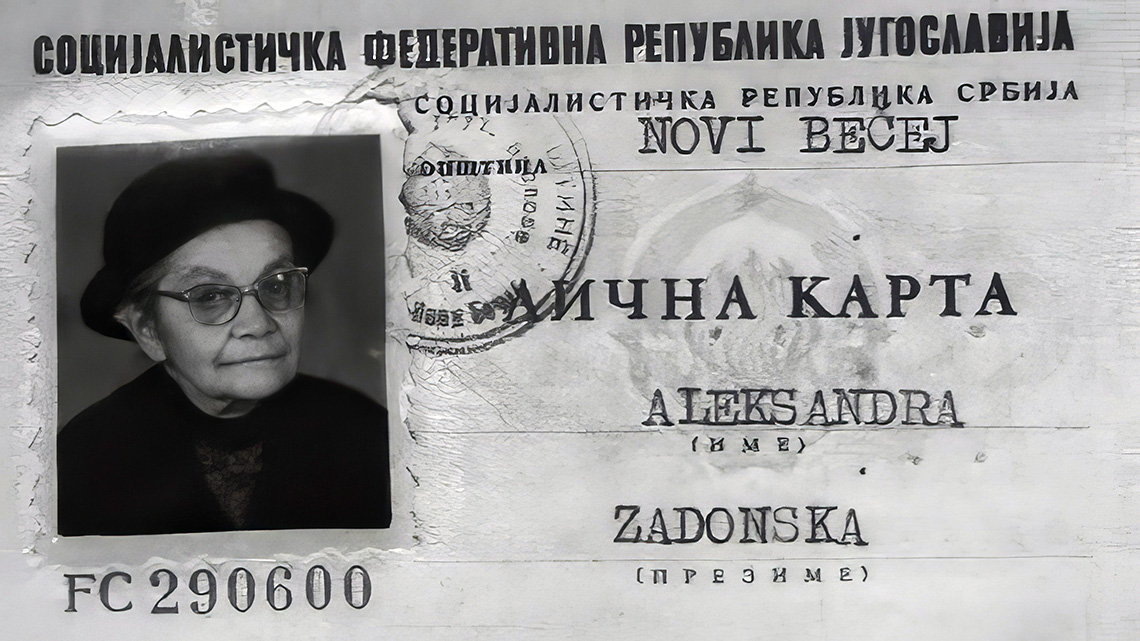
In this regard, we first mention Aleksandra Ivanovna Zadonski - Madame
She was born in 1897 in the Russian city of Kharkov, to father Ivan Zadonski and mother Nadezhda. During the Russian October Revolution, the Zadonski family was in Switzerland. As members of the upper class, they could not return to their homeland and found refuge in the Kingdom of Serbs, Croats, and Slovenes—in Belgrade. They lived there for some time until around 1925 when Aleksandra Zadonska arrived in Novi Bečej. At that time, the Kharkov Institute, under the protection of Her Majesty Queen Maria, was already operating in the area, and the family of Aleksandra Zadonska became involved in its activities.
Zadonska did not have her own family, so she dedicated all her time to the children of Novi Bečej. Highly educated, she taught them French, German, and Russian, preparing them for exams and more. This also provided her with a source of income.
She was remembered as a petite and seemingly fragile woman with aristocratic manners. She never asked to be addressed by her name, but simply as “Madame.” She witnessed the end of World War II and the arrival of the communists to power, often joking about it. In the 1960s and 70s, she was still active, teaching without any remuneration. She was beloved by both the parents of the children and the students themselves. In her later years, she was showered with attention and various gifts. Madame did not need help or compassion, but she greatly enjoyed the company of her students. As they grew into successful professionals in their fields, they often came to see her and chat with her.
When her health and strength began to decline in 1977, she agreed to be placed in a nursing home on May 28. With exceptionally few, almost no demands, Madame received great attention from the staff. Withdrawn into herself and her thoughts, she was a quiet resident of the Home. On December 14, 1981, she peacefully closed her eyes, reportedly with a smile on her face. She was buried in the Orthodox cemetery, attended by numerous educators, her students, and friends.
Nađ Olga, born Mandić
She was born on August 14, 1933, in Čantavir. She completed teacher training college. She lived in Subotica, where she worked in the theater. After that, she moved to Belgrade. She lived in London for two years and pursued acting.
From 1950 to 1970, she acted in feature films, television series, short films, and theater (“Hanka” - 1955, “Milicija” - 1956, “Stepenice hrabrosti” and “Leto je krivo za sve” - 1961, “Srećna Nova godina” - 1961, “Moja luda glava” - 1971, and “Nacionalna klasa” - 1979).
Olga was the first to announce the start of television broadcasting. She appeared on the television screen in 1958 but did not achieve significant popularity among the audience, unlike the famous Mića Orlović.
Dragoljub Stojšić
He has been living and creating in the Home since 2004. Dragoljub Stojšić came here from Sremska Mitrovica. Soon, it became evident that Dragoljub was a successful writer. Before coming to the Home, he published three poetry collections: “Imprints of Summer on the Soul,” “I'm Not Here,” and “Journey to the Center of the Earth.”
Stojšić also tried his hand at prose writing, which, according to experts, is not inferior to his poetry. He continued his creative career in the Home, which helped publish his poetry book. He received numerous awards for his works at contests and competitions. Without his stories, poems, insights.... the magazine “Shine in the Eye” would be much poorer in content and quality.
Stojan Sekulić
He was born on January 22, 1930, in Novi Milošev. He completed elementary school in his hometown, high school in Kikinda, and Medical Faculty in Belgrade. He was a doctor by profession. He worked at the Health Center in Novi Milošev, where he was very successful and respected in his field. He retired in 2000 but continued to practice medicine explicitly at the request of his patients.
Gordana Šijan
He was admitted to the Home on June 12, 2003, due to dementia. He passed away in the Home on March 21, 2004.
She was born on April 28, 1946, in Kragujevac. She is the mother of two children, son Marko Urošević and daughter Jelena Konstantinović.
She arrived at the "Saint Vasilije Ostroški - Miracle Worker" Home for the accommodation of mentally ill individuals in Novi Bečej on September 17, 1996. In occupational therapy, she actively engaged in what she loved and did throughout her life—painting. She learned painting in the art workshop of Sergije Jovanović.
Her independent and sales exhibition of paintings at the Culture Center Gallery in Novi Bečej in 2004 was noteworthy. Her works beautify the rooms of the first department. She passed away on April 14, 2015.
Tatjana Lopičić
She was born on February 5, 1948, in Belgrade. After finishing the V Belgrade Gymnasium as an excellent student, she chose to study at the Faculty of Philology in Belgrade, advised by her philosophy professor, majoring in Yugoslav and World Literature. She then enrolled in postgraduate studies, where she completed all exams. She wrote the written part of her thesis in the Home, as she noted in later years, which speaks to the positive impact of the Home on her.
She never defended her master's thesis.
During her working life, Tatjana worked in various jobs. Among other things, she worked as a professor of Serbo-Croatian language and in job classification. She then went on disability pension. Tatjana also worked as a journalist, writing reviews for the newspapers “Politika” and “Prosvetni pregled.” She published her poetry in the magazine “Beograd 011.” All the jobs she held brought her joy, especially working with youth in schools, who refreshed her with their progressive ideas.
She lived in a common-law marriage with Mića Begović for 23 years until his death.
Tatjana came to the Home on March 7, 2001, where she still resides today. It is impossible to imagine the Home without her. She is recognized for her lively spirit and exceptional communication skills. Many residents of the Home have said that they have learned a lot from her. Despite her tragic fate, she has never lost hope and faith in a better life.


Comments